Misiewicz Tracy M, Simmons Tracey S, Fine Paul V A
Department of Integrative Biology, University and Jepson Herbaria University of California Berkeley CA USA.
Department of Biological Sciences San Jose State University San Jose CA USA.
Ecol Evol. 2020 Jun 17;10(13):6646-6663. doi: 10.1002/ece3.6396. eCollection 2020 Jul.
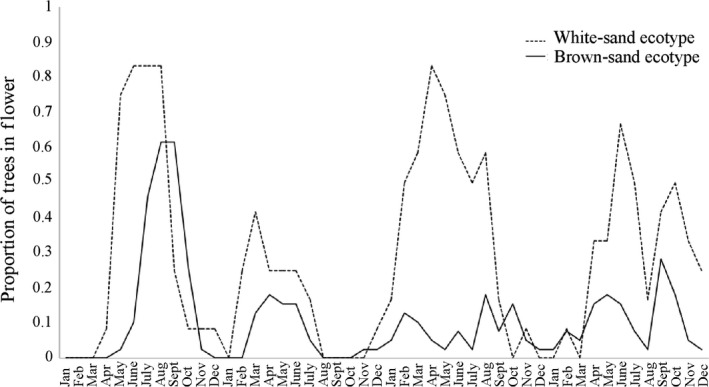
Disentangling the strength and importance of barriers to reproduction that arise between diverging lineages is central to our understanding of species origin and maintenance. To date, the vast majority of studies investigating the importance of different barriers to reproduction in plants have focused on short-lived temperate taxa while studies of reproductive isolation in trees and tropical taxa are rare. Here, we systematically examine multiple barriers to reproduction in an Amazonian tree, (Burseraceae) with diverging lineages of soil specialist ecotypes. Using observational, molecular, distributional, and experimental data, we aimed to quantify the contributions of individual prezygotic and postzygotic barriers including ecogeographic isolation, flowering phenology, pollinator assemblage, pollen adhesion, pollen germination, pollen tube growth, seed development, and hybrid fitness to total reproductive isolation between the ecotypes. We were able to identify five potential barriers to reproduction including ecogeographic isolation, phenological differences, differences in pollinator assemblages, differential pollen adhesion, and low levels of hybrid seed development. We demonstrate that ecogeographic isolation is a strong and that a combination of intrinsic and extrinsic prezygotic and postzygotic barriers may be acting to maintain near complete reproductive isolation between edaphically divergent populations of the tropical tree, .
厘清不同谱系之间出现的繁殖障碍的强度和重要性,对于我们理解物种的起源和维持至关重要。迄今为止,绝大多数研究植物中不同繁殖障碍重要性的研究都集中在短命的温带类群上,而对树木和热带类群的生殖隔离研究却很少。在这里,我们系统地研究了一种亚马逊树木(橄榄科)中多个繁殖障碍,该树木具有不同谱系的土壤特化生态型。利用观察、分子、分布和实验数据,我们旨在量化各个合子前和合子后障碍的贡献,包括生态地理隔离、开花物候、传粉者组合、花粉黏附、花粉萌发、花粉管生长、种子发育以及杂种适合度,以确定这些障碍对生态型之间总生殖隔离的影响。我们能够识别出五个潜在的繁殖障碍,包括生态地理隔离、物候差异、传粉者组合差异、花粉黏附差异以及杂种种子发育水平低。我们证明生态地理隔离是一个强大的障碍,并且内在和外在的合子前与合子后障碍的组合可能在维持热带树木在土壤条件上不同的种群之间近乎完全的生殖隔离中发挥作用。