Patoine Guillaume, Bruelheide Helge, Haase Josephine, Nock Charles, Ohlmann Niklas, Schwarz Benjamin, Scherer-Lorenzen Michael, Eisenhauer Nico
German Centre for Integrative Biodiversity Research (iDiv) Halle-Jena-Leipzig Leipzig Germany.
Institute of Biology Leipzig University Leipzig Germany.
Ecol Evol. 2020 Jun 17;10(13):6752-6768. doi: 10.1002/ece3.6474. eCollection 2020 Jul.
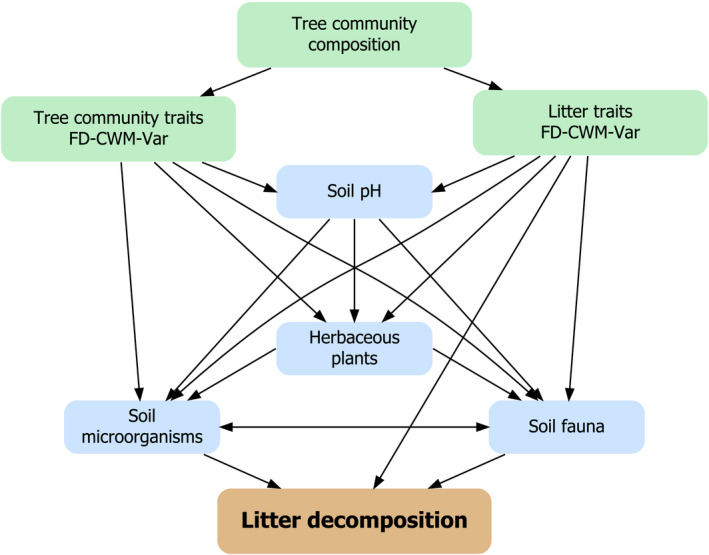
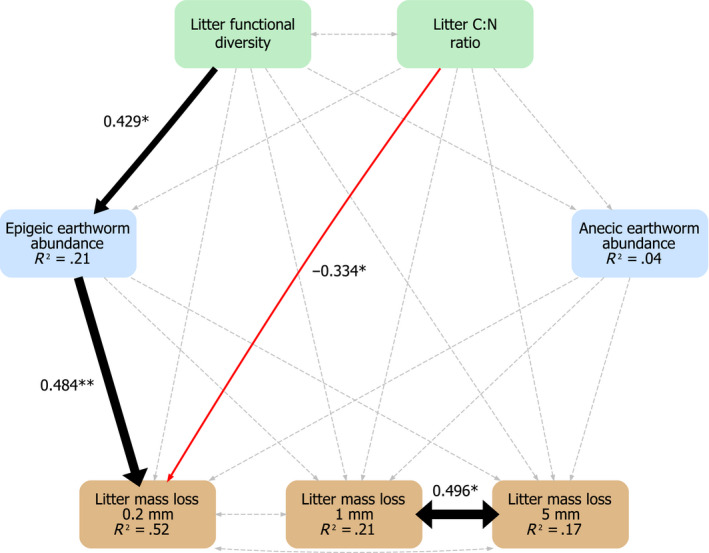
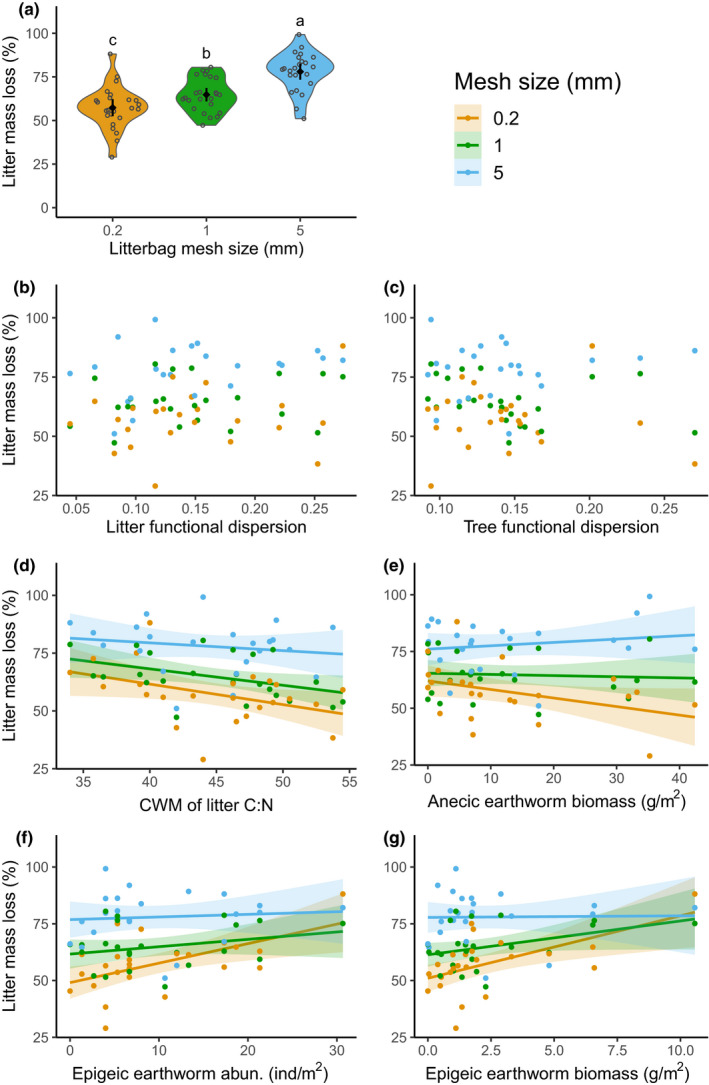
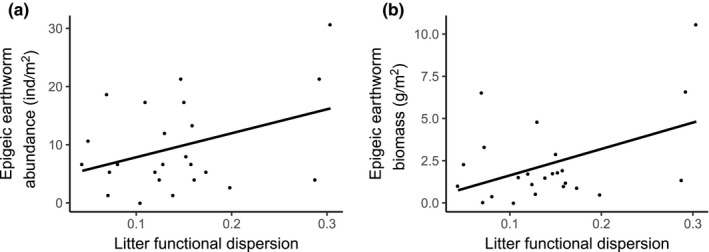
Biodiversity is a major driver of numerous ecosystem functions. However, consequences of changes in forest biodiversity remain difficult to predict because of limited knowledge about how tree diversity influences ecosystem functions. Litter decomposition is a key process affecting nutrient cycling, productivity, and carbon storage and can be influenced by plant biodiversity. Leaf litter species composition, environmental conditions, and the detritivore community are main components of the decomposition process, but their complex interactions are poorly understood. In this study, we tested the effect of tree functional diversity (FD) on litter decomposition in a field experiment manipulating tree diversity and partitioned the effects of litter physiochemical diversity and the detritivore community. We used litterbags with different mesh sizes to separate the effects of microorganisms and microfauna, mesofauna, and macrofauna and monitored soil fauna using pitfall traps and earthworm extractions. We hypothesized that higher tree litter FD accelerates litter decomposition due to the availability of complementary food components and higher activity of detritivores. Although we did not find direct effects of tree FD on litter decomposition, we identified key litter traits and macrodetritivores that explained part of the process. Litter mass loss was found to decrease with an increase in leaf litter carbon:nitrogen ratio. Moreover, litter mass loss increased with an increasing density of epigeic earthworms, with most pronounced effects in litterbags with a smaller mesh size, indicating indirect effects. Higher litter FD and litter nutrient content were found to increase the density of surface-dwelling macrofauna and epigeic earthworm biomass. Based on structural equation modeling, we conclude that tree FD has a weak positive effect on soil surface litter decomposition by increasing the density of epigeic earthworms and that litter nitrogen-related traits play a central role in tree composition effects on soil fauna and decomposition.
生物多样性是众多生态系统功能的主要驱动因素。然而,由于对树木多样性如何影响生态系统功能的了解有限,森林生物多样性变化的后果仍然难以预测。凋落物分解是影响养分循环、生产力和碳储存的关键过程,并且可能受到植物生物多样性的影响。落叶的物种组成、环境条件和分解者群落是分解过程的主要组成部分,但它们之间复杂的相互作用却鲜为人知。在本研究中,我们通过一项操纵树木多样性的田间实验,测试了树木功能多样性(FD)对凋落物分解的影响,并划分了凋落物理化多样性和分解者群落的影响。我们使用不同网孔大小的凋落物袋来区分微生物、小型动物、中型动物和大型动物的影响,并使用陷阱诱捕器和蚯蚓采集法监测土壤动物。我们假设,由于互补食物成分的可用性和分解者更高的活性,更高的树木凋落物功能多样性会加速凋落物分解。尽管我们没有发现树木功能多样性对凋落物分解有直接影响,但我们确定了解释该过程部分原因的关键凋落物特征和大型分解者。研究发现,凋落物质量损失随着落叶碳氮比的增加而减少。此外,凋落物质量损失随着地表蚯蚓密度的增加而增加,在网孔较小的凋落物袋中影响最为明显,表明存在间接影响。研究发现,更高的凋落物功能多样性和凋落物养分含量会增加地表大型动物的密度和地表蚯蚓的生物量。基于结构方程模型,我们得出结论,树木功能多样性通过增加地表蚯蚓的密度对土壤表面凋落物分解有微弱的正向影响,并且与凋落物氮相关的特征在树木组成对土壤动物和分解的影响中起着核心作用。