National Infection Service, Public Health England, London, UK.
National Institute for Health Research (NIHR) Health Protection Research Unit in Blood Borne and Sexually Transmitted Infections, London, UK.
J Antimicrob Chemother. 2020 Nov 1;75(11):3311-3318. doi: 10.1093/jac/dkaa309.
HIV treatment guidelines have traditionally recommended that all HIV-positive individuals are tested for evidence of drug resistance prior to starting ART. Testing for resistance to reverse transcriptase inhibitors and PIs is well established in routine care. However, testing for integrase strand transfer inhibitor (InSTI) resistance is less consistent.
To inform treatment guidelines by determining the prevalence of InSTI resistance in a national cohort of recently infected individuals.
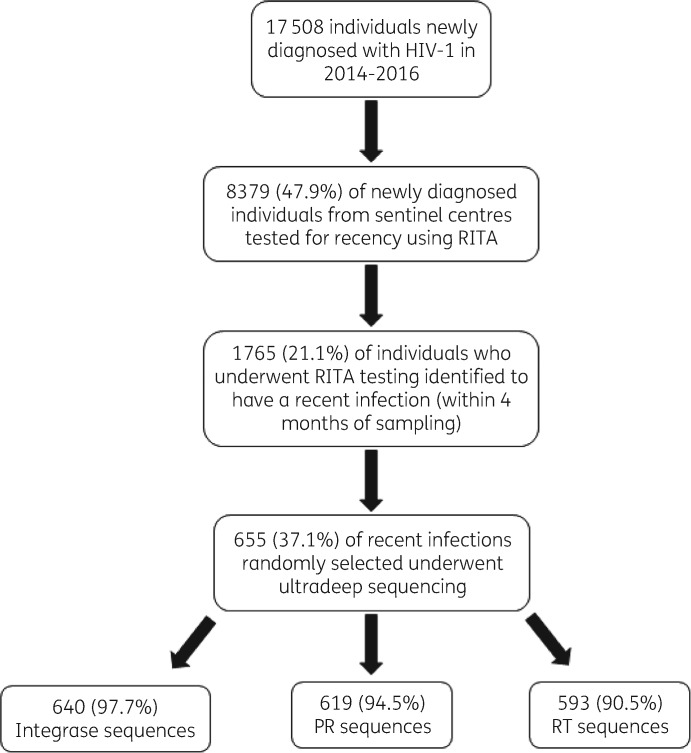
Recent (within 4 months) HIV-1 infections were identified using a Recent Infection Testing Algorithm of new HIV-1 diagnoses in the UK. Resistance-associated mutations (RAMs) in integrase, protease and reverse transcriptase were detected by ultradeep sequencing, which allows for the sensitive estimation of the frequency of each resistant variant in a sample.
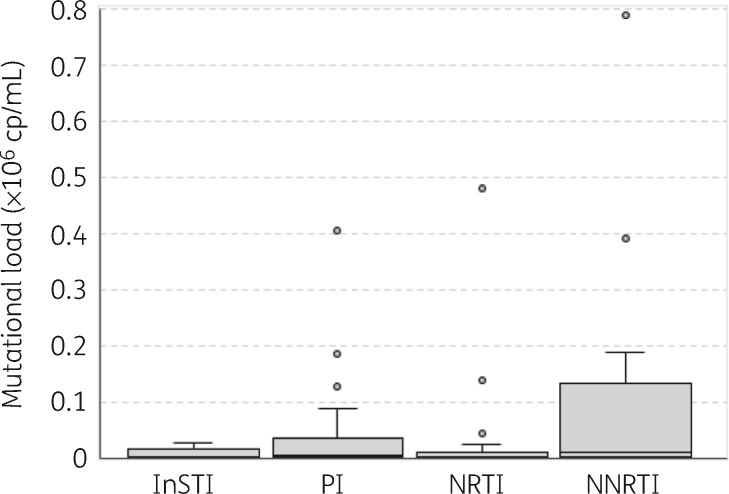
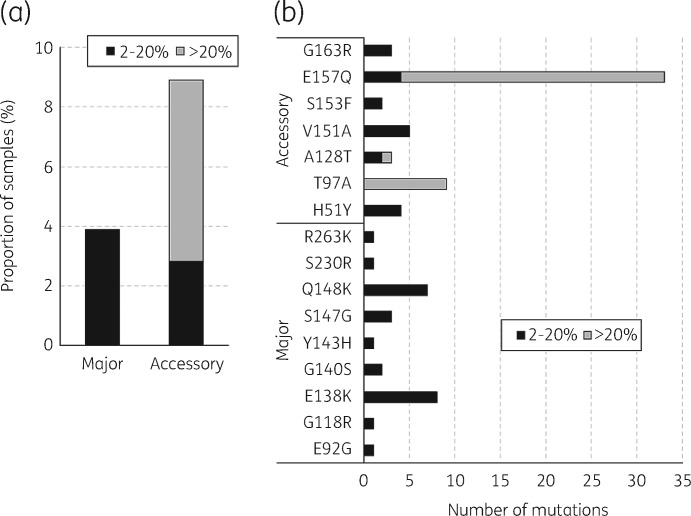
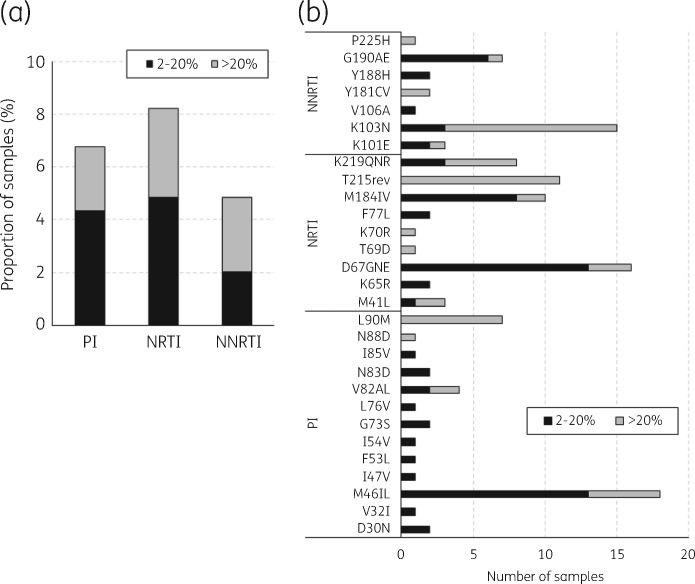
The analysis included 655 randomly selected individuals (median age = 33 years, 95% male, 83% MSM, 78% white) sampled in the period 2014 to 2016 and determined to have a recent infection. These comprised 320, 138 and 197 samples from 2014, 2015 and 2016, respectively. None of the samples had major InSTI RAMs occurring at high variant frequency (≥20%). A subset (25/640, 3.9%) had major InSTI RAMs occurring only as low-frequency variants (2%-20%). In contrast, 47/588 (8.0%) had major reverse transcriptase inhibitor and PI RAMs at high frequency.
Between 2014 and 2016, major InSTI RAMs were uncommon in adults with recent HIV-1 infection, only occurring as low-frequency variants of doubtful clinical significance. Continued surveillance of newly diagnosed patients for evidence of transmitted InSTI resistance is recommended to inform clinical practice.
艾滋病毒治疗指南传统上建议所有艾滋病毒阳性个体在开始接受抗逆转录病毒治疗前进行耐药性检测。在常规护理中,已经很好地建立了针对逆转录酶抑制剂和蛋白酶抑制剂的耐药性检测。然而,整合酶链转移抑制剂(INSTI)耐药性检测则不太一致。
通过确定新感染个体的国家队列中 INSTI 耐药的流行率,为治疗指南提供信息。
使用英国新艾滋病毒感染诊断的近期感染检测算法,确定最近(4 个月内)的 HIV-1 感染。通过超深度测序检测整合酶、蛋白酶和逆转录酶中的耐药相关突变(RAM),这使得能够敏感地估计样本中每种耐药变异体的频率。
该分析包括 2014 年至 2016 年期间随机选择的 655 名(中位年龄 33 岁,95%为男性,83%为男男性接触者,78%为白人)近期感染的个体。这包括分别来自 2014 年、2015 年和 2016 年的 320、138 和 197 个样本。没有样本具有高变异频率(≥20%)的主要 INSTI RAM。有一小部分(25/640,3.9%)仅有主要 INSTI RAM 作为低频变异体(2%-20%)出现。相比之下,47/588(8.0%)的样本具有高频率的主要逆转录酶抑制剂和 PI RAM。
2014 年至 2016 年间,新近感染 HIV-1 的成年人中,主要 INSTI RAM 罕见,仅作为低频变异体出现,临床意义不大。建议继续对新诊断患者进行耐药性检测,为临床实践提供信息。