Computational Neuroscience Laboratories, ATR Institute International, Kyoto, Japan.
Department of Neuroscience and Physiology, New York University School of Medicine, New York, New York, United States of America.
PLoS Comput Biol. 2020 Jul 30;16(7):e1008075. doi: 10.1371/journal.pcbi.1008075. eCollection 2020 Jul.
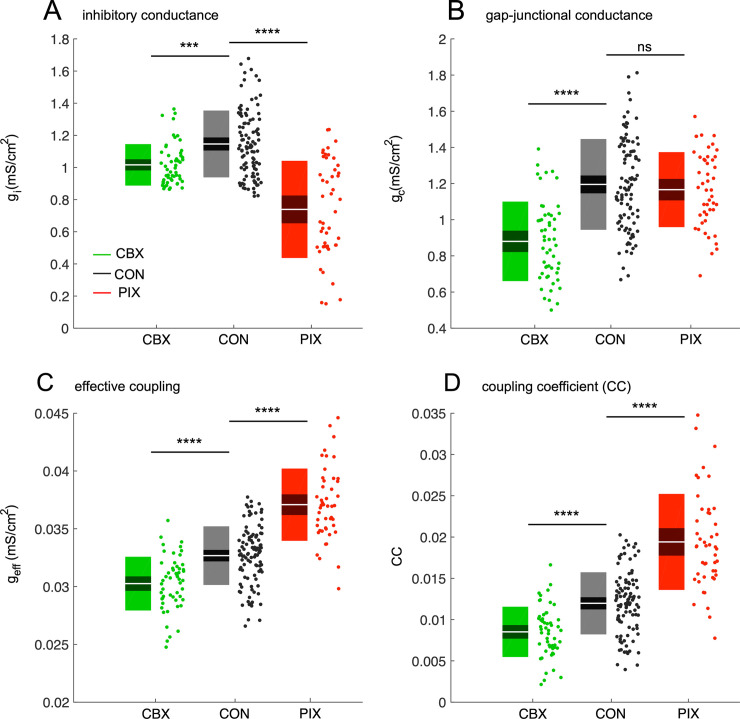
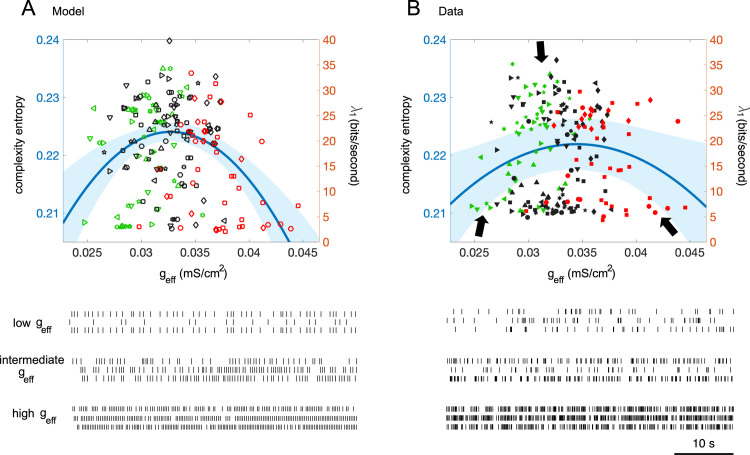
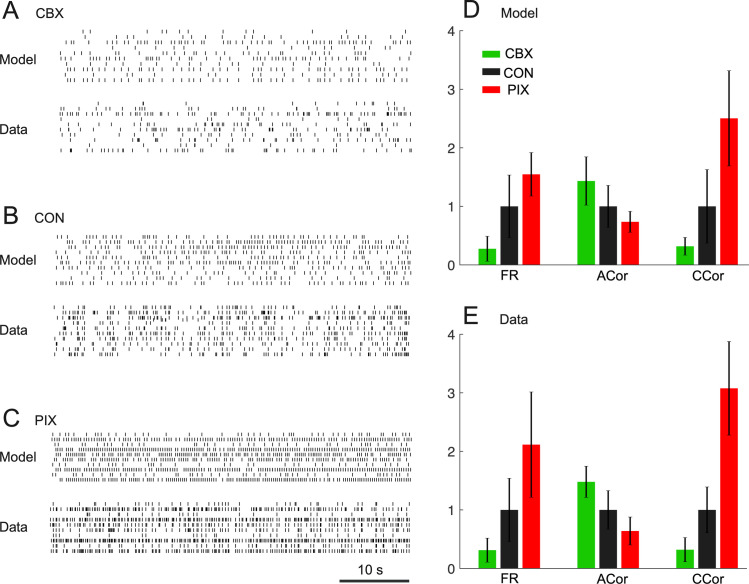
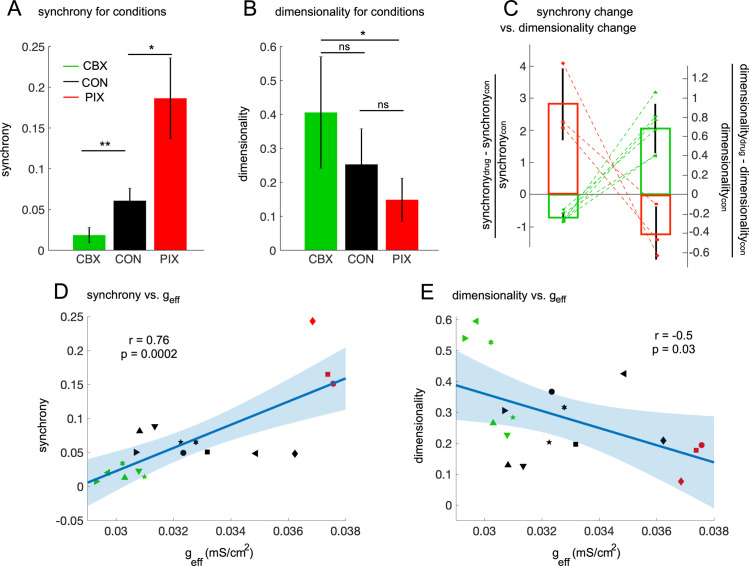
We previously proposed, on theoretical grounds, that the cerebellum must regulate the dimensionality of its neuronal activity during motor learning and control to cope with the low firing frequency of inferior olive neurons, which form one of two major inputs to the cerebellar cortex. Such dimensionality regulation is possible via modulation of electrical coupling through the gap junctions between inferior olive neurons by inhibitory GABAergic synapses. In addition, we previously showed in simulations that intermediate coupling strengths induce chaotic firing of inferior olive neurons and increase their information carrying capacity. However, there is no in vivo experimental data supporting these two theoretical predictions. Here, we computed the levels of synchrony, dimensionality, and chaos of the inferior olive code by analyzing in vivo recordings of Purkinje cell complex spike activity in three different coupling conditions: carbenoxolone (gap junctions blocker), control, and picrotoxin (GABA-A receptor antagonist). To examine the effect of electrical coupling on dimensionality and chaotic dynamics, we first determined the physiological range of effective coupling strengths between inferior olive neurons in the three conditions using a combination of a biophysical network model of the inferior olive and a novel Bayesian model averaging approach. We found that effective coupling co-varied with synchrony and was inversely related to the dimensionality of inferior olive firing dynamics, as measured via a principal component analysis of the spike trains in each condition. Furthermore, for both the model and the data, we found an inverted U-shaped relationship between coupling strengths and complexity entropy, a measure of chaos for spiking neural data. These results are consistent with our hypothesis according to which electrical coupling regulates the dimensionality and the complexity in the inferior olive neurons in order to optimize both motor learning and control of high dimensional motor systems by the cerebellum.
我们之前从理论上提出,小脑在运动学习和控制过程中必须调节神经元活动的维度,以应对下橄榄核神经元的低发放频率,下橄榄核神经元是小脑皮层的两个主要输入之一。这种维度调节可以通过抑制性 GABA 能突触对下橄榄核神经元之间的电耦合进行调制来实现。此外,我们之前在模拟中表明,中等耦合强度会诱导下橄榄核神经元混沌放电,并增加其信息承载能力。然而,目前尚无支持这两个理论预测的体内实验数据。在这里,我们通过分析三种不同耦合条件下浦肯野细胞复合锋电位活动的体内记录,计算了下橄榄核代码的同步性、维度和混沌水平:carbenoxolone(缝隙连接阻断剂)、对照和 picrotoxin(GABA-A 受体拮抗剂)。为了研究电耦合对维度和混沌动力学的影响,我们首先使用下橄榄核的生物物理网络模型和新的贝叶斯模型平均方法的组合,确定了三种条件下下橄榄核神经元之间有效耦合的生理范围。我们发现,有效耦合与同步性共变,与下橄榄核放电动力学的维度呈反比关系,这是通过在每种条件下对尖峰列车进行主成分分析来测量的。此外,对于模型和数据,我们发现耦合强度与复杂度熵之间存在倒 U 形关系,复杂度熵是尖峰神经数据混沌的度量。这些结果与我们的假设一致,即电耦合调节下橄榄核神经元的维度和复杂性,以优化小脑对高维运动系统的运动学习和控制。