Kasahara Toshihiko, Miyauchi Akira, Ito Yasuhiro, Kudo Takumi, Masuoka Hiroo, Higashiyama Takuya, Ito Mitsuru, Kihara Minoru, Miya Akihiro
Department of Internal Medicine, Kuma Hospital, 8-2-35 Shimoyamate-dori, Chuo-ku, Kobe 650-0011, Japan.
Department of Surgery, Kuma Hospital, 8-2-35 Shimoyamate-dori, Chuo-ku, Kobe 650-0011, Japan.
J Thyroid Res. 2020 Jul 18;2020:4652767. doi: 10.1155/2020/4652767. eCollection 2020.
Young patients with papillary thyroid carcinoma (PTC) generally have excellent prognoses despite their often-advanced disease status. The reasons for this excellent prognosis are poorly understood.
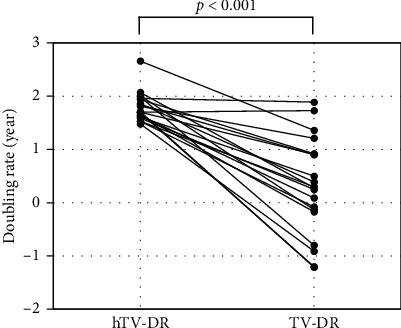
To investigate the natural history of PTC in young patients, we compared the observed tumor volume-doubling rate (TV-DR) with the hypothetical tumor volume-doubling rate (hTV-DR) before presentation in young PTC patients. DR is an inverse of the doubling time and indicates the number of doublings that occur in a unit of time. A negative value indicates the number of times the volume is reduced by half per unit time.
We enrolled 20 patients with the following characteristics: age ≤19 years, diagnosed with PTC according to the cytology results between 2013 and 2018 and followed-up with periodical ultrasound examinations for ≥3 months before surgery for various reasons. Seventeen patients later underwent surgery confirming the diagnosis. We calculated TV-DRs using serial measurements of tumor diameters after presentation and hTV-DRs using tumor diameters and patients' age at presentation, assuming that a single cancer cell was present at the patient's birth and that the tumor grew at a constant rate. These values indicate the lowest growth rates necessary for a single cancer cell to achieve the full tumor size at presentation.
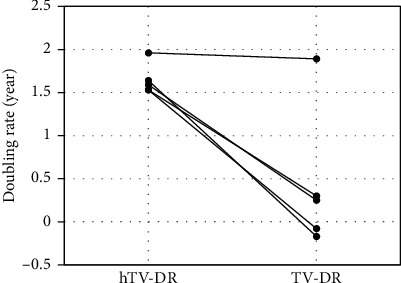
Thirteen patients had positive TV-DRs (/year) ranging from 0.09 to 1.89, indicating tumor growth, and the remaining seven patients had negative values (-0.08 to -1.21), indicating regression. The median TV-DR was 0.29. The hTV-DRs (1.48-2.66, median 1.71) were significantly larger than the TV-DRs ( < 0.001), indicating much faster growth before presentation.
These data suggest that deceleration of tumor growth had already occurred at presentation in the majority of the cases. This might explain why disease-specific survival is excellent despite frequent findings of advanced disease in young patients with PTC.
年轻的甲状腺乳头状癌(PTC)患者尽管疾病状态往往已处于进展期,但总体预后良好。这种良好预后的原因尚不清楚。
为了研究年轻PTC患者的疾病自然史,我们比较了年轻PTC患者就诊前观察到的肿瘤体积倍增率(TV-DR)与假设的肿瘤体积倍增率(hTV-DR)。倍增率是倍增时间的倒数,表明单位时间内发生的倍增次数。负值表示单位时间内体积减半的次数。
我们纳入了20例具有以下特征的患者:年龄≤19岁,根据2013年至2018年的细胞学结果诊断为PTC,因各种原因在手术前接受了≥3个月的定期超声检查。17例患者随后接受手术确诊。我们使用就诊后肿瘤直径的系列测量值计算TV-DR,并使用就诊时的肿瘤直径和患者年龄计算hTV-DR,假设患者出生时存在单个癌细胞且肿瘤以恒定速率生长。这些值表示单个癌细胞在就诊时达到完整肿瘤大小所需的最低生长速率。
13例患者的TV-DR为正值(/年),范围为0.09至1.89,表明肿瘤生长,其余7例患者的值为负值(-0.08至-1.21),表明肿瘤消退。TV-DR的中位数为0.29。hTV-DR(1.48 - 2.66,中位数1.71)显著大于TV-DR(<0.001),表明就诊前生长速度快得多。
这些数据表明,在大多数情况下,就诊时肿瘤生长已经减速。这可能解释了为什么尽管在年轻的PTC患者中经常发现疾病已进展,但疾病特异性生存率却很好。