Braun Hannah-Sophie, Sponder Gerhard, Aschenbach Jörg R, Kerner Katharina, Bauerfeind Rolf, Deiner Carolin
Institute of Veterinary Physiology, Freie Universität Berlin, Oertzenweg 19b, 14163 Berlin, Germany.
Institute of Hygiene and Infectious Diseases of Animals, Justus Liebig University, Frankfurter Strasse 85-89, 35392 Gießen, Germany.
Vet Anim Sci. 2017 Apr 27;3:10-17. doi: 10.1016/j.vas.2017.04.001. eCollection 2017 Jun.
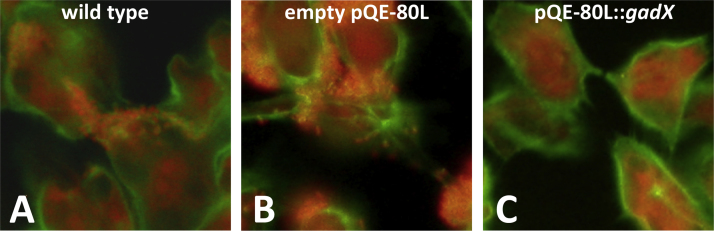
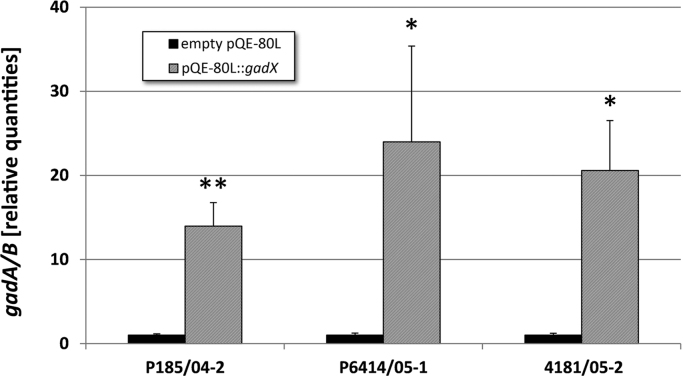
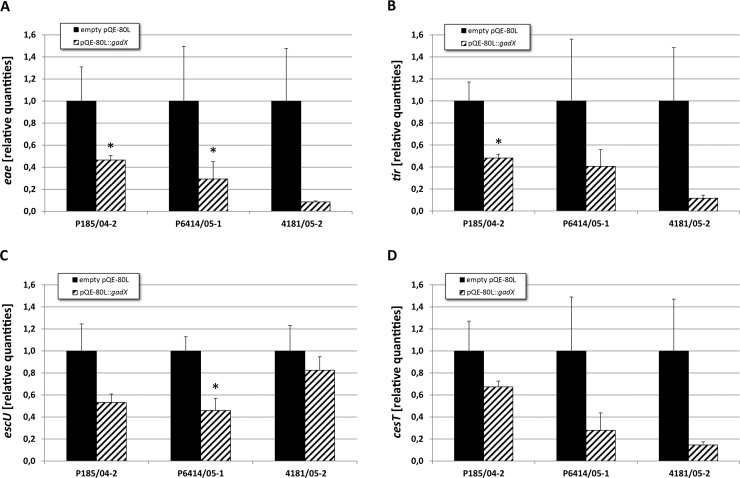
The ability of enteropathogenic (EPEC) to express virulence factor genes and develop attaching and effacing (AE) lesions is inhibited in acidic environmental conditions. This inhibition is due to the activation of transcription factor GadX, which upregulates expression of glutamic acid decarboxylase (Gad). Gad, in turn, produces γ-aminobutyric acid (GABA), which was recently shown to have a beneficial effect on the jejunal epithelium due to increased mucin-1 levels. In the present study, we sought to test whether forced GadX activation/overexpression abolishes virulence associated features of EPEC and provokes increased GABA production. EPEC strains were isolated from diarrheic pigs and submitted to activation of GadX by acidification as well as overexpression via an inducible expression vector plasmid. GABA concentrations in the growth medium, ability for adhesion to porcine intestinal epithelial cells (IPEC-J2) and virulence gene expression were determined. Growth in acidified media led to increased GABA levels, upregulated expression and downregulated mRNA synthesis of the bacterial adhesin . EPEC strains transformed with the gene produced 2.1-3.4-fold higher GABA levels than empty-vector controls and completely lost their ability to adhere to IPEC-J2 cells and to induce actin accumulation. We conclude that intensified activation can abolish the ability of EPEC to adhere to the intestinal epithelium by reducing the expression of major virulence genes.
在酸性环境条件下,肠道致病性大肠杆菌(EPEC)表达毒力因子基因并形成紧密黏附与抹平(AE)损伤的能力受到抑制。这种抑制是由于转录因子GadX的激活,其上调了谷氨酸脱羧酶(Gad)的表达。Gad进而产生γ-氨基丁酸(GABA),最近研究表明,由于黏蛋白-1水平升高,GABA对空肠上皮具有有益作用。在本研究中,我们试图测试强制激活/过表达GadX是否会消除EPEC的毒力相关特征并促使GABA产量增加。从腹泻猪中分离出EPEC菌株,通过酸化激活GadX,并通过诱导表达载体质粒进行过表达。测定生长培养基中的GABA浓度、对猪肠上皮细胞(IPEC-J2)的黏附能力以及毒力基因表达。在酸化培养基中生长导致GABA水平升高、细菌黏附素的表达上调和mRNA合成下调。用该基因转化的EPEC菌株产生的GABA水平比空载体对照高2.1至3.4倍,并完全丧失了黏附IPEC-J2细胞和诱导肌动蛋白积累的能力。我们得出结论,强化激活可以通过降低主要毒力基因的表达来消除EPEC黏附肠上皮的能力。