
作为基础日粮补充剂喂养的山羊的生化指标和血液学参数。 (原文中“fed and as supplements to a basal diet”部分表述不完整,可能有信息缺失,但按照要求尽量完整翻译了现有内容)
Biochemical indices and heamtological parameters of goats fed and as supplements to a basal diet.
作者信息
Soul Washaya, Mupangwa John, Muchenje Voster, Mpendulo Thando Conference
机构信息
University of Fort Hare, Faculty of Science and Agriculture, Department of Livestock and Pasture Science, P. Bag X1314, Alice 5700, South Africa.
Africa University, College of Health, Agriculture and Natural Sciences, Department of Agriculture, P.O. Box 1320 Mutare.
出版信息
Vet Anim Sci. 2019 Sep 27;8:100073. doi: 10.1016/j.vas.2019.100073. eCollection 2019 Dec.
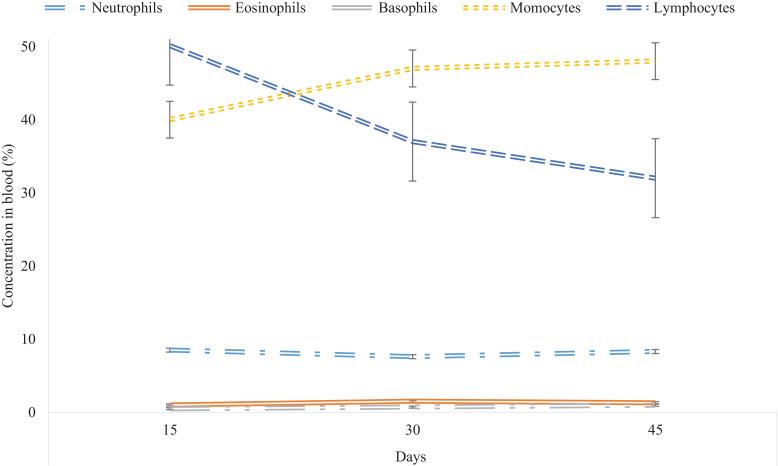
The objective of this study was to evaluate the effects of forage legume diets on haematological and biochemical indices of Xhosa goats. Eighteen animals, one-year-old, of average live weight 14.13 ± 0.24 kg were assigned, in a completely randomized design, to three treatment diets. Animals were housed individually and sex was equally represented among treatments with 6 animals per treatment. Weights and blood samples were taken every fortnight. A pair of blood samples (5 ml each) were collected from each goat, via jugular vein puncture and were subjected to either haematological or biochemical analysis. The results show that treatment diets and sex significantly ( < 0.05) affected DMI, total gain, ADG, and feed conversion ratio. Treatment diets and sex had no effects ( > 0.05) on serum total proteins, globulins, urea, creatinine, alanine aminotransferase, alkaline phosphatase (ALP), and gamma- glutamyl transferase concentrations. The diet influenced albumin was ( < 0.05) while sex influenced ALP concentration ( < 0.05). Measured over time, the plasma concentration of urea and ALP significantly increased ( < 0.05) while creatinine and cholesterol concentration decreased ( < 0.05). Although the overall blood biochemical properties remain unchanged among the treatments and between sexes; treatment by sex, treatment by day and sex by day interactions were significant ( < 0.05). The white blood cells, red blood cell, mean corpuscular haemoglobin, mean corpuscular haemoglobin concentration, haemoglobin, haematocrit, and platelet and mean platelet volume levels were similar among treatments and between sexes ( > 0.05). The mean cell volume and red cell distribution width were different among treatments ( < 0.05). Treatment diets significantly ( < 0.05) influenced neutrophil (%) content while sex influenced basophile (%) content. In conclusion forage legumes did not cause toxicity in goats or any pathological condition.
本研究的目的是评估豆科牧草日粮对科萨山羊血液学和生化指标的影响。18只一岁山羊,平均体重14.13±0.24千克,采用完全随机设计,分为三种处理日粮。动物单独饲养,各处理间性别均衡,每个处理6只动物。每两周测量体重并采集血样。通过颈静脉穿刺从每只山羊采集一对血样(各5毫升),分别进行血液学或生化分析。结果表明,处理日粮和性别对干物质采食量、总增重、平均日增重和饲料转化率有显著影响(P<0.05)。处理日粮和性别对血清总蛋白、球蛋白、尿素、肌酐、谷丙转氨酶、碱性磷酸酶(ALP)和γ-谷氨酰转移酶浓度无影响(P>0.05)。日粮影响白蛋白(P<0.05),而性别影响ALP浓度(P<0.05)。随着时间推移,血浆尿素和ALP浓度显著升高(P<0.05),而肌酐和胆固醇浓度降低(P<0.05)。虽然各处理间和性别间的总体血液生化特性保持不变;但处理与性别、处理与天数以及性别与天数的交互作用显著(P<0.05)。各处理间和性别间的白细胞、红细胞、平均红细胞血红蛋白、平均红细胞血红蛋白浓度、血红蛋白、血细胞比容、血小板和平均血小板体积水平相似(P>0.05)。平均细胞体积和红细胞分布宽度在各处理间存在差异(P<0.05)。处理日粮显著影响中性粒细胞(%)含量,而性别影响嗜碱性粒细胞(%)含量。总之,豆科牧草不会对山羊造成毒性或引发任何病理状况。

 Zotero 插件