Stanford University School of Medicine, California.
Stanford University School of Medicine, California.
J Am Acad Child Adolesc Psychiatry. 2021 Apr;60(4):458-469. doi: 10.1016/j.jaac.2020.07.892. Epub 2020 Aug 1.
We compared intrinsic network connectivity in symptomatic youths at high risk (HR) for bipolar disorder (BD) and healthy comparison (HC) youths. In HR youths, we also investigated treatment-related changes in intrinsic connectivity after family-focused therapy for high-risk youths (FFT-HR) vs standardized family psychoeducation.
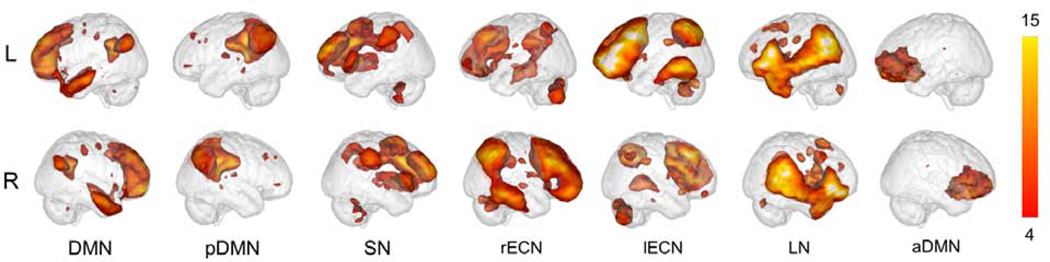
HR youths (N = 34; age 9-17 years; mean 14 years, 56% girls and 44% boys) with depressive and/or hypomanic symptoms and at least 1 first- or second-degree relative with BD I or II were randomly assigned to 4 months of FFT-HR (12 sessions of psychoeducation, communication, and problem-solving skills training) or enhanced care (EC; 3 family and 3 individual psychoeducation sessions). Before and after 4 months of treatment, participants underwent resting state functional magnetic resonance imaging (rs-fMRI). A whole-brain independent component analysis compared rs-fMRI networks in HR youths and 30 age-matched HC youths at a pretreatment baseline. Then we identified pretreatment to posttreatment (4-month) changes in network connectivity in HR youths receiving FFT-HR (n = 16) or EC (n = 18) and correlated these changes with depression improvement.
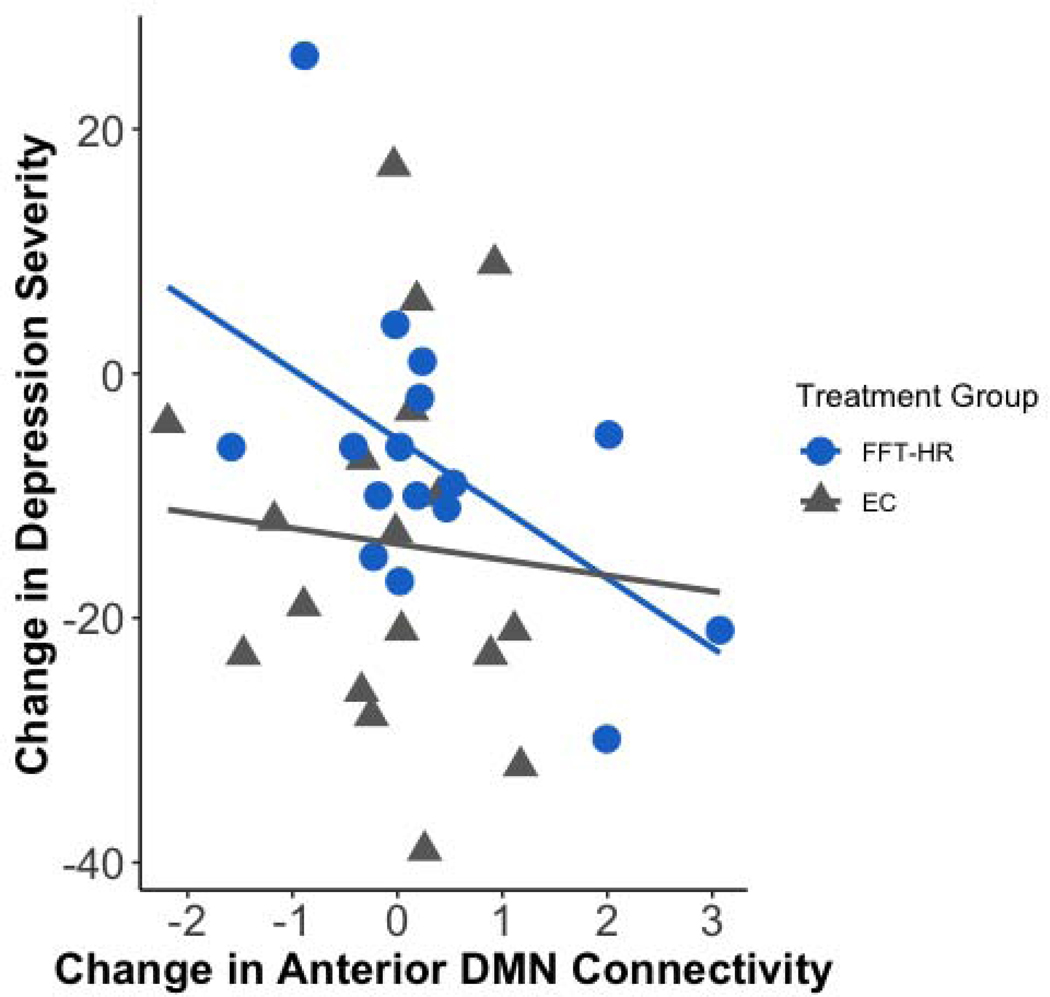
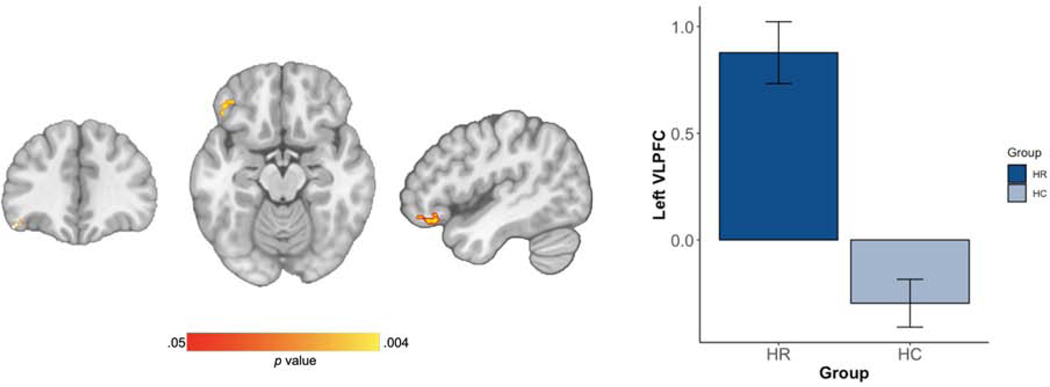
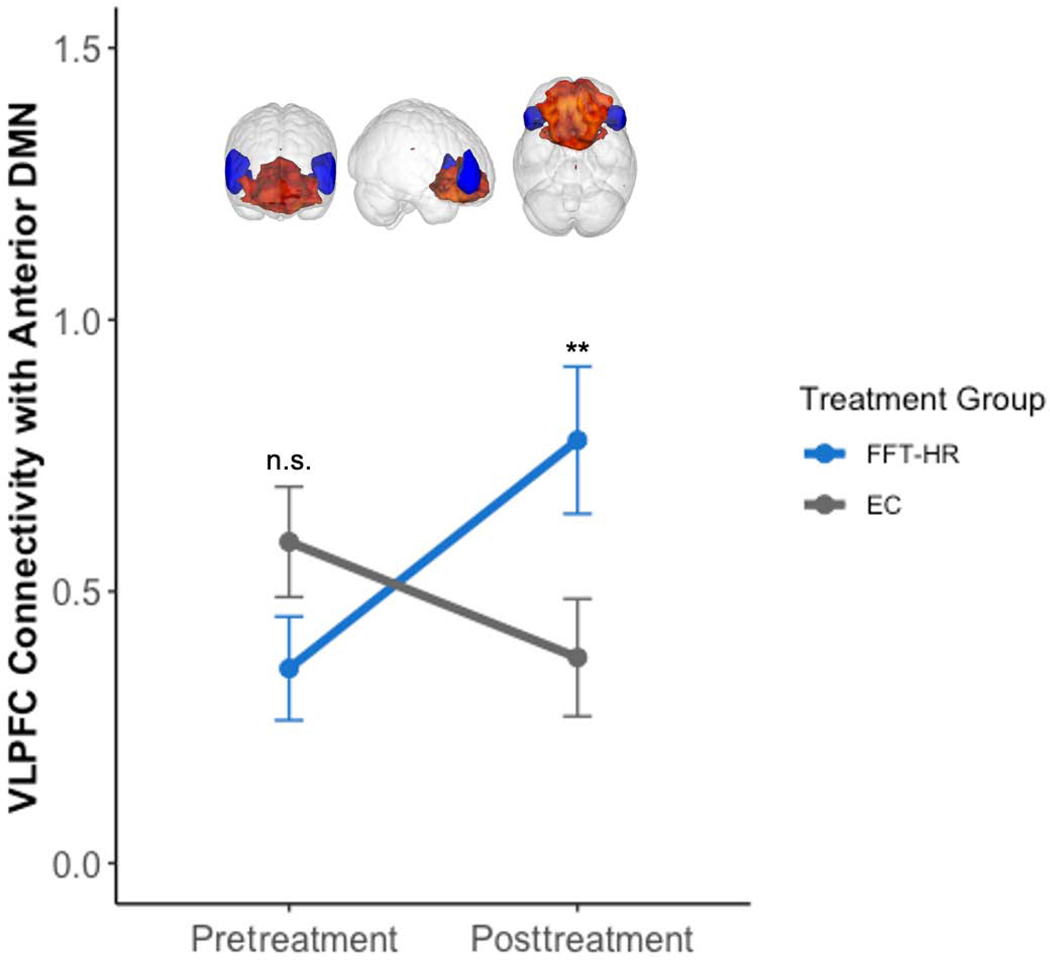
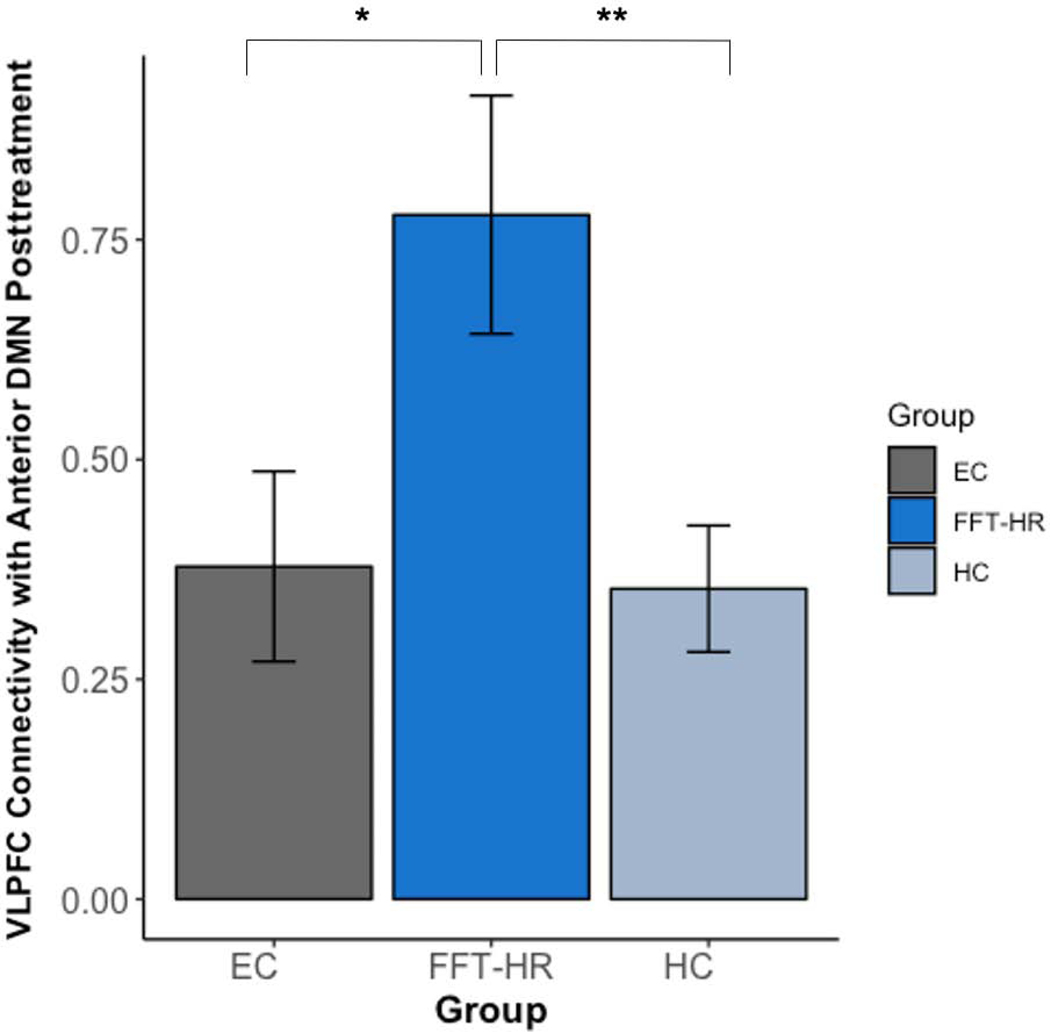
At baseline, HR youths had greater connectivity between the ventrolateral prefrontal cortex (VLPFC) and the anterior default mode network (aDMN) than did HCs (p = .004). Over 4 months of treatment, FFT-HR-assigned HR youths had increased VLPFC-aDMN connectivity from pre- to posttreatment (p = .003), whereas HR youths in EC showed no significant change over time (p = .11) (treatment by time interaction, t = 3.33, 95% CI = 0.27-1.14, p = .002]. Reduction in depression severity over 4 months inversely correlated with enhanced anterior DMN (r = -0.71) connectivity in the FFT-HR but not in the EC (r = -0.07) group (z = -2.17, p = .015).
Compared to standard psychoeducation, FFT-HR is associated with stronger connectivity between the VLPFC and aDMN, suggesting possible enhancements of self-awareness, illness awareness, and emotion regulation.
Early Intervention for Youth at Risk for Bipolar Disorder; https://clinicaltrials.gov/; NCT01483391.
我们比较了有双相障碍(BD)风险的症状性青少年(HR)和健康对照组(HC)的内在网络连接。在 HR 青少年中,我们还研究了家庭为中心的治疗高危青少年(FFT-HR)与标准化家庭心理教育治疗后内在连通性的变化。
HR 青少年(N=34;年龄 9-17 岁;平均 14 岁,56%为女孩,44%为男孩)有抑郁和/或轻躁狂症状,至少有 1 位一级或二级亲属患有 BD I 或 II。他们被随机分配到 4 个月的 FFT-HR(12 次心理教育、沟通和解决问题技能培训)或强化护理(EC;3 次家庭和 3 次个体心理教育)。在治疗前和 4 个月后,参与者进行了静息态功能磁共振成像(rs-fMRI)。全脑独立成分分析比较了 HR 青少年和 30 名年龄匹配的 HC 青少年在治疗前基线的 rs-fMRI 网络。然后,我们确定了接受 FFT-HR(n=16)或 EC(n=18)治疗的 HR 青少年从治疗前到治疗后(4 个月)网络连通性的变化,并将这些变化与抑郁改善相关联。
在基线时,HR 青少年的腹外侧前额叶皮层(VLPFC)与前默认模式网络(aDMN)之间的连通性大于 HC(p=0.004)。在 4 个月的治疗过程中,FFT-HR 分配的 HR 青少年的 VLPFC-aDMN 连通性从治疗前到治疗后增加(p=0.003),而 EC 中的 HR 青少年在时间上没有显著变化(p=0.11)(治疗与时间的交互作用,t=3.33,95%CI=0.27-1.14,p=0.002)。4 个月内抑郁严重程度的降低与 FFT-HR 中增强的前 DMN(r=0.71)连通性呈负相关,但在 EC(r=0.07)组中没有(r=0.07)(z=-2.17,p=0.015)。
与标准心理教育相比,FFT-HR 与 VLPFC 和 aDMN 之间更强的连通性相关,这表明可能增强了自我意识、疾病意识和情绪调节。
青少年双相障碍风险干预;https://clinicaltrials.gov/;NCT01483391。