Lukas Dieter, Clutton-Brock Tim
Department of Zoology, University of Cambridge, Cambridge, UK.
Department of Human Behavior, Ecology and Culture, Max Planck Institute for Evolutionary Anthropology, Leipzig, Germany.
Behav Ecol. 2020 Jul-Aug;31(4):943-949. doi: 10.1093/beheco/araa039. Epub 2020 May 6.
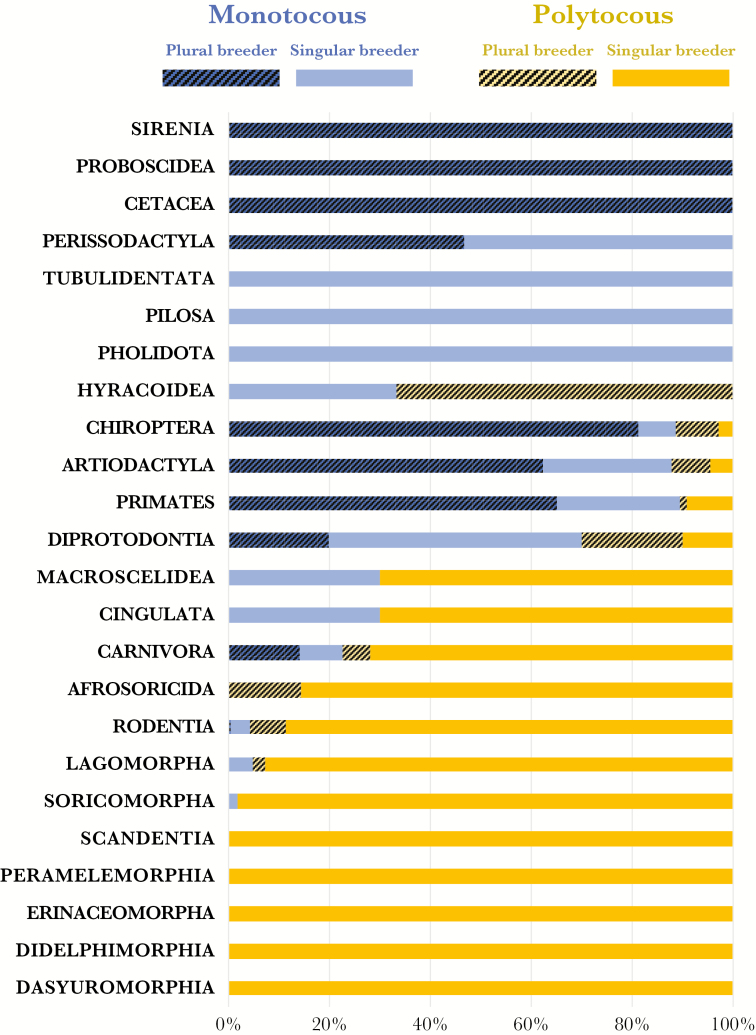
In many mammals, breeding females are intolerant of each other and seldom associate closely but, in some, they aggregate in groups that vary in size, stability, and kinship structure. Aggregation frequently increases competition for food, and interspecific differences in female sociality among mammals are commonly attributed to contrasts in ecological parameters, including variation in activity timing, the distribution of resources, as well as the risk of predation. However, there is increasing indication that differences in female sociality are also associated with phylogenetic relationships and with contrasts in life-history parameters. We show here that evolutionary transitions from systems where breeding females usually occupy separate ranges ("singular breeding") to systems where breeding females usually aggregate ("plural breeding") have occurred more frequently in monotocous lineages where females produce single young than in polytocous ones where they produce litters. A likely explanation of this association is that competition between breeding females for resources is reduced where they produce single young and is more intense where they produce litters. Our findings reinforce evidence that variation in life-history parameters plays an important role in shaping the evolution of social behavior.
在许多哺乳动物中,处于繁殖期的雌性彼此之间互不相容,很少紧密联系,但在某些物种中,它们会聚集在一起形成大小、稳定性和亲属结构各异的群体。聚集常常会加剧对食物的竞争,哺乳动物雌性社交行为的种间差异通常归因于生态参数的差异,包括活动时间的变化、资源分布以及被捕食的风险。然而,越来越多的迹象表明,雌性社交行为的差异也与系统发育关系以及生活史参数的差异有关。我们在此表明,从繁殖期雌性通常占据各自领地的系统(“单胎繁殖”)到繁殖期雌性通常聚集的系统(“多胎繁殖”)的进化转变,在单胎生殖谱系中比在多胎生殖谱系中更频繁发生,在单胎生殖谱系中雌性产单仔,而在多胎生殖谱系中雌性产多仔。这种关联的一个可能解释是,繁殖期雌性产单仔时,它们对资源的竞争会减少,而产多仔时竞争会更激烈。我们的研究结果进一步证明,生活史参数的变化在塑造社会行为的进化过程中起着重要作用。