Department of Human Genetics, Donders Institute for Brain, Cognition and Behavior, Radboud university medical center, 6500 HB Nijmegen, The Netherlands.
Department of Cognitive Neuroscience, Donders Institute for Brain, Cognition and Behavior, Radboud university medical center, 6500 HB Nijmegen, The Netherlands.
Hum Mol Genet. 2020 Sep 30;29(R1):R42-R50. doi: 10.1093/hmg/ddaa175.
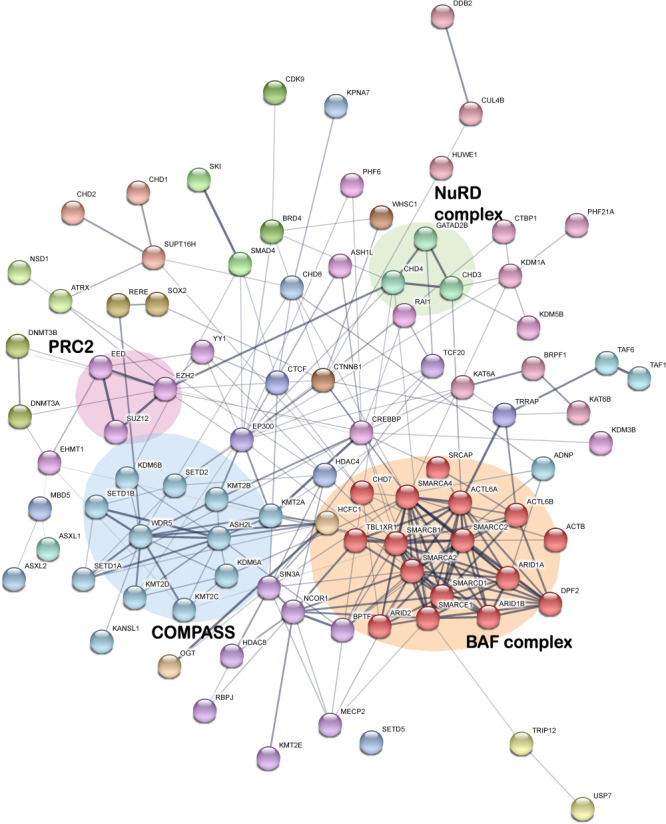
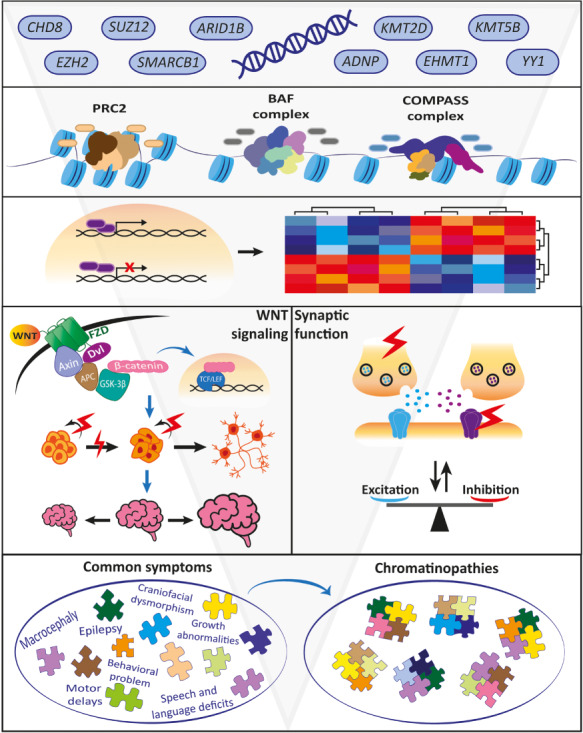
Disruption of chromatin structure due to epimutations is a leading genetic etiology of neurodevelopmental disorders, collectively known as chromatinopathies. We show that there is an increasing level of convergence from the high diversity of genes that are affected by mutations to the molecular networks and pathways involving the respective proteins, the disrupted cellular and subcellular processes, and their consequence for higher order cellular network function. This convergence is ultimately reflected by specific phenotypic features shared across the various chromatinopathies. Based on these observations, we propose that the commonly disrupted molecular and cellular anomalies might provide a rational target for the development of symptomatic interventions for defined groups of genetically distinct neurodevelopmental disorders.
由于表观遗传突变导致的染色质结构破坏是神经发育障碍的主要遗传病因,统称为染色质病。我们表明,受突变影响的基因的高度多样性与涉及相应蛋白质的分子网络和途径、受干扰的细胞和亚细胞过程及其对高级细胞网络功能的影响之间存在趋同程度不断增加。这种趋同最终反映在各种染色质病中共同存在的特定表型特征上。基于这些观察结果,我们提出,共同受到干扰的分子和细胞异常可能为针对具有明确遗传差异的神经发育障碍的特定群体开发有症状的干预措施提供合理的目标。