Institute of Organic Chemistry, RWTH Aachen University, Landoltweg 1, 52074, Aachen, Germany.
Angew Chem Int Ed Engl. 2020 Nov 16;59(47):21176-21182. doi: 10.1002/anie.202009893. Epub 2020 Sep 11.
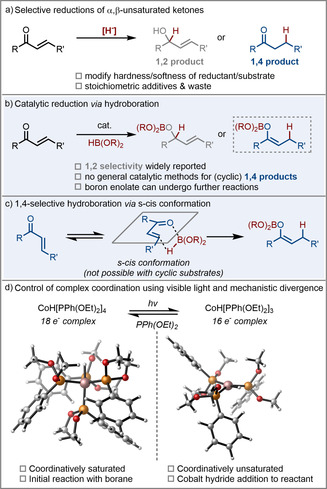
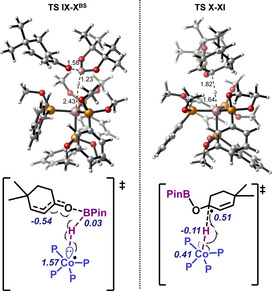
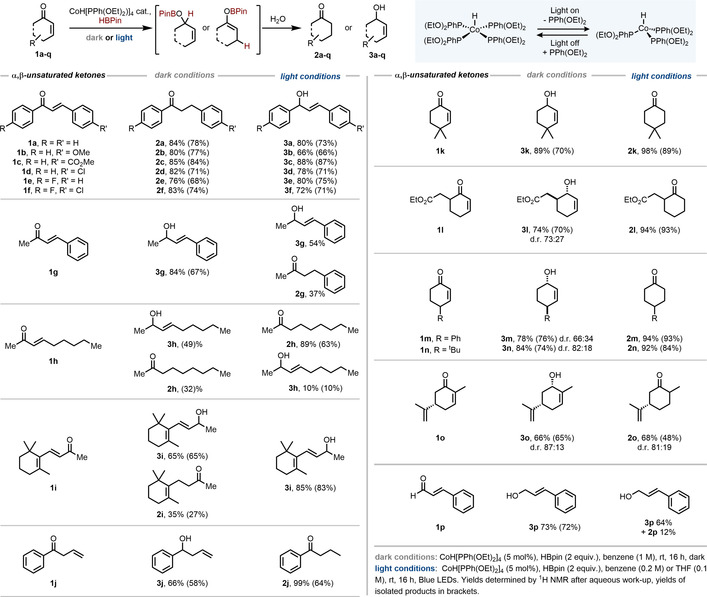
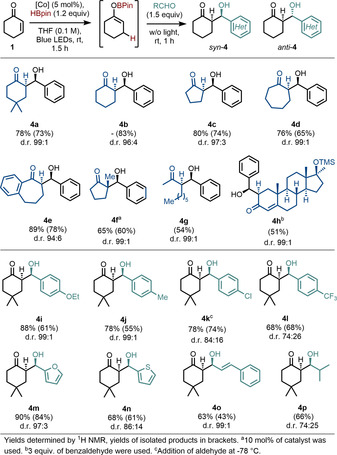
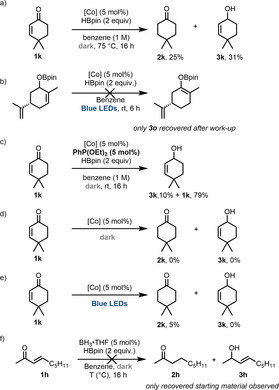
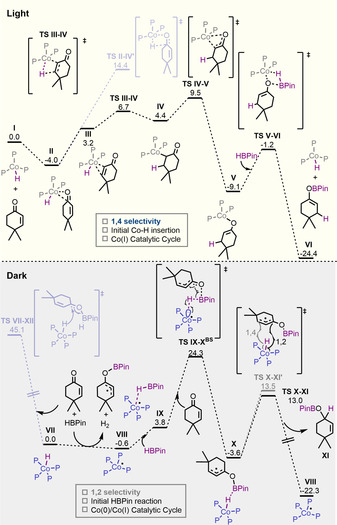
Selectivity between 1,2 and 1,4 addition of a nucleophile to an α,β-unsaturated carbonyl compound has classically been modified by the addition of stoichiometric additives to the substrate or reagent to increase their "hard" or "soft" character. Here, we demonstrate a conceptually distinct approach that instead relies on controlling the coordination sphere of a catalyst with visible light. In this way, we bias the reaction down two divergent pathways, giving contrasting products in the catalytic hydroboration of α,β-unsaturated ketones. This includes direct access to previously elusive cyclic enolborates, via 1,4-selective hydroboration, providing a straightforward and stereoselective route to rare syn-aldol products in one-pot. DFT calculations and mechanistic experiments confirm two different mechanisms are operative, underpinning this unusual photocontrolled selectivity switch.
经典的方法是通过向底物或试剂中添加化学计量添加剂来改变亲核试剂与α,β-不饱和羰基化合物 1,2 和 1,4 加成的选择性,以增加它们的“硬”或“软”性质。在这里,我们展示了一种截然不同的方法,它依赖于用光来控制催化剂的配位场。通过这种方式,我们使反应沿着两条不同的途径进行,在α,β-不饱和酮的催化硼氢化反应中得到截然不同的产物。这包括通过 1,4-选择性硼氢化反应直接获得以前难以捉摸的环状烯醇硼酸盐,为一锅法中罕见的顺式-羟醛产物提供了一种简单和立体选择性的途径。DFT 计算和机理实验证实,两种不同的机制在起作用,为这种不寻常的光控选择性开关提供了依据。