Cirad, UMR 17, Intertryp, Montpellier, France; IES, UMR 5214 Univ. Montpellier-CNRS, Montpellier, France.
Department of Evolutionary Biology, Ecology and Environmental Sciences, University of Barcelona, Biodiversity Research Institute, Barcelona, Spain.
Infect Genet Evol. 2020 Oct;84:104493. doi: 10.1016/j.meegid.2020.104493. Epub 2020 Aug 5.
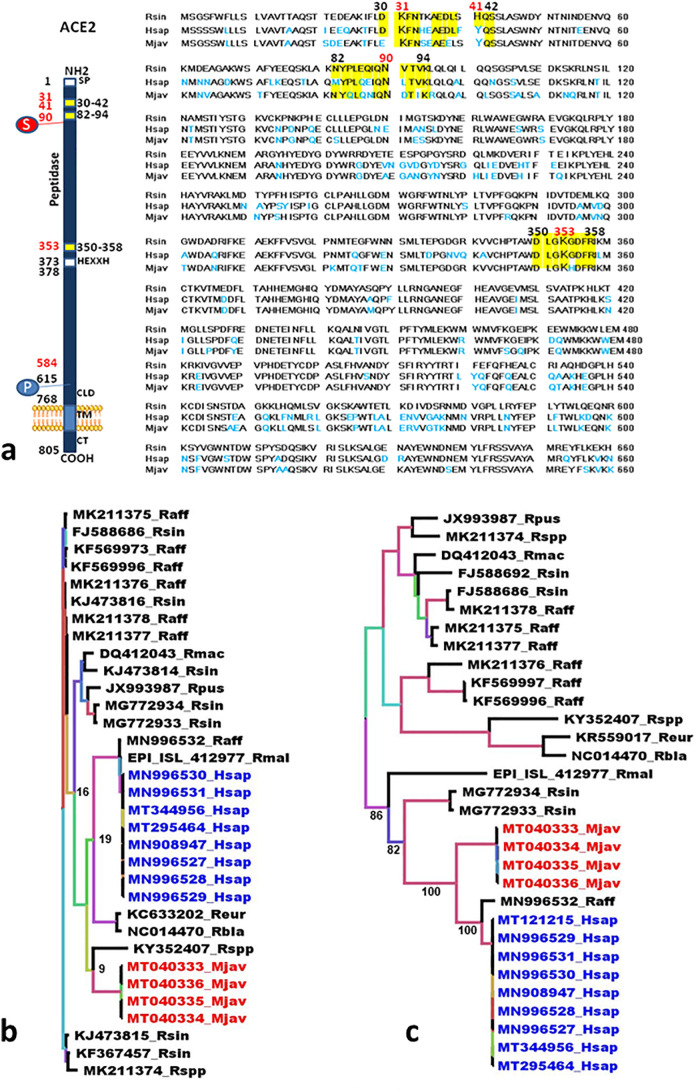
The emergence of COVID-19 has triggered many works aiming at identifying the animal intermediate potentially involved in the transmission of SARS-CoV-2 to humans. The presence of SARS-CoV-2-related viruses in Malayan pangolins, in silico analysis of the ACE2 receptor polymorphism and sequence similarities between the Receptor Binding Domain (RBD) of the spike proteins of pangolin and human Sarbecoviruses led to the proposal of pangolin as intermediary. However, the binding affinity of the pangolin ACE2 receptor for SARS-CoV-2 RBD was later on reported to be low. Here, we provide evidence that the pangolin is not the intermediate animal at the origin of the human pandemic. Moreover, data available do not fit with the spillover model currently proposed for zoonotic emergence which is thus unlikely to account for this outbreak. We propose a different model to explain how SARS-CoV-2 related coronaviruses could have circulated in different species, including humans, before the emergence of COVID-19.
新冠疫情的爆发促使人们开展了大量工作,旨在确定可能在 SARS-CoV-2 向人类传播过程中充当中间宿主的动物。马来穿山甲中存在与 SARS-CoV-2 相关的病毒、利用计算机对 ACE2 受体多态性进行分析以及对棘突蛋白受体结合域(RBD)的序列相似性进行分析,这些都表明穿山甲可能是中间宿主。然而,后来有报道称,穿山甲 ACE2 受体与 SARS-CoV-2 RBD 的结合亲和力较低。在此,我们提供的证据表明,穿山甲不是导致此次人类大流行的中间宿主。此外,现有数据不符合当前提出的人畜共患病出现的溢出模型,因此不太可能解释此次疫情。我们提出了一种不同的模型来解释 SARS-CoV-2 相关冠状病毒在 COVID-19 出现之前如何在包括人类在内的不同物种中传播。