University Hospitals Cleveland Medical Center.
Rainbow Babies and Children's Hospital.
AIDS. 2020 Sep 1;34(11):1615-1623. doi: 10.1097/QAD.0000000000002615.
There is evidence for endothelial dysfunction in youth living with perinatally acquired HIV (YLPHIV). However, little data exist on its mechanisms.
YLPHIV and age-matched HIV-uninfected (HIV-) youth enrolled in the Cape Town Adolescent Antiretroviral Cohort in South Africa between 9 and 14 years of age were included. YLPHIV were on antiretroviral therapy more than 6 months with viral load less than 400 copies/ml at baseline and 24 months. Serum biomarkers of systemic inflammation, monocyte activation, intestinal integrity, and oxidized LDL-cholesterol were measured at baseline and after 24 months. Endothelial function was measured at 24 months using reactive hyperemic index (RHI); endothelial dysfunction was defined as RHI less than 1.35. Spearman correlation coefficient and quantile regression were used to examine associations between RHI and different biomarkers.
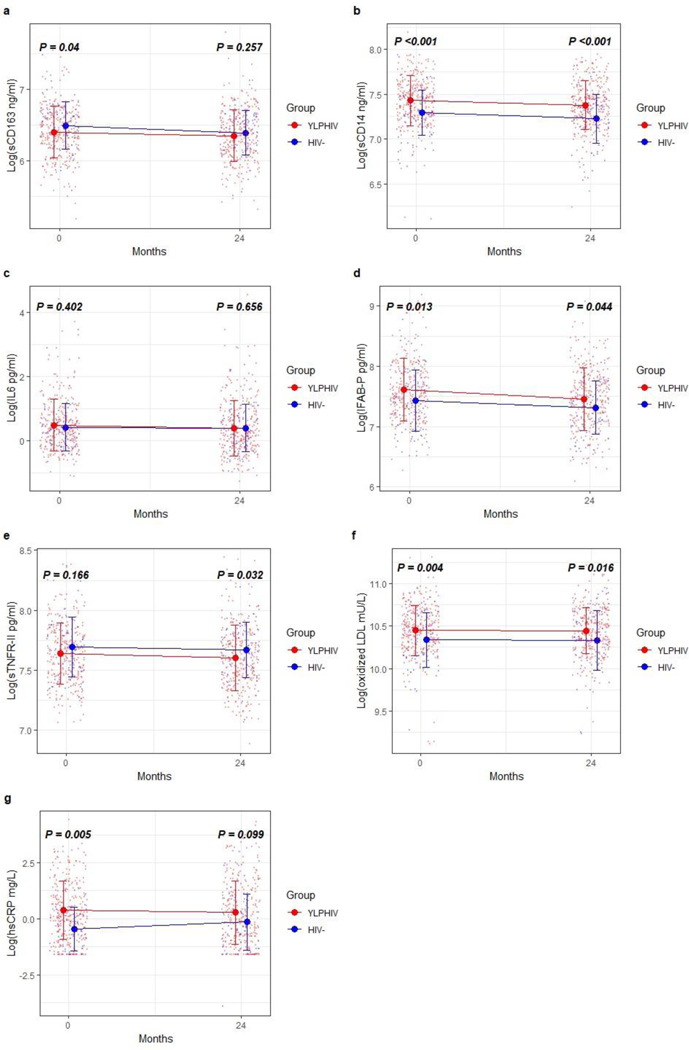
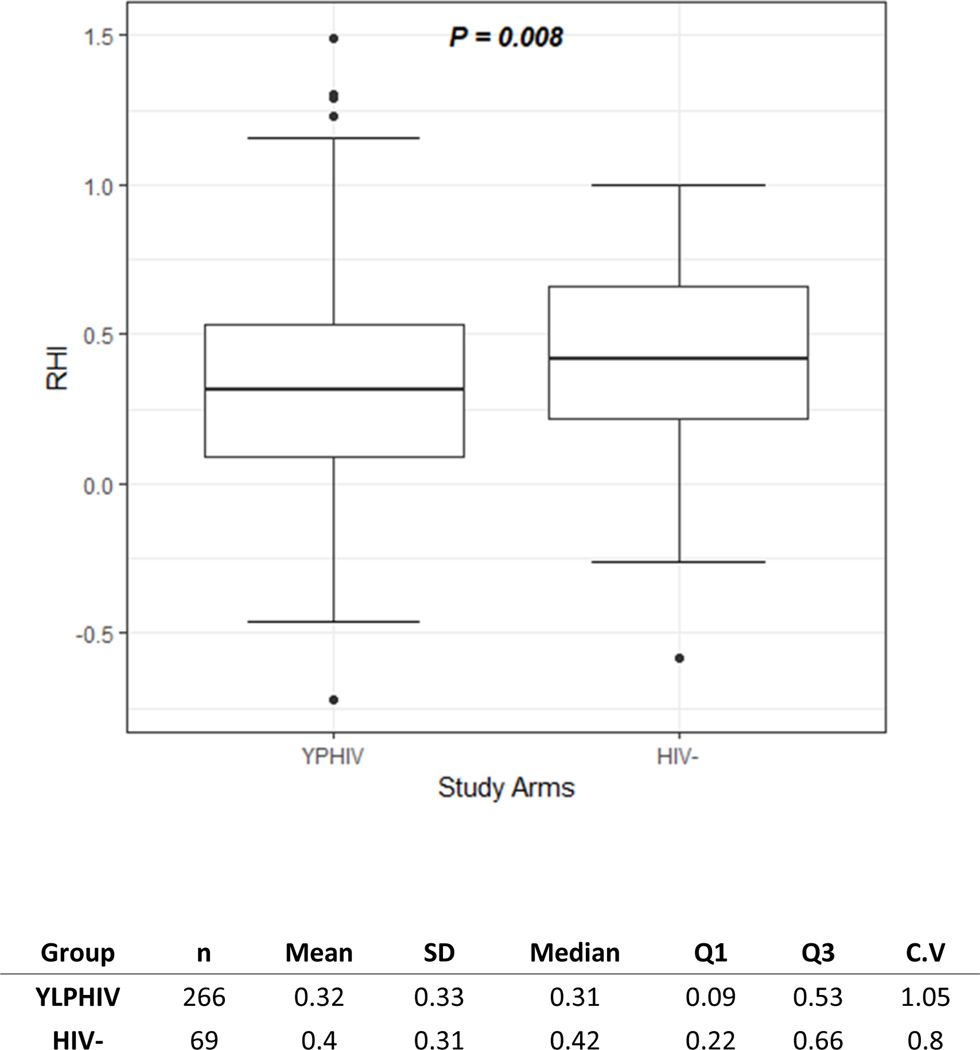
We included 266 YLPHIV and 69 HIV- participants. At baseline, median (Q1, Q3) age was 12 (11, 13) years and 53% were females. YLPHIV had poorer endothelial function compared with HIV- youth (RHI = 1.36 vs. 1.52, P < 0.01). At baseline and 24 months, YLPHIV had higher markers of monocyte activation (soluble CD14), gut barrier dysfunction (intestinal fatty acid binding protein) and oxidized LDL-cholesterol (P ≤ 0.04) compared with HIV- youth. Among YLPHIV, soluble CD14 remained associated with endothelial dysfunction after adjusting for age, sex, Tanner stage, and antiretroviral therapy duration (β: -0.05, P = 0.01).
Despite viral suppression, South African YLPHIV have poor endothelial function and persistent evidence of monocyte activation and gut barrier dysfunction compared with HIV- youth. The long-term clinical significance of gut integrity and monocyte activation needs to be further assessed in YLPHIV.
有证据表明,在感染艾滋病毒的青少年中存在内皮功能障碍(YLPHIV)。然而,关于其机制的数据很少。
本研究纳入了南非开普敦青少年抗逆转录病毒队列中年龄在 9 至 14 岁之间、接受过抗逆转录病毒治疗(ART)超过 6 个月、病毒载量低于 400 拷贝/ml 且在基线和 24 个月时均达到上述标准的 YLPHIV 以及年龄匹配的未感染 HIV(HIV-)青少年。在基线和 24 个月时测量了血清系统炎症、单核细胞活化、肠道完整性和氧化型 LDL-胆固醇的生物标志物。在 24 个月时使用反应性充血指数(RHI)测量内皮功能;RHI 小于 1.35 定义为内皮功能障碍。采用 Spearman 相关系数和分位数回归分析 RHI 与不同生物标志物之间的相关性。
本研究共纳入了 266 名 YLPHIV 和 69 名 HIV- 参与者。在基线时,中位(Q1,Q3)年龄为 12(11,13)岁,53%为女性。与 HIV- 青少年相比,YLPHIV 的内皮功能较差(RHI=1.36 与 1.52,P<0.01)。在基线和 24 个月时,YLPHIV 的单核细胞活化标志物(可溶性 CD14)、肠道屏障功能障碍标志物(肠脂肪酸结合蛋白)和氧化型 LDL-胆固醇(P≤0.04)均高于 HIV- 青少年。在 YLPHIV 中,在校正年龄、性别、Tanner 分期和抗逆转录病毒治疗时间后,可溶性 CD14 与内皮功能障碍仍相关(β:-0.05,P=0.01)。
尽管病毒得到抑制,但与 HIV- 青少年相比,南非 YLPHIV 仍存在内皮功能障碍以及持续存在的单核细胞活化和肠道屏障功能障碍证据。需要进一步评估肠道完整性和单核细胞活化在 YLPHIV 中的长期临床意义。