Department of Cardiology, Sina Hospital, Tehran University of Medical Sciences, Tehran, Iran.
Students' Scientific Research Center (SSRC), Tehran University of Medical Sciences, Tehran, Iran.
Intern Emerg Med. 2020 Nov;15(8):1415-1424. doi: 10.1007/s11739-020-02466-1. Epub 2020 Aug 9.
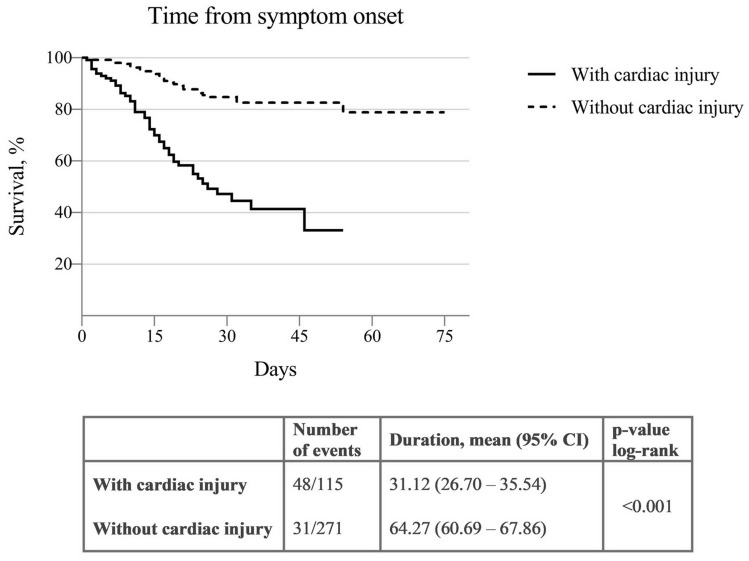
In this study, we aimed to assess the association between development of cardiac injury and short-term mortality as well as poor in-hospital outcomes in hospitalized patients with COVID-19. In this prospective, single-center study, we enrolled hospitalized patients with laboratory-confirmed COVID-19 and highly suspicious patients with compatible chest computed tomography features. Cardiac injury was defined as a rise of serum high sensitivity cardiac Troponin-I level above 99th percentile (men: > 26 ng/mL, women: > 11 ng/mL). A total of 386 hospitalized patients with COVID-19 were included. Cardiac injury was present among 115 (29.8%) of the study population. The development of cardiac injury was significantly associated with a higher in-hospital mortality rate compared to those with normal troponin levels (40.9% vs 11.1%, p value < 0.001). It was shown that patients with cardiac injury had a significantly lower survival rate after a median follow-up of 18 days from symptom onset (p log-rank < 0.001). It was further demonstrated in the multivariable analysis that cardiac injury could possibly increase the risk of short-term mortality in hospitalized patients with COVID-19 (HR = 1.811, p-value = 0.023). Additionally, preexisting cardiovascular disease, malignancy, blood oxygen saturation < 90%, leukocytosis, and lymphopenia at presentation were independently associated with a greater risk of developing cardiac injury. Development of cardiac injury in hospitalized patients with COVID-19 was significantly associated with higher rates of in-hospital mortality and poor in-hospital outcomes. Additionally, it was shown that development of cardiac injury was associated with a lower short-term survival rate compared to patients without myocardial damage and could independently increase the risk of short-term mortality by nearly two-fold.
在这项研究中,我们旨在评估心脏损伤的发展与 COVID-19 住院患者的短期死亡率和住院预后不良之间的关联。在这项前瞻性、单中心研究中,我们纳入了实验室确诊的 COVID-19 住院患者和具有相容胸部计算机断层扫描特征的高度疑似患者。心脏损伤定义为血清高敏肌钙蛋白 I 水平升高至第 99 百分位以上(男性:>26ng/mL,女性:>11ng/mL)。共有 386 例 COVID-19 住院患者被纳入研究。在研究人群中,115 例(29.8%)存在心脏损伤。与肌钙蛋白水平正常的患者相比,心脏损伤的发生与更高的住院死亡率显著相关(40.9%比 11.1%,p 值<0.001)。研究表明,在中位随访 18 天从症状出现开始后,心脏损伤患者的生存率显著降低(p log-rank<0.001)。多变量分析进一步表明,心脏损伤可能增加 COVID-19 住院患者短期死亡率的风险(HR=1.811,p 值=0.023)。此外,存在心血管疾病、恶性肿瘤、血氧饱和度<90%、白细胞增多和淋巴细胞减少在出现时与发生心脏损伤的风险增加独立相关。COVID-19 住院患者心脏损伤的发展与更高的住院死亡率和不良住院预后显著相关。此外,与无心肌损伤的患者相比,心脏损伤的发展与短期生存率降低显著相关,并且可能使短期死亡率独立增加近两倍。