Department of Molecular Physiology and Biophysics, Vanderbilt Genetics Institute, Vanderbilt University, Nashville, TN 37232, USA.
Devision of Genetic Medicine, Vanderbilt Genetics Institute, Vanderbilt University Medical Center, Nashville, TN 37232, USA.
Trends Genet. 2020 Nov;36(11):857-867. doi: 10.1016/j.tig.2020.07.006. Epub 2020 Aug 6.
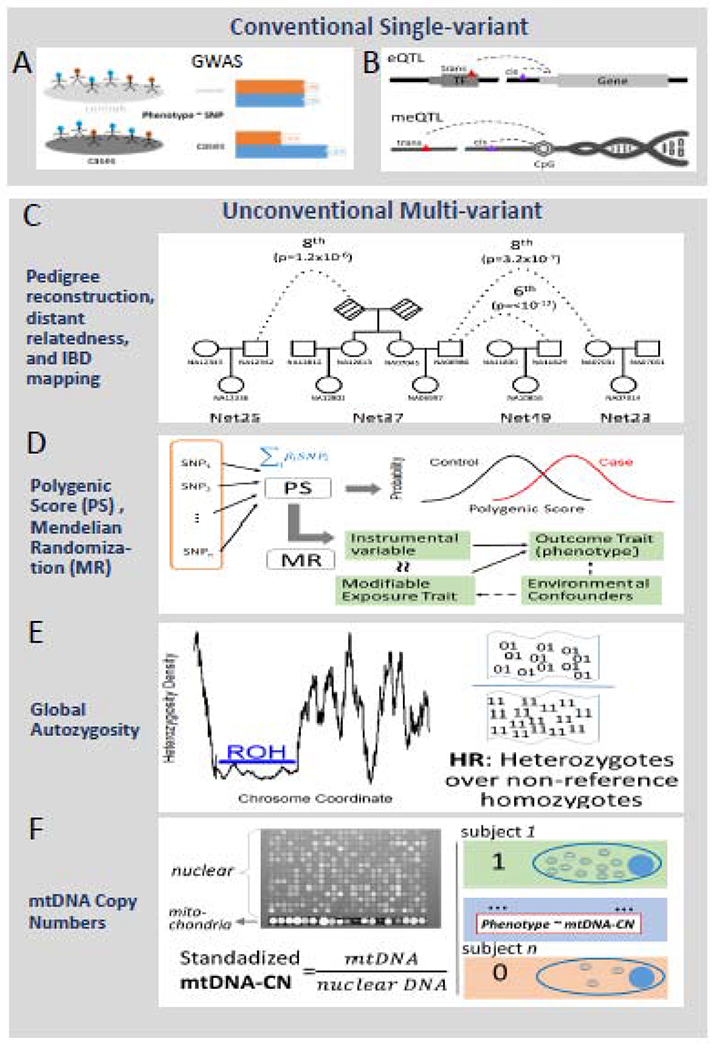
One of the forerunners that pioneered the revolution of high-throughput genomic technologies is the genotyping microarray technology, which can genotype millions of single-nucleotide variants simultaneously. Owing to apparent benefits, such as high speed, low cost, and high throughput, the genotyping array has gained lasting applications in genome-wide association studies (GWAS) and thus accumulated an enormous amount of data. Empowered by continuous manufactural upgrades and analytical innovation, unconventional applications of genotyping array data have emerged to address more diverse genetic problems, holding promise of boosting genetic research into human diseases through the re-mining of the rich accumulated data. Here, we review several unconventional genotyping array analysis techniques that have been built on the idea of large-scale multivariant analysis and provide empirical application examples. These unconventional outcomes of genotyping arrays include polygenic score, runs of homozygosity (ROH)/heterozygosity ratio, distant pedigree computation, and mitochondrial DNA (mtDNA) copy number inference.
其中一个率先开创高通量基因组技术革命的是基因分型微阵列技术,它可以同时对数百万个单核苷酸变体进行基因分型。由于具有明显的优势,如高速、低成本和高通量,基因分型阵列在全基因组关联研究(GWAS)中得到了持久的应用,从而积累了大量的数据。借助不断的制造升级和分析创新,基因分型阵列数据的非常规应用已经出现,以解决更多样化的遗传问题,有望通过对丰富的积累数据的重新挖掘,推动人类疾病的遗传研究。在这里,我们回顾了几种基于大规模多变量分析思想的非常规基因分型阵列分析技术,并提供了经验应用实例。这些基因分型阵列的非常规结果包括多基因评分、纯合性(ROH)/杂合性比、远系谱计算和线粒体 DNA(mtDNA)拷贝数推断。