Koutsoumanis Konstantinos, Allende Ana, Bolton Declan Joseph, Bover-Cid Sara, Chemaly Marianne, Davies Robert, De Cesare Alessandra, Herman Lieve Maria, Hilbert Friederike, Lindqvist Roland, Nauta Maarten, Peixe Luisa, Ru Giuseppe, Simmons Marion, Skandamis Panagiotis, Suffredini Elisabetta, Escámez Pablo Fernández, Ortiz-Peláez Angel, Ashe Seán, Alvarez-Ordóñez Avelino
EFSA J. 2020 Aug 5;18(8):e06226. doi: 10.2903/j.efsa.2020.6226. eCollection 2020 Aug.
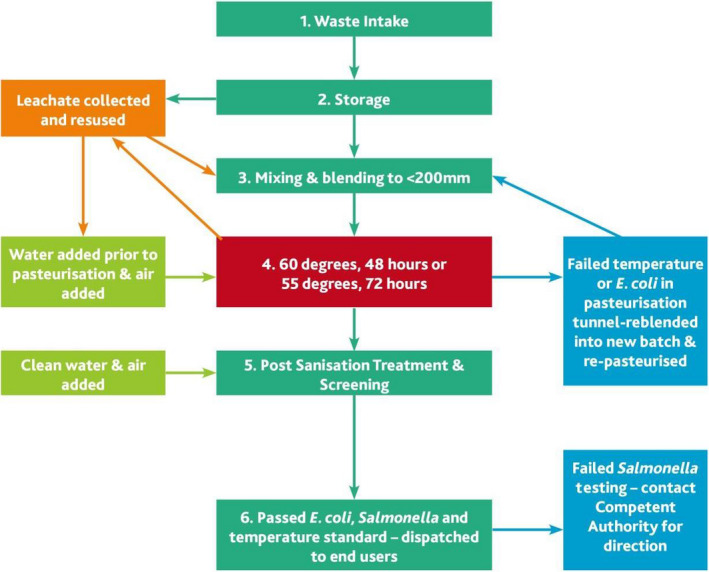
Two alternative methods for the production of compost from certain category 3 animal by-products (catering waste and processed foodstuffs of animal origin) were assessed. The first proposed a minimum temperature of 55°C for 72 h; the second 60°C for 48 h, each with a maximum particle size of 200 mm. The proposed composting processes were assessed by the BIOHAZ Panel for their efficacy to achieve a reduction of 5 log of or Senftenberg (775W, HS negative) and a 3 log reduction of the infectivity titre of thermoresistant viruses, such as parvovirus, in the composted material, as set out in Annex V, Chapter 3, Section 2 of Commission Regulation (EU) No 142/2011. The assessment of the BIOHAZ Panel exclusively focused on the ABP raw materials (catering waste and processed foodstuffs) intended for human consumption. The applicant did not provide any validation experiments with direct measurement of the reduction of viability of endogenous indicators or spiked surrogate bacteria. However, from thermal inactivation parameters reported in the literature, it can be concluded that the proposed composting standards can achieve at least a 5 log reduction of or Senftenberg 775W. The applicant did not consider thermoresistant viruses as a relevant hazard and therefore did not provide any data from direct measurements of the reduction of infectivity of spiked thermoresistant viruses, nor provide data from validation studies undertaken at national level or data from literature supporting the efficacy of the proposed composting standards on thermoresistant viruses. However, thermoresistant viruses should be considered to be a relevant hazard in this context and validation data should have been provided accordingly. The BIOHAZ Panel considers that the evidence provided by the applicant does not demonstrate that the requirements of Annex V, Chapter 3, Section 2 of Commission Regulation (EU) No 142/2011 are achieved.
对两种利用特定3类动物副产品(餐饮垃圾和动物源加工食品)生产堆肥的替代方法进行了评估。第一种方法建议最低温度为55°C,持续72小时;第二种方法是60°C,持续48小时,每种方法的最大颗粒尺寸均为200毫米。生物危害评估小组对提议的堆肥过程进行了评估,以确定其是否能达到欧盟委员会第142/2011号条例附件V第3章第2节规定的,使堆肥材料中的 或森夫滕贝格菌(775W,HS阴性)减少5个对数级,以及使耐热病毒(如细小病毒)的感染性滴度降低3个对数级的效果。生物危害评估小组的评估仅集中于供人类消费的动物副产品原料(餐饮垃圾和加工食品)。申请人未提供任何直接测量内源性指标或加标替代细菌活力降低情况的验证实验。然而,从文献报道的热灭活参数可以得出结论,提议的堆肥标准至少可以使 或森夫滕贝格775W减少5个对数级。申请人未将耐热病毒视为相关危害,因此未提供任何直接测量加标耐热病毒感染性降低情况的数据,也未提供在国家层面进行的验证研究数据或支持提议的堆肥标准对耐热病毒有效性的文献数据。然而,在这种情况下,耐热病毒应被视为相关危害,因此应相应提供验证数据。生物危害评估小组认为,申请人提供的证据未能证明符合欧盟委员会第142/2011号条例附件V第3章第2节的要求。