Showalter Loral, Czerniecki Brian J, Koski Gary K
Department of Biological Sciences, University Esplanade, Kent State University, Kent, Ohio, USA.
Department of Breast Oncology, H. Lee Moffitt Cancer Center and Research Institute, Tampa, FL, USA.
Oncotarget. 2020 Jul 28;11(30):2873-2888. doi: 10.18632/oncotarget.27556.
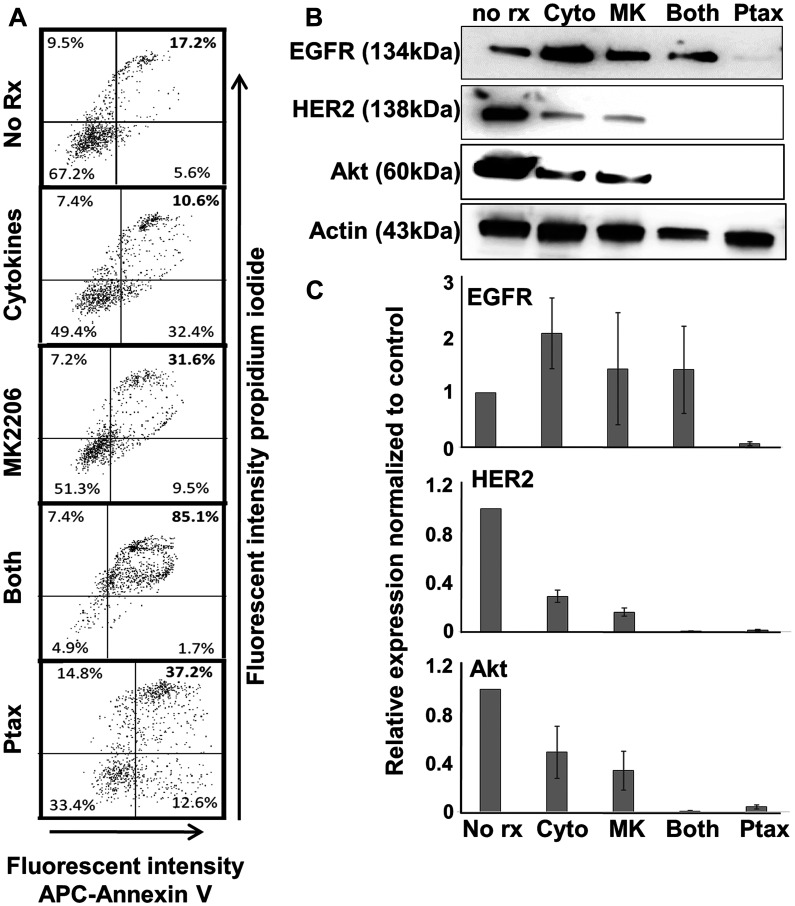
Targeted drug approaches have been a major focus for developing new anticancer therapies. Although many such agents approved in the last 20 years have improved outcomes, almost all have underperformed expectations. The full potential of such agents may yet be obtained through novel combinations. Previously, we showed that anti-estrogen drugs combined with a dendritic cell-based anti-HER-2 vaccine known to induce strong Th1-polarized immunity dramatically improved clinical response rates in patients with HER-2/ER early breast cancer. Here, we show that the small molecule Akt antagonist MK-2206, when combined with the Th1 cytokines IFN-gamma and TNF-alpha, maximize indicators of apoptotic cell death in a panel of phenotypically-diverse human breast cancer lines. These findings were mirrored by other, structurally-unrelated Akt-targeting drugs that work through different mechanisms. Interestingly, we found that MK-2206, as well as the other Akt antagonist drugs, also had a tendency to suppress Th1 cytokine expression in stimulated human and murine lymphocytes, potentially complicating their use in conjunction with active immunotherapy. After verifying that MK-2206 plus IFN-gamma could show similar combined effects against breast cancer lines, even in the absence of TNF-alpha, we tested in a rodent HER-2 breast cancer model either a HER-2-based DC vaccine, or recombinant IFN-gamma with or without MK-2206 administration. We found that for MK-2206, co-administration of recombinant IFN-gamma outperformed co-administration of DC vaccination for slowing tumor growth kinetics. These findings suggest a combined therapy approach for Akt-targeting drugs that incorporates recombinant Interferon-gamma and is potentially translatable to humans.
靶向药物治疗方法一直是开发新型抗癌疗法的主要重点。尽管在过去20年中批准的许多此类药物都改善了治疗效果,但几乎所有药物的表现都未达预期。通过新颖的联合用药可能会充分发挥此类药物的潜力。此前,我们发现抗雌激素药物与一种已知可诱导强烈Th1极化免疫的基于树突状细胞的抗HER-2疫苗联合使用,可显著提高HER-2/ER早期乳腺癌患者的临床缓解率。在此,我们表明,小分子Akt拮抗剂MK-2206与Th1细胞因子IFN-γ和TNF-α联合使用时,能使一组表型各异的人乳腺癌细胞系中的凋亡细胞死亡指标最大化。其他通过不同机制起作用的、结构上不相关的靶向Akt药物也得到了类似的结果。有趣的是,我们发现MK-2206以及其他Akt拮抗剂药物还倾向于抑制受刺激的人和小鼠淋巴细胞中Th1细胞因子的表达,这可能会使它们与主动免疫疗法联合使用时变得复杂。在证实即使没有TNF-α,MK-2206加IFN-γ对乳腺癌细胞系也能显示出类似的联合作用后,我们在一个啮齿动物HER-2乳腺癌模型中测试了基于HER-2的DC疫苗,或重组IFN-γ单独或与MK-2206联合给药的效果。我们发现,对于MK-2206,联合给予重组IFN-γ在减缓肿瘤生长动力学方面优于联合给予DC疫苗。这些发现提示了一种将重组干扰素-γ与靶向Akt的药物联合使用的治疗方法,并且可能适用于人类。