Yan Cenqi, Tang Hua, Ma Ruijie, Zhang Ming, Liu Tao, Lv Jie, Huang Jiaming, Yang YanKang, Xu Tongle, Kan Zhipeng, Yan He, Liu Feng, Lu Shirong, Li Gang
The Hong Kong Polytechnic University ShenZhen Research institute Shenzhen 518057 China.
Department of Electronic and Information Engineering The Hong Kong Polytechnic University Hung Hum Kowloon Hong Kong 999077 China.
Adv Sci (Weinh). 2020 Jun 18;7(15):2000149. doi: 10.1002/advs.202000149. eCollection 2020 Aug.
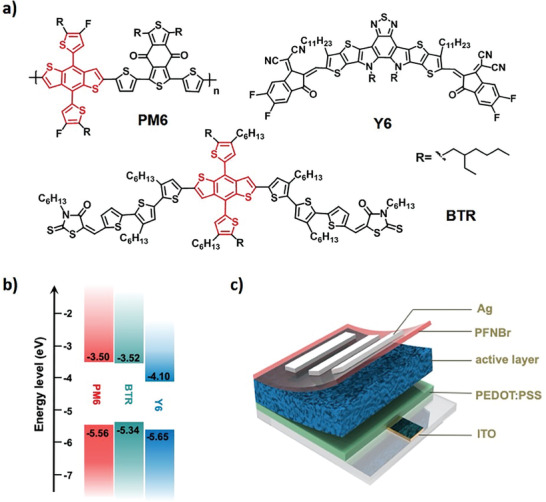
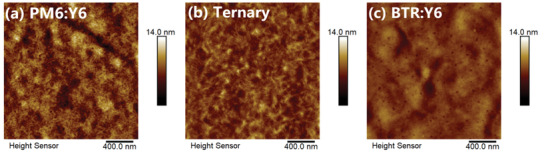
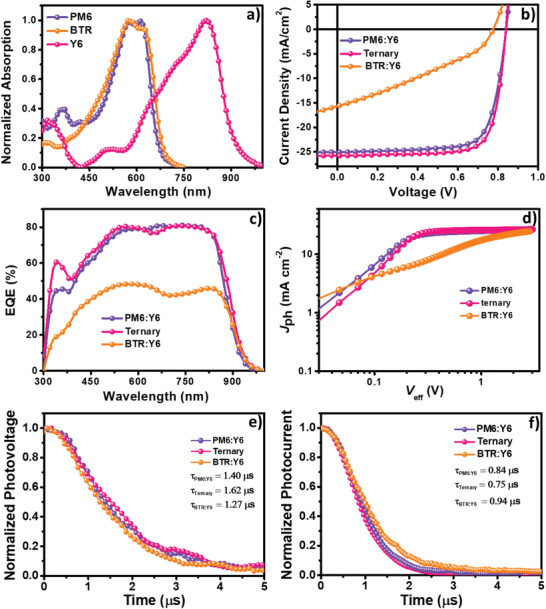
Achieving an ideal morphology is an imperative avenue for enhancing key parameters toward high-performing organic solar cells (OSCs). Among a myriad of morphological-control methods, the strategy of incorporating a third component with structural similarity and crystallinity difference to construct ternary OSCs has emerged as an effective approach to regulate morphology. A nematic liquid-crystalline benzodithiophene terthiophene rhodamine (BTR) molecule, which possesses the same alkylthio-thienyl-substituted benzo moiety but obviously stronger crystallinity compared to classical medium-bandgap polymeric donor PM6, is employed as a third component to construct ternary OSCs based on a PM6:BTR:Y6 system. The doping of BTR (5 wt%) is found to be enough to improve the OSC morphology-significantly enhancing the crystallinity of the photoactive layer while slightly reducing the donor/acceptor phase separation scale simultaneously. Rarely is such a morphology evolution reported. It positively affects the electronic properties of the device-prolongs the carrier lifetime, shortens the photocurrent decay time, facilitates exciton dissociation, charge transport, and collection, and ultimately boosts the power conversion efficiency from 15.7% to 16.6%. This result demonstrates that the successful synergy of liquid-crystalline small-molecule and polymeric donors delicately adjusts the active-layer morphology and refines device performance, which brings vibrancy to the OSC research field.
实现理想的形态是提高高性能有机太阳能电池(OSC)关键参数的必要途径。在众多形态控制方法中,引入具有结构相似性和结晶度差异的第三组分来构建三元OSC的策略已成为调节形态的有效方法。一种向列型液晶苯并二噻吩三联噻吩罗丹明(BTR)分子,它具有相同的烷硫基噻吩基取代苯部分,但与经典的中带隙聚合物供体PM6相比,结晶度明显更强,被用作第三组分来构建基于PM6:BTR:Y6体系的三元OSC。发现5 wt%的BTR掺杂足以改善OSC的形态——显著提高光活性层的结晶度,同时略微减小供体/受体相分离尺度。很少有这样的形态演变报道。这对器件的电子性能产生积极影响——延长载流子寿命,缩短光电流衰减时间,促进激子解离、电荷传输和收集,并最终将功率转换效率从15.7%提高到16.6%。这一结果表明,液晶小分子和聚合物供体的成功协同作用巧妙地调节了活性层形态并优化了器件性能,为OSC研究领域带来了活力。