Sasongko Ananto Tri, Jati Grafika, Fanany Mohamad Ivan, Jatmiko Wisnu
Faculty of Computer Science, Universitas Indonesia, Indonesia.
Data Brief. 2020 Jul 23;32:106061. doi: 10.1016/j.dib.2020.106061. eCollection 2020 Oct.
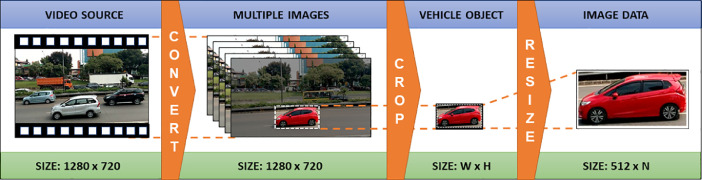
Vehicle classifications with different methods have been applied for many purposes. The data provided in this article is useful for classifying vehicle purposes following the Indonesia toll road tariffs. Indonesia toll road tariff regulations divide vehicles into five groups as follows, group-1, group-2, group-3, group-4, and group-5, respectively. Group-1 is a class of non-truck vehicles, while group-2 to group-5 are classes of truck vehicles. The non-truck class consists of the sedan, pick-up, minibus, bus, MPV, and SUV. Truck classes are grouped based on the number of truck's axles. Group-2 is a class of trucks with two axles, a group-3 truck with three axles, a group-4 truck with four axles, and a group-5 truck with five axles or more. The dataset is categorized into five classes accordingly, which are group-1, group-2, group-3, group-4, and group-5 images. The data made available in this article observes images of vehicles obtained using a smartphone camera. The vehicle images dataset incorporated with deep learning, transfer learning, fine-tuning, and the Residual Neural Network (ResNet) model can yield exceptional results in the classification of vehicles by the number of axles.
为了多种目的,已采用不同方法进行车辆分类。本文提供的数据对于按照印度尼西亚收费公路费率对车辆用途进行分类很有用。印度尼西亚收费公路费率规定将车辆分为以下五组,即第一组、第二组、第三组、第四组和第五组。第一组是非卡车类车辆,而第二组至第五组是卡车类车辆。非卡车类包括轿车、皮卡、小型巴士、巴士、多用途汽车和运动型多用途汽车。卡车类是根据卡车的轴数进行分组的。第二组是双轴卡车类,第三组是三轴卡车,第四组是四轴卡车,第五组是五轴及以上的卡车。数据集相应地分为五类,即第一组、第二组、第三组、第四组和第五组图像。本文提供的数据观察了使用智能手机摄像头获取的车辆图像。结合深度学习、迁移学习、微调以及残差神经网络(ResNet)模型的车辆图像数据集在按轴数对车辆进行分类方面可以产生出色的结果。