Department of Biomedical Sciences, Humanitas University, Pieve Emanuele, Milan, Italy; Department of Gastroenterology, Inserm Nutrition - Genetics and exposure to environmental risks U1256, University Hospital of Nancy, University of Lorraine, Vandoeuvre-lès-Nancy, France.
Department of Biomedical Sciences, Humanitas University, Pieve Emanuele, Milan, Italy; Inflammatory Bowel Disease Center, Department of Gastroenterology, Humanitas Clinical and Research Center, Istituto di Ricovero e Cura a Carattere Scientifico, Rozzano Milan, Italy.
Clin Gastroenterol Hepatol. 2020 Nov;18(12):2689-2700. doi: 10.1016/j.cgh.2020.08.003. Epub 2020 Aug 7.
BACKGROUND & AIMS: Data on the clinical characteristics of patients with inflammatory bowel diseases (IBDs) with coronavirus disease 2019 (COVID-19) are scarce. The aim of our systematic review was to investigate symptoms and diagnostic-therapeutic management of IBD patients with COVID-19.
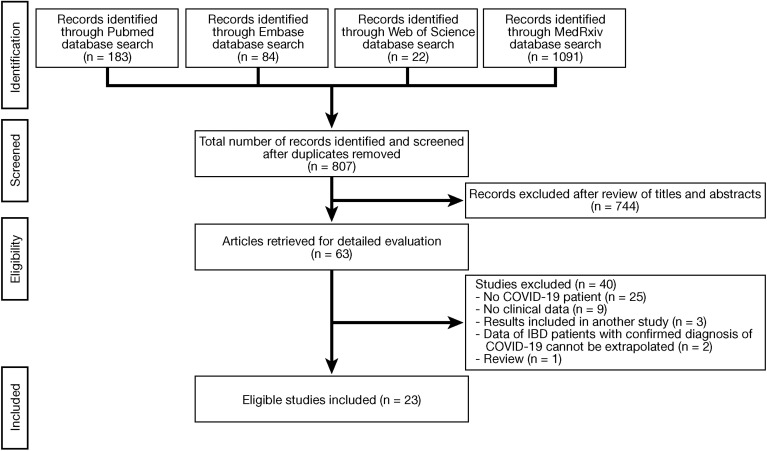
We searched PubMed, Embase, Web of Science, and MedRxiv up to July 29, 2020, to identify all studies reporting clinical information on adult and pediatric IBD patients with confirmed COVID-19.
Twenty-three studies met our inclusion criteria, including 243,760 IBD patients. COVID-19 was diagnosed in 1028 patients (509 with Crohn's disease [49.5%], 428 with ulcerative colitis [41.6%], 49 with indeterminate colitis [4.8%], and 42 with missing data [4.1%]), accounting for a cumulative prevalence of 0.4%. Viral infection occurred more frequently in males than in females (56.5% vs 39.7%), and the mean age ranged from 14 to 85 years. The most common symptoms were fever (48.3%), cough (46.5%), and diarrhea (20.5%), and a COVID-19 diagnosis was achieved mainly through polymerase chain reaction analysis of nasopharyngeal swabs (94.4%) and chest computed tomography scans (38.9%). Hydroxychloroquine (23.9%), lopinavir/ritonavir (8.2%), steroids (3.2%), and antibiotics (3.1%) were the most used drugs. Overall, approximately a third of patients were hospitalized (30.6%), and 11.4% of them required admission to the intensive care unit. In total, 29 COVID-19-related deaths were reported (3.8%), and increasing age and the presence of comorbidities were recognized as risk factors for COVID-19 and negative outcomes.
Diarrhea occurs more frequently in IBD patients with COVID-19 than in the non-IBD population. Further studies are needed to define the optimal diagnostic-therapeutic approach in IBD patients with COVID-19.
关于患有 2019 冠状病毒病(COVID-19)的炎症性肠病(IBD)患者的临床特征的数据很少。我们系统评价的目的是调查 IBD 合并 COVID-19 患者的症状和诊断-治疗管理。
我们检索了 PubMed、Embase、Web of Science 和 MedRxiv,截至 2020 年 7 月 29 日,以确定所有报告成人和儿科 IBD 患者确诊 COVID-19 临床信息的研究。
23 项研究符合纳入标准,共纳入 243760 例 IBD 患者。确诊 COVID-19 的患者共 1028 例(509 例克罗恩病[49.5%],428 例溃疡性结肠炎[41.6%],49 例不确定结肠炎[4.8%],42 例数据缺失[4.1%]),累积患病率为 0.4%。男性病毒感染发生率高于女性(56.5% vs 39.7%),平均年龄为 14 至 85 岁。最常见的症状是发热(48.3%)、咳嗽(46.5%)和腹泻(20.5%),主要通过鼻咽拭子聚合酶链反应分析(94.4%)和胸部计算机断层扫描(38.9%)诊断 COVID-19。羟氯喹(23.9%)、洛匹那韦/利托那韦(8.2%)、类固醇(3.2%)和抗生素(3.1%)是最常用的药物。总体而言,约三分之一的患者住院(30.6%),11.4%的患者需要入住重症监护病房。共报告 COVID-19 相关死亡 29 例(3.8%),年龄增长和合并症被认为是 COVID-19 和不良结局的危险因素。
IBD 合并 COVID-19 患者腹泻的发生率高于非 IBD 人群。需要进一步研究以确定 IBD 合并 COVID-19 患者的最佳诊断-治疗方法。