Zhang Yuzhu, Dian Liping, Wei Xiaoqing, Huang Junyan, Sun Yang, Song Xue, Yang Chunmin, Kang Mengling, Ou Aihua, Chen Qianjun, Xu Rui
Breast Department, Guangdong Provincial Hospital of Chinese Medicine, Guangzhou, China.
The Second Affiliated Hospital of Guangzhou University of Chinese Medicine, Guangzhou, China.
Breast Cancer Res Treat. 2020 Nov;184(2):567-583. doi: 10.1007/s10549-020-05854-5. Epub 2020 Aug 10.
As more young patients with breast cancer undergo treatments and obtain good prognoses, the issue of postoperative reproduction in breast cancer patients has attracted more attention.
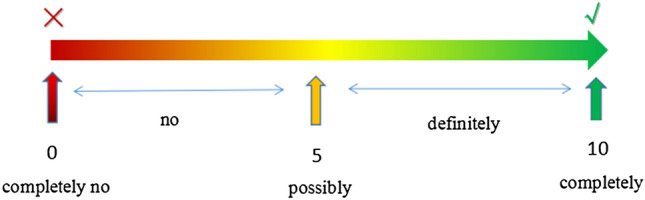
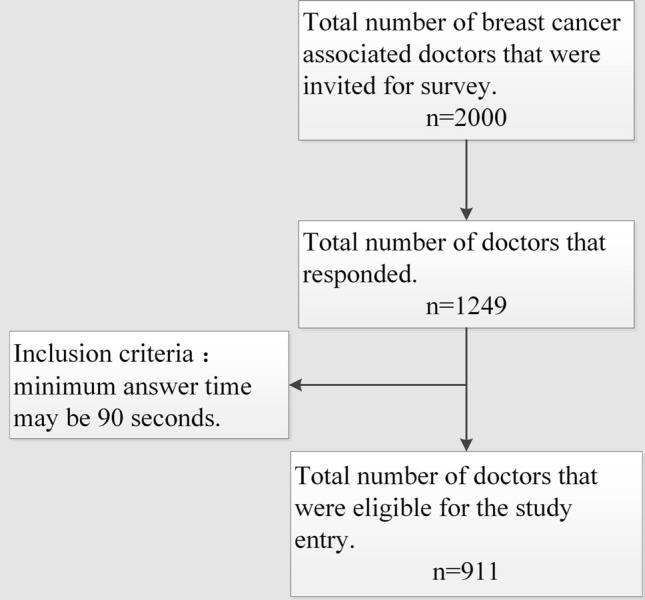
We conducted a prospective, cross-sectional survey of 2000 breast cancer-associated physicians using a 24-items questionnaire adapted from prior guides. Then we used a multivariable linear regression model to confirm independent associations between the propensity of physicians' attitudes toward reproduction and physicians' specific demographic characteristics.
A total of 911/1249 (72.93%) eligible physicians completed the questionnaire. Regarding the most concerning topic of whether breast cancer patients could conceive, 65 (7.1%) physicians having low and 457 (50.2%) physicians having high propensity for recommending reproduction. For ductal carcinoma in situ (DCIS) after surgery and radiotherapy, 599 (65.8%) physicians did not agree with the recommendation to conceive. 231 (25.4%) highly agree with the recommendation of reproduction for 2 years after surgery in invasive breast cancer patients with lymph nodes-negative. Only 140 (15.4%) physicians did not agree with the recommendation for 5 years after surgery in invasive breast cancer patients with lymph nodes-positive. A total of 861 (94.5%) physicians stated that they advised the patients to consult experts from other disciplines, such as gynecology, oncology, genetic and psychology disciplines. In multivariable analysis, more positive attitude toward reproduction was significantly associated with male, more than 11 times of participating in academic forum on breast cancer, 1-2 times of consulting about reproduction problems after breast cancer surgery per outpatient service and more than 11 min spending on solving the problem about reproduction in early breast cancer.
This study showed that attitudes towards reproduction of young breast cancer patients from physicians in China. Physicians had a high propensity for recommending reproduction. Compared with the two reproduction guidelines recommendation when to reproduce in different circumstances for breast cancer patients, physicians from China remained a relatively conservative attitude. Most physicians advised the patients to consult experts from other disciplines, such as gynecology, oncology, genetic and psychology disciplines.
随着越来越多的年轻乳腺癌患者接受治疗并获得良好预后,乳腺癌患者术后生育问题受到更多关注。
我们使用一份改编自先前指南的包含24个条目的问卷,对2000名乳腺癌相关医生进行了一项前瞻性横断面调查。然后我们使用多变量线性回归模型来确定医生对生育态度的倾向与医生特定人口统计学特征之间的独立关联。
共有911/1249(72.93%)名符合条件的医生完成了问卷。关于乳腺癌患者能否怀孕这一最受关注的话题,65名(7.1%)医生对推荐生育的倾向较低,457名(50.2%)医生对推荐生育的倾向较高。对于术后放疗后的导管原位癌(DCIS),599名(65.8%)医生不同意怀孕的建议。231名(25.4%)医生高度同意对淋巴结阴性的浸润性乳腺癌患者术后2年进行生育推荐。只有140名(15.4%)医生不同意对淋巴结阳性的浸润性乳腺癌患者术后5年进行生育推荐。共有861名(94.5%)医生表示他们建议患者咨询其他学科的专家,如妇科、肿瘤学、遗传学和心理学学科的专家。在多变量分析中,对生育更积极的态度与男性、参加11次以上乳腺癌学术论坛、每次门诊服务1 - 2次咨询乳腺癌手术后的生育问题以及花费超过11分钟解决早期乳腺癌生育问题显著相关。
本研究显示了中国医生对年轻乳腺癌患者生育的态度。医生对推荐生育有较高的倾向。与针对乳腺癌患者在不同情况下何时生育的两个生育指南建议相比,中国医生的态度相对保守。大多数医生建议患者咨询其他学科的专家,如妇科、肿瘤学、遗传学和心理学学科的专家。