Department of Fundamental Microbiology, Institute of Biotechnology, University of Lausanne, Switzerland.
Selexis SA, Geneva, Switzerland.
Biotechnol Bioeng. 2020 Dec;117(12):3628-3638. doi: 10.1002/bit.27534. Epub 2020 Aug 24.
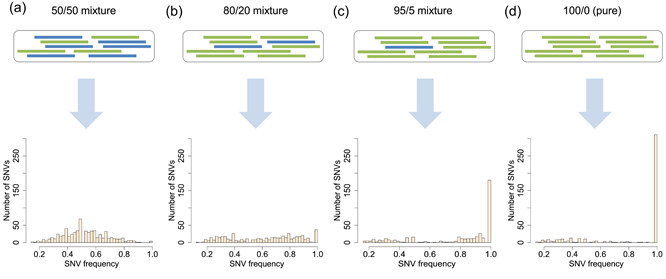
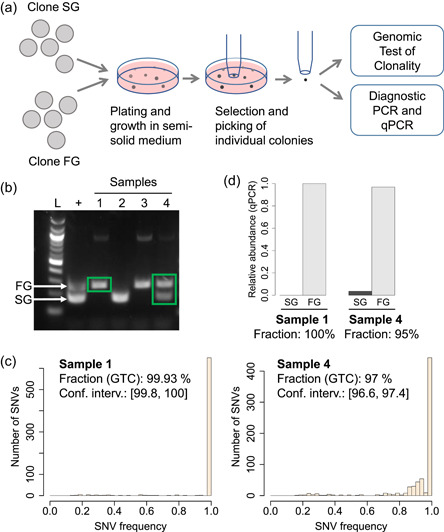
A clonally derived (or "monoclonal") cell line is a cell population derived from a single progenitor cell. Clonally derived cell lines are required for many biotechnological applications. For instance, recombinant mammalian cells used to produce therapeutic proteins are expected by regulatory authorities to be clonally derived. Assurance of clonal derivation (or "clonality") is usually obtained from the characterization of the procedure used for cell cloning, for instance by assessing the success rate of single-cell sorting but not by assessing the cell line itself. We have developed a method to assess clonal derivation directly from the genetic makeup of cells. The genomic test of clonality is based on whole-genome sequencing and statistical analysis of single nucleotide variants. This approach quantifies the clonal fractions present in nonclonal samples and it provides a measure of the probability that a cell line is derived from a single cell. Upon experimental validation of the test, we show that it is highly accurate and that it can robustly detect minor clonal fractions of as little as 1% of the cell population. Moreover, we find that it is applicable to various cell line development protocols. This approach can simplify development protocols and shorten timelines while ensuring clonal derivation with high confidence.
一个克隆衍生(或“单克隆”)的细胞系是由一个单一的祖细胞衍生而来的细胞群体。克隆衍生的细胞系是许多生物技术应用所必需的。例如,用于生产治疗性蛋白质的重组哺乳动物细胞,监管机构期望其为克隆衍生。克隆衍生(或“克隆性”)的保证通常是通过对细胞克隆所用方法的特性进行评估来获得的,例如通过评估单细胞分选的成功率,但不通过评估细胞系本身来评估。我们已经开发了一种从细胞的遗传构成直接评估克隆衍生的方法。克隆性的基因组测试基于全基因组测序和单核苷酸变异的统计分析。这种方法量化了非克隆样品中存在的克隆分数,并提供了一种衡量细胞系是否源自单个细胞的概率的方法。在对该测试进行实验验证后,我们表明它具有高度的准确性,并且可以稳健地检测到少至 1%的细胞群体的微小克隆分数。此外,我们发现它适用于各种细胞系开发方案。这种方法可以简化开发方案并缩短时间线,同时确保高置信度的克隆衍生。