• 文献检索
  • 文档翻译
  • 深度研究
  • 学术资讯
  • Suppr Zotero 插件Zotero 插件
  • 邀请有礼
  • 套餐&价格
  • 历史记录
应用&插件
Suppr Zotero 插件Zotero 插件浏览器插件Mac 客户端Windows 客户端微信小程序
定价
高级版会员购买积分包购买API积分包
服务
文献检索文档翻译深度研究API 文档MCP 服务
关于我们
关于 Suppr公司介绍联系我们用户协议隐私条款
关注我们

Suppr 超能文献

核心技术专利:CN118964589B侵权必究
粤ICP备2023148730 号-1Suppr @ 2026

文献检索

告别复杂PubMed语法,用中文像聊天一样搜索,搜遍4000万医学文献。AI智能推荐,让科研检索更轻松。

立即免费搜索

文件翻译

保留排版,准确专业,支持PDF/Word/PPT等文件格式,支持 12+语言互译。

免费翻译文档

深度研究

AI帮你快速写综述,25分钟生成高质量综述,智能提取关键信息,辅助科研写作。

立即免费体验

由初级保健团队识别和治疗阻塞性睡眠呼吸暂停,其中亚组重点关注慢性疼痛管理。

Identification and treatment of obstructive sleep apnea by a primary care team with a subset focus on chronic pain management.

机构信息

Internal Medicine, Intermountain Healthcare, Sandy, Utah, United States of America.

Intermountain Healthcare, Sandy, Utah, United States of America.

出版信息

PLoS One. 2020 Aug 13;15(8):e0237359. doi: 10.1371/journal.pone.0237359. eCollection 2020.

DOI:10.1371/journal.pone.0237359
PMID:32790789
原文链接:https://pmc.ncbi.nlm.nih.gov/articles/PMC7425939/
Abstract

BACKGROUND

Patients diagnosed with obstructive sleep apnea (OSA), who also consume prescription opioids, have a greater likelihood of morbidity and mortality. This study evaluated whether a primary care team, focused on chronic pain care management, could use a validated questionnaire (STOP-Bang) and motivational follow-up, to increase identification and treatment of OSA.

METHODS

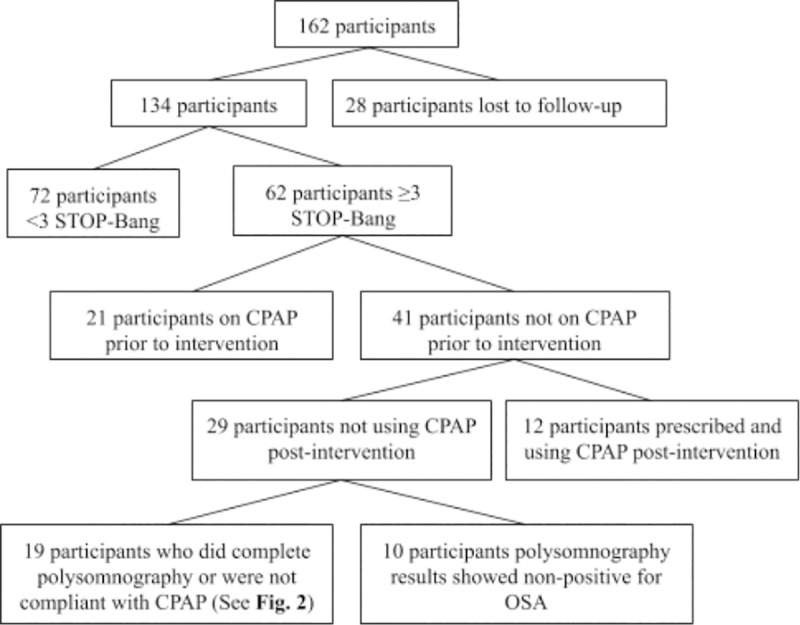
This study was a retrospective, dual arm, pre/post controlled study. Participants of this study included the complete chronic pain management sub group treated by this primary care team. Participants were ≥ 18 years old and prescribed daily opioids for treatment of chronic pain. All participants had a multifaceted, individualized, educational meeting that included completing a STOP-Bang questionnaire. Participants who received a score ≥ three were advised to follow up with their primary care physician. Participants were seen quarterly throughout the study.

RESULTS

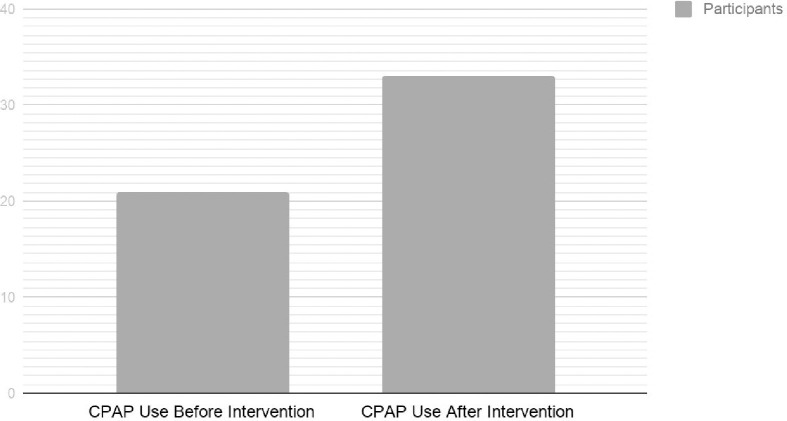
The primary outcome of this study was that 65% of participants with likely OSA were using CPAP for a minimum of 12 months (range of 12-25 months, 18-month average) post-intervention vs. 37% CPAP-use in the control group (12 months of observation), both groups were chronic opioid users with OSA. This was a 28% relative improvement (p = 0.0034). A secondary outcome was that 8.9% of non-prior CPAP users obtained CPAP post- intervention; a 56.7% pre-post improvement (p = 0.0064, x2 = 10.08 with 1 degree of freedom). Also, participants who were likely to have OSA (STOP-Bang score ≥ 3 or had a positive polysomnography (AHI >5 with comorbidities)) compared to those unlikely to have OSA (STOP-Bang score <3 or had a negative polysomnography (AHI <5)) in this study were more likely to be male, have a higher BMI, have hypertension, have cardiovascular disease and/or have diabetes (all types).

CONCLUSION

Team based care management for participants taking prescription opioids, where STOP-Bang questionnaires were completed, were associated with an increase in the identification and treatment of OSA.

摘要

背景

患有阻塞性睡眠呼吸暂停(OSA)并服用处方类阿片类药物的患者,其发病率和死亡率更高。本研究评估了专注于慢性疼痛管理的初级保健团队是否可以使用经过验证的问卷(STOP-Bang)和动机随访来增加 OSA 的识别和治疗。

方法

本研究为回顾性、双臂、前后对照研究。本研究的参与者包括该初级保健团队治疗的完整慢性疼痛管理亚组。参与者年龄≥18 岁,每日服用阿片类药物治疗慢性疼痛。所有参与者都参加了一次多方面、个性化的教育会议,包括填写 STOP-Bang 问卷。评分≥3 分的参与者被建议与初级保健医生跟进。研究期间,参与者每季度接受一次随访。

结果

本研究的主要结果是,65%的可能患有 OSA 的参与者在干预后至少使用 CPAP 治疗 12 个月(范围为 12-25 个月,平均 18 个月),而对照组中仅 37%的参与者使用 CPAP(12 个月的观察期),两组均为慢性阿片类药物使用者合并 OSA。这是 28%的相对改善(p = 0.0034)。次要结果是,8.9%的非 CPAP 使用者在干预后获得 CPAP;使用 CPAP 的比例从 56.7%提高(p = 0.0064,x2 = 10.08,自由度为 1)。此外,与不太可能患有 OSA(STOP-Bang 评分<3 或睡眠多导图检查结果为阴性(AHI<5))的参与者相比,患有 OSA(STOP-Bang 评分≥3 或睡眠多导图检查结果阳性(AHI>5 且合并症)的参与者更有可能为男性、体重指数更高、患有高血压、心血管疾病和/或糖尿病(所有类型)。

结论

接受处方类阿片类药物治疗的患者接受团队为基础的护理管理,其中包括完成 STOP-Bang 问卷,与 OSA 的识别和治疗增加有关。
https://cdn.ncbi.nlm.nih.gov/pmc/blobs/1ede/7425939/b284136d790a/pone.0237359.g003.jpg
https://cdn.ncbi.nlm.nih.gov/pmc/blobs/1ede/7425939/ecd7c37a82bc/pone.0237359.g001.jpg
https://cdn.ncbi.nlm.nih.gov/pmc/blobs/1ede/7425939/6487e30305f8/pone.0237359.g002.jpg
https://cdn.ncbi.nlm.nih.gov/pmc/blobs/1ede/7425939/b284136d790a/pone.0237359.g003.jpg
https://cdn.ncbi.nlm.nih.gov/pmc/blobs/1ede/7425939/ecd7c37a82bc/pone.0237359.g001.jpg
https://cdn.ncbi.nlm.nih.gov/pmc/blobs/1ede/7425939/6487e30305f8/pone.0237359.g002.jpg
https://cdn.ncbi.nlm.nih.gov/pmc/blobs/1ede/7425939/b284136d790a/pone.0237359.g003.jpg

相似文献

1
Identification and treatment of obstructive sleep apnea by a primary care team with a subset focus on chronic pain management.由初级保健团队识别和治疗阻塞性睡眠呼吸暂停,其中亚组重点关注慢性疼痛管理。
PLoS One. 2020 Aug 13;15(8):e0237359. doi: 10.1371/journal.pone.0237359. eCollection 2020.
2
Impact of Opioid Dose and Obstructive Sleep Apnea in Chronic Opioid Patients Using STOP-Bang Questionnaire.使用 STOP-Bang 问卷评估慢性阿片类药物使用者中阿片类药物剂量和阻塞性睡眠呼吸暂停的影响。
Pain Physician. 2022 Nov;25(8):E1263-E1267.
3
Implementing protocol for obstructive sleep apnea screening in the primary care setting.在初级保健环境中实施阻塞性睡眠呼吸暂停筛查方案。
Appl Nurs Res. 2019 Apr;46:67-71. doi: 10.1016/j.apnr.2019.02.005. Epub 2019 Feb 22.
4
STOP-Bang Questionnaire: A Practical Approach to Screen for Obstructive Sleep Apnea.STOP-Bang问卷:一种筛查阻塞性睡眠呼吸暂停的实用方法。
Chest. 2016 Mar;149(3):631-8. doi: 10.1378/chest.15-0903. Epub 2016 Jan 12.
5
CPAP adherence in patients with newly diagnosed obstructive sleep apnea prior to elective surgery.择期手术前新诊断为阻塞性睡眠呼吸暂停患者的持续气道正压通气(CPAP)依从性。
J Clin Sleep Med. 2012 Oct 15;8(5):501-6. doi: 10.5664/jcsm.2140.
6
Pain Intensity and Opioid Utilization in Response to CPAP Therapy in Veterans with Obstructive Sleep Apnea on Chronic Opioid Treatment.慢性阿片类药物治疗的阻塞性睡眠呼吸暂停退伍军人在接受持续气道正压通气(CPAP)治疗时的疼痛强度和阿片类药物使用情况。
J Clin Sleep Med. 2016 Aug 15;12(8):1105-11. doi: 10.5664/jcsm.6046.
7
The STOP-BANG questionnaire shows an insufficient specificity for detecting obstructive sleep apnea in patients with atrial fibrillation.STOP-BANG 问卷在检测房颤患者阻塞性睡眠呼吸暂停方面特异性不足。
J Sleep Res. 2018 Dec;27(6):e12702. doi: 10.1111/jsr.12702. Epub 2018 Apr 22.
8
Evaluation of the Arabic version of STOP-Bang questionnaire as a screening tool for obstructive sleep apnea.评估阿拉伯语版STOP-Bang问卷作为阻塞性睡眠呼吸暂停筛查工具的效果。
Sleep Breath. 2015 Dec;19(4):1235-40. doi: 10.1007/s11325-015-1150-x. Epub 2015 Mar 11.
9
STOP-Bang questionnaire: the validation of a Portuguese version as a screening tool for obstructive sleep apnea (OSA) in primary care.STOP-Bang 问卷:作为初级保健中阻塞性睡眠呼吸暂停(OSA)筛查工具的葡萄牙版本的验证。
Sleep Breath. 2018 Sep;22(3):757-765. doi: 10.1007/s11325-017-1608-0. Epub 2017 Dec 29.
10
Can STOP-Bang and Pulse Oximetry Detect and Exclude Obstructive Sleep Apnea?STOP-Bang 量表和脉搏血氧饱和度仪能否检测和排除阻塞性睡眠呼吸暂停?
Anesth Analg. 2018 Sep;127(3):736-743. doi: 10.1213/ANE.0000000000003607.

引用本文的文献

1
Improving CPAP Adherence in Adults With Obstructive Sleep Apnea Syndrome: A Scoping Review of Motivational Interventions.改善阻塞性睡眠呼吸暂停综合征成人患者的持续气道正压通气依从性:动机干预的范围综述
Front Psychol. 2021 Aug 12;12:705364. doi: 10.3389/fpsyg.2021.705364. eCollection 2021.

本文引用的文献

1
Opioids for Acute Pain Management in Patients With Obstructive Sleep Apnea: A Systematic Review.阿片类药物治疗阻塞性睡眠呼吸暂停患者急性疼痛的管理:系统评价。
Anesth Analg. 2018 Oct;127(4):988-1001. doi: 10.1213/ANE.0000000000003549.
2
Primary Care of Patients With Chronic Pain.慢性疼痛患者的初级护理。
JAMA. 2017 Jun 20;317(23):2367-2368. doi: 10.1001/jama.2017.5787.
3
Pain Intensity and Opioid Utilization in Response to CPAP Therapy in Veterans with Obstructive Sleep Apnea on Chronic Opioid Treatment.慢性阿片类药物治疗的阻塞性睡眠呼吸暂停退伍军人在接受持续气道正压通气(CPAP)治疗时的疼痛强度和阿片类药物使用情况。
J Clin Sleep Med. 2016 Aug 15;12(8):1105-11. doi: 10.5664/jcsm.6046.
4
Obstructive sleep apnea: Who should be tested, and how?阻塞性睡眠呼吸暂停:谁应该接受检测,以及如何检测?
Cleve Clin J Med. 2016 Jan;83(1):25-7. doi: 10.3949/ccjm.83a.14074.
5
Assessing risk for drug overdose in a national cohort: role for both daily and total opioid dose?评估全国队列中药物过量的风险:每日阿片类药物剂量和总阿片类药物剂量的作用?
J Pain. 2015 Apr;16(4):318-25. doi: 10.1016/j.jpain.2014.11.007. Epub 2014 Dec 5.
6
Effect of opioids on sleep and breathing in chronic pain patients.阿片类药物对慢性疼痛患者睡眠和呼吸的影响。
J Clin Sleep Med. 2014 Aug 15;10(8):853-4. doi: 10.5664/jcsm.3952.
7
Treatment outcomes and compliance according to obesity in patients with obstructive sleep apnea.根据阻塞性睡眠呼吸暂停患者的肥胖情况评估治疗效果和顺应性。
Eur Arch Otorhinolaryngol. 2013 Nov;270(11):2885-90. doi: 10.1007/s00405-013-2397-0. Epub 2013 Feb 28.
8
The STOP-Bang equivalent model and prediction of severity of obstructive sleep apnea: relation to polysomnographic measurements of the apnea/hypopnea index.STOP-Bang 等效模型与阻塞性睡眠呼吸暂停严重程度的预测:与睡眠呼吸暂停低通气指数的多导睡眠图测量的关系。
J Clin Sleep Med. 2011 Oct 15;7(5):459-65B. doi: 10.5664/JCSM.1306.
9
Obstructive sleep apnea syndrome and postoperative complications: clinical use of the STOP-BANG questionnaire.阻塞性睡眠呼吸暂停综合征与术后并发症:STOP-BANG问卷的临床应用
Arch Otolaryngol Head Neck Surg. 2010 Oct;136(10):1020-4. doi: 10.1001/archoto.2010.1020.
10
Gender differences in obstructive sleep apnea and treatment response to continuous positive airway pressure.阻塞性睡眠呼吸暂停的性别差异及持续气道正压通气治疗反应。
J Clin Sleep Med. 2009 Dec 15;5(6):512-8.