Ebrahimi Khonacha Shima, Janahmadi Mahyar, Motamedi Fereshteh
Neuroscience Research Center, School of Medicine, Shahid Beheshti University of Medical Sciences, Tehran, Iran.
Department of Physiology, School of Medicine, Shahid Beheshti University of Medical Sciences, Tehran, Iran.
Iran J Pharm Res. 2019 Fall;18(Suppl1):169-181. doi: 10.22037/ijpr.2019.112199.13599.
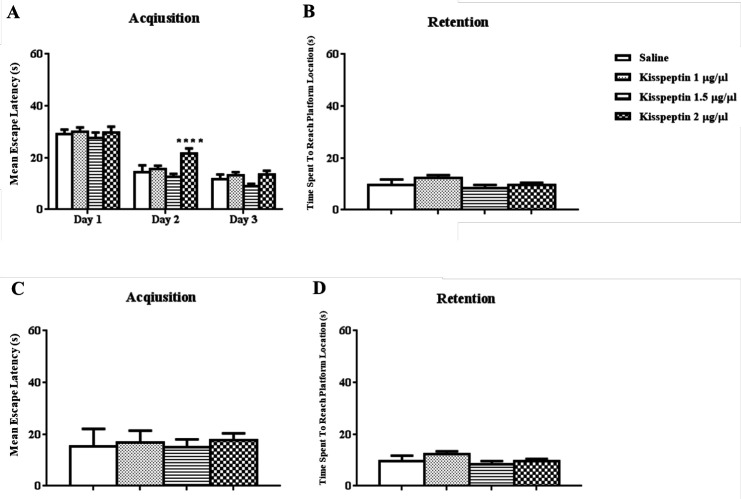
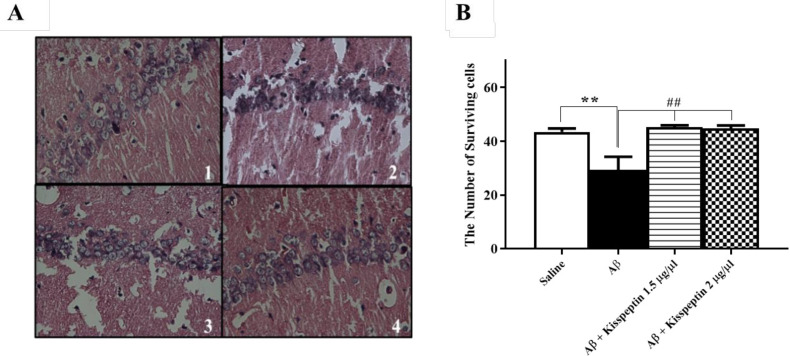
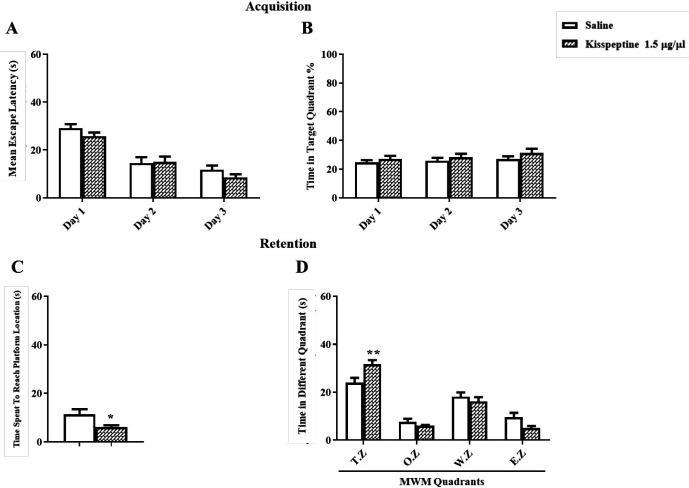
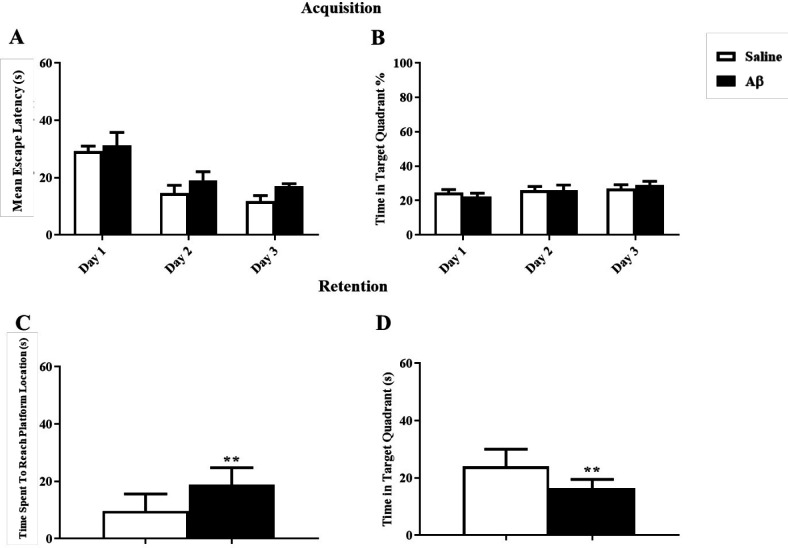
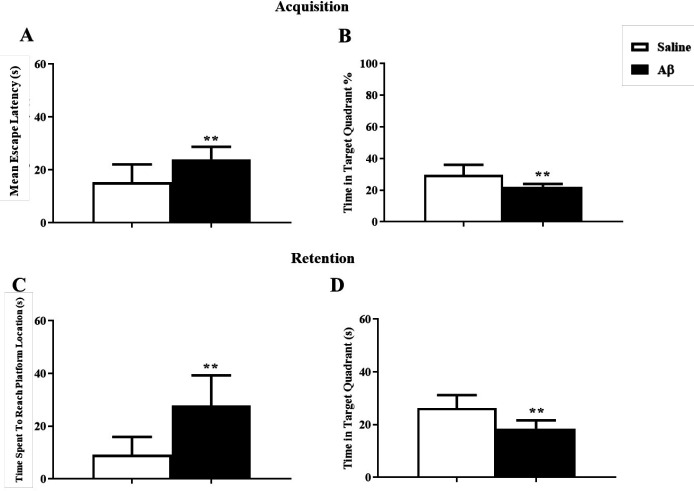
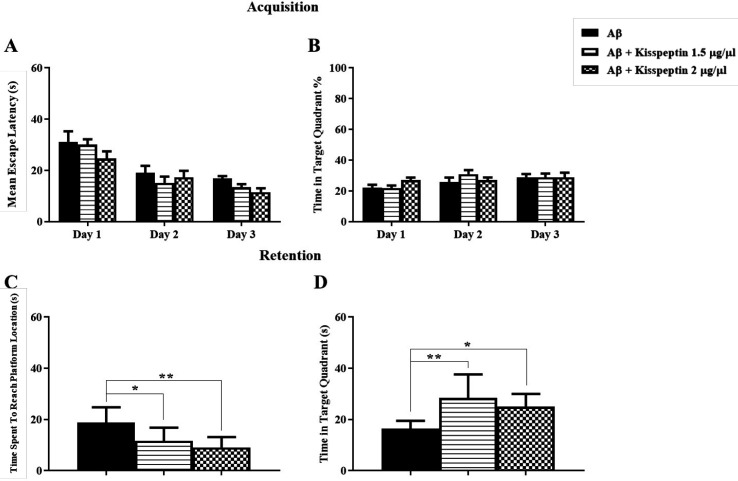
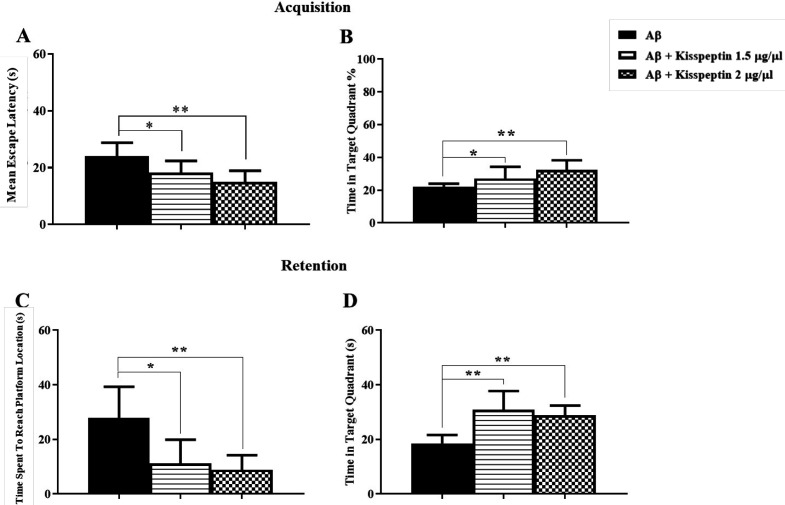
It has been shown that brain glucose metabolism impairment, obesity, and diabetes could lead to cognitive decline and Alzheimer's disease (AD) pathogenesis. Kisspeptin (KP) a G-protein coupled receptor neuropeptide, has been suggested as a link between energy balance and reproduction. Some studies have shown that the attenuation of KP signaling decreases metabolism and energy expenditure. KP mRNAs and receptors are detected in the hippocampus and cause the promotion of excitatory synaptic responses through modulation of postsynaptic signaling. The purpose of this study was to investigate the effect of KP on spatial learning and memory and its possible neuroprotective effect on Amyloid-Beta induced cognitive impairment using the Morris Water Maze (MWM) task in rats. The reference and reversal spatial learning and memory have been measured in this study. Rats were injected bilaterally by Aβ1-42 (2 μg/μL) or saline as a vehicle into the hippocampal CA1 area. One week later, KP-13 (1.5 or 2 µg/µL) was injected i.c.v before or after each training session for 3 days and memory was tested 24 h later. The results showed KP-13 by itself could significantly enhance spatial memory consolidation and retrieval, and Aβ induced reversal and reference memory impairment was significantly ameliorated by KP-13. In Conclusion, it seems that KP-13 as a neuropeptide has to enhance spatial memory properties and could be a possible neuroprotective peptide on amyloid-beta induced pathology.
研究表明,脑葡萄糖代谢受损、肥胖和糖尿病可导致认知能力下降和阿尔茨海默病(AD)发病机制。 kisspeptin(KP)是一种G蛋白偶联受体神经肽,被认为是能量平衡与生殖之间的联系。一些研究表明,KP信号的减弱会降低新陈代谢和能量消耗。在海马体中检测到KP mRNA和受体,它们通过调节突触后信号促进兴奋性突触反应。本研究的目的是使用大鼠的莫里斯水迷宫(MWM)任务,研究KP对空间学习和记忆的影响及其对β-淀粉样蛋白诱导的认知障碍可能的神经保护作用。本研究测量了参考和逆向空间学习与记忆。将大鼠双侧海马CA1区注射Aβ1-42(2μg/μL)或作为对照的生理盐水。一周后,在每次训练前或训练后3天通过脑室内注射KP-13(1.5或2µg/µL),24小时后测试记忆。结果表明,单独使用KP-13可显著增强空间记忆巩固和检索,KP-13可显著改善Aβ诱导的逆向和参考记忆损伤。总之,KP-13作为一种神经肽似乎具有增强空间记忆的特性,并且可能是一种对β-淀粉样蛋白诱导的病理具有神经保护作用的肽。