Shivani Narendra, Smiline-Girija Aseervatham Selvi, Paramasivam Arumugam, Vijayashree-Priyadharsini Jayaseelan
Saveetha Dental College, Saveetha Institute of Medical and Technical Sciences (SIMATS), Saveetha University, Chennai, India.
Department of Microbiology, Saveetha Dental College, Saveetha Institute of Medical and Technical Sciences (SIMATS), Saveetha University, 162, Poonamallee High Road, Chennai 600077, Tamil Nadu, India.
Mol Biol Res Commun. 2020 Jun;9(2):63-69. doi: 10.22099/mbrc.2020.35413.1456.
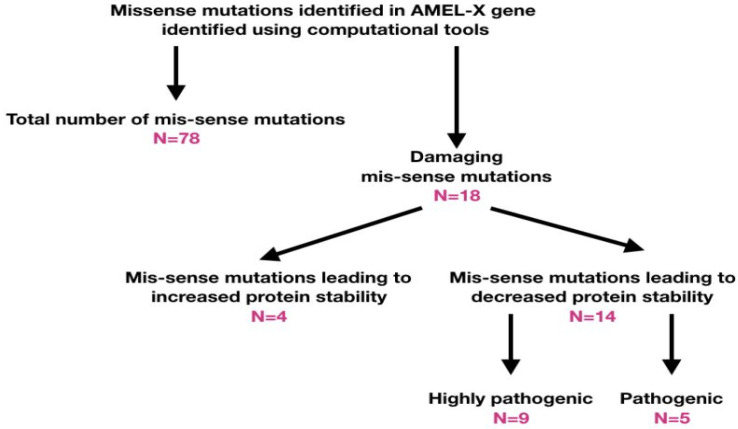
Amelogenin gene encodes an enamel protein called amelogenin, which plays a vital role in tooth development. Any mutations in this gene or the associated pathway lead to developmental abnormalities of the tooth. The present study aims to analyze functional missense mutations in genes and derive an association with amelogenesis imperfecta. The information on missense mutations of human gene was collected from Ensembl database (https://asia.ensembl.org). Three different computational tools viz., SIFT, PolyPhen and PROVEAN were used to identify the deleterious or pathogenic forms of mutations in the gene studied. I-Mutant Suit was used to identify the stability of the proteins identified as deleterious by the three tools. Further, MutPred analysis revealed the pathogenicity of these mutations. Among 96 missense variants reported in gene, 18 were found to be deleterious using the three prediction tools (SIFT, PolyPhen and PROVEAN). When these variants were subjected to protein stability analysis, about 14 missense variants showed decreased stability whereas the other 8 variants showed increased stability. Further, these variants were analyzed using MutPred which identified 9 variants to be highly pathogenic. ExAC database revealed that all the pathogenic mutations had a minor allele frequency less than 0.01. The analysis revealed highly pathogenic mutations in amelogenin gene which could have a putative association with amelogenesis imperfecta. These mutations should be screened in patients for early diagnosis of susceptibility to AI.
釉原蛋白基因编码一种名为釉原蛋白的牙釉质蛋白,它在牙齿发育中起着至关重要的作用。该基因或相关途径中的任何突变都会导致牙齿发育异常。本研究旨在分析该基因中的功能性错义突变,并得出其与牙釉质发育不全的关联。人类该基因错义突变的信息从Ensembl数据库(https://asia.ensembl.org)收集。使用三种不同的计算工具,即SIFT、PolyPhen和PROVEAN,来识别所研究基因中有害或致病形式的突变。I-Mutant Suit用于识别被这三种工具鉴定为有害的蛋白质的稳定性。此外,MutPred分析揭示了这些突变的致病性。在该基因报告的96个错义变体中,使用这三种预测工具(SIFT、PolyPhen和PROVEAN)发现18个是有害的。当对这些变体进行蛋白质稳定性分析时,约14个错义变体显示稳定性降低,而其他8个变体显示稳定性增加。此外,使用MutPred对这些变体进行分析,该工具鉴定出9个变体具有高度致病性。ExAC数据库显示,所有致病突变的次要等位基因频率均小于0.01。该分析揭示了釉原蛋白基因中的高度致病突变,这些突变可能与牙釉质发育不全存在推定关联。应在患者中筛查这些突变,以便对牙釉质发育不全易感性进行早期诊断。