Misko Albert L, Liang Ye, Kohl Joshua B, Eichler Florian
Departments of Neurology (A.L.M., Y.L., F.E.), Massachusetts General Hospital and Harvard Medical School, Boston; and the Department of Chemistry (J.B.K.), Institute of Biochemistry, University of Cologne, Germany.
Neurol Genet. 2020 Jul 14;6(4):e486. doi: 10.1212/NXG.0000000000000486. eCollection 2020 Aug.
To define the phenotypic spectrum of isolated sulfite oxidase (ISOD) and molybdenum cofactor deficiency (MoCD), aiming to promote timely diagnosis and assist in future clinical trial design.
We analyzed clinical, radiographic, biochemical, and genetic data from 146 patients reported in the literature.
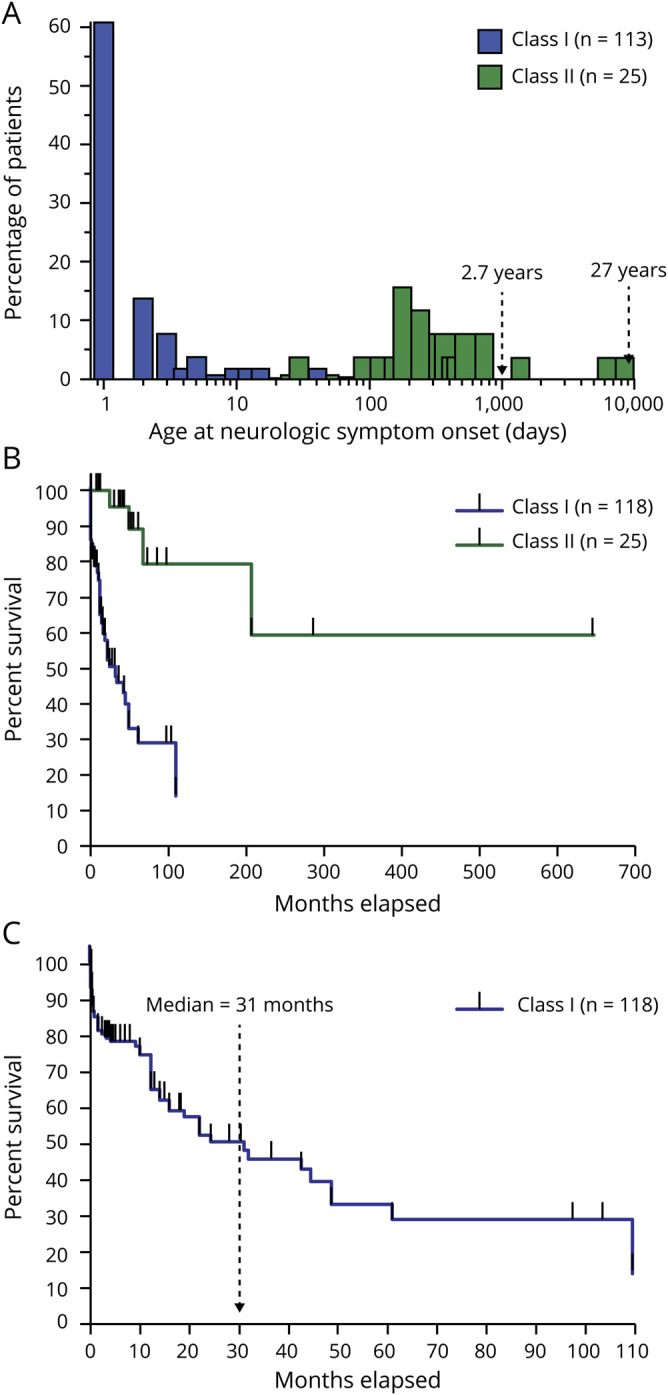
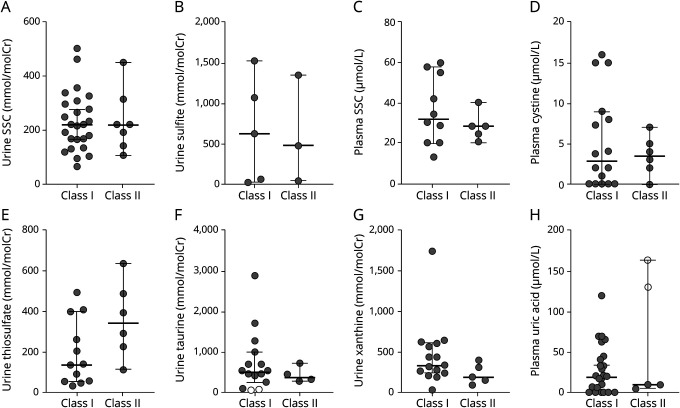
We stratified patients into 2 phenotypic subgroups based on clinical and radiographic characteristics. In the first (Class I), patients presented early in life (age 1-50 days) with acute onset of neurologic symptoms and development of diffuse brain injury with cystic leukomalacia. Patients in the second subgroup (Class II) presented later in life (age 30 days-23 years) with prominent movement abnormalities and selective injury of the basal ganglia and cerebellum. A significant difference in survival estimates correlated with milder disease severity among Class II patients. Substantial overlap in sulfur-containing metabolite levels prevented discrimination of subgroups based on diagnostic biomarkers, but genotype-phenotype correlations suggested that residual SUOX activity may contribute to milder phenotypes.
Patients with SUOX and MoCD gravitate toward 1 of 2 distinct clinicoradiographic profiles. Patient stratification may help promote accurate diagnosis, prognostication, and aid in the design of future clinical trials.
明确孤立性亚硫酸盐氧化酶(ISOD)和钼辅因子缺乏症(MoCD)的表型谱,旨在促进及时诊断并协助未来临床试验设计。
我们分析了文献报道的146例患者的临床、影像学、生化和基因数据。
我们根据临床和影像学特征将患者分为2个表型亚组。在第一组(I类)中,患者在生命早期(1至50天)出现,伴有急性神经症状发作,并发展为伴有囊性脑白质软化的弥漫性脑损伤。第二亚组(II类)患者在生命后期(30天至23岁)出现,伴有明显的运动异常以及基底神经节和小脑的选择性损伤。生存估计的显著差异与II类患者中较轻的疾病严重程度相关。含硫代谢物水平的大量重叠使得无法根据诊断生物标志物区分亚组,但基因型-表型相关性表明,残余的SUOX活性可能导致较轻的表型。
SUOX和MoCD患者倾向于两种不同临床影像学特征中的一种。患者分层可能有助于促进准确诊断、预后评估,并有助于未来临床试验的设计。