Social Development and Health Promotion Research Center, Health Institute, Kermanshah University of Medical Sciences, Kermanshah, Iran.
Research Center for Environmental Determinants of Health, Health Institute, Kermanshah University of Medical Sciences, Kermanshah, Iran.
J Prev Med Hyg. 2020 Jul 4;61(2):E215-E220. doi: 10.15167/2421-4248/jpmh2020.61.2.1394. eCollection 2020 Jun.
The magnitude and underlying determinants of socioeconomic inequality in dental flossing are poorly understood in Iran. This study aimed to measure and decompose socioeconomic inequalities in dental flossing in Ravansar, Iran.
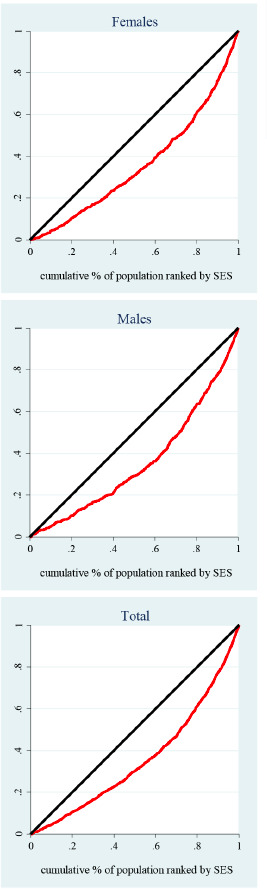
Data of 10,002 individuals aged 35-65 years who participated in the Ravansar Non- communicable Diseases (RaNCD) cohort study in Kermanshah province, western Iran, were analyzed. Based on an asset-based method, socioeconomic status (SES) was measured using principal component analysis (PCA). The concentration index and curve were employed to measure socioeconomic inequality in dental flossing. Decomposition analysis was used to estimate the contribution of each determinant to the overall inequality.
Of 10,002 participants, 11.74% were found to practice dental floss. The normalized CI for dental flossing was 0.327 in the entire population, 0.323 in females and 0.329 in males, indicating that the use of dental floss is more concentrated among high-SES individuals. The decomposition analysis indicated that SES (50.58%) and level of education (44.90%) respectively contributed the most to this inequality. Place of residence (10.55%) and age group (2.7%) were the next main contributors, respectively.
We found a low prevalence of dental flossing among participants in RaNCD study. We also observed a relatively high degree of pro-rich inequality in dental flossing. The observed inequality was mainly explained by socioeconomic status, level of education and place of residence. Policy interventions should consider these factors to reduce inequalities in dental flossing.
在伊朗,人们对牙线使用的社会经济不平等的程度和潜在决定因素了解甚少。本研究旨在衡量和分解伊朗拉万萨尔(Ravansar)地区牙线使用的社会经济不平等。
对参加伊朗克尔曼沙阿省拉万萨尔非传染性疾病(RaNCD)队列研究的 10002 名年龄在 35-65 岁的个体进行数据分析。根据基于资产的方法,使用主成分分析(PCA)来衡量社会经济地位(SES)。采用集中指数和曲线来衡量牙线使用的社会经济不平等。采用分解分析来估计每个决定因素对总体不平等的贡献。
在 10002 名参与者中,有 11.74%的人使用牙线。整个人群中牙线使用的归一化集中指数为 0.327,女性为 0.323,男性为 0.329,表明牙线的使用更集中在高 SES 个体中。分解分析表明,SES(50.58%)和教育水平(44.90%)分别是造成这种不平等的主要原因。其次是居住地(10.55%)和年龄组(2.7%)。
我们发现 RaNCD 研究中的参与者中牙线使用的比例较低。我们还观察到牙线使用存在较高程度的有利于富人的不平等。观察到的不平等主要由社会经济地位、教育水平和居住地解释。政策干预措施应考虑这些因素,以减少牙线使用方面的不平等。