Blair Thies Melanie, DeRosse Pamela, Sarpal Deepak K, Argyelan Miklos, Fales Christina L, Gallego Juan A, Robinson Delbert G, Lencz Todd, Homan Philipp, Malhotra Anil K
Division of Psychiatry Research, Zucker Hillside Hospital, Glen Oaks, NY.
Institute of Behavioral Science, Feinstein Institutes for Medical Research, Manhasset, NY.
Schizophr Bull Open. 2020 Jan;1(1):sgaa014. doi: 10.1093/schizbullopen/sgaa014. Epub 2020 Mar 20.
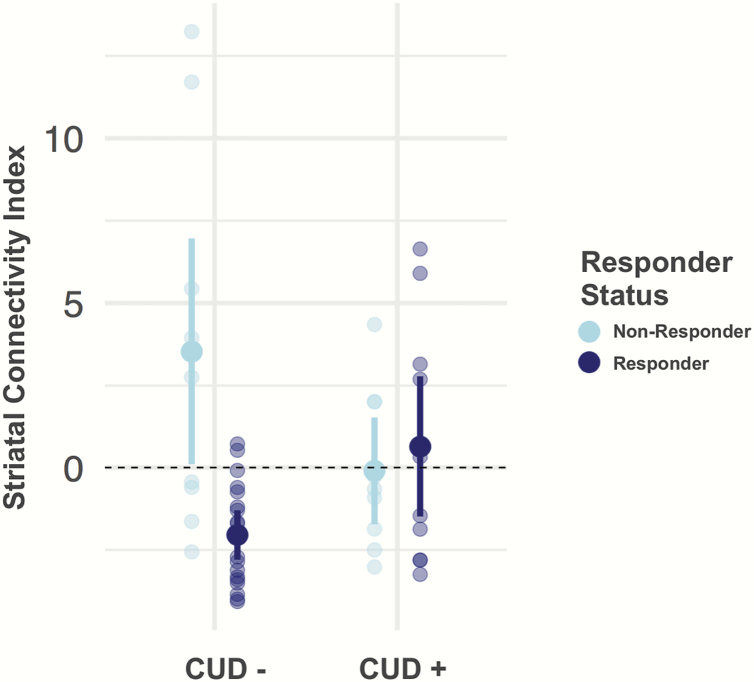
Antipsychotic (AP) medications are the mainstay for the treatment of schizophrenia spectrum disorders (SSD), but their efficacy is unpredictable and widely variable. Substantial efforts have been made to identify prognostic biomarkers that can be used to guide optimal prescription strategies for individual patients. Striatal regions involved in salience and reward processing are disrupted as a result of both SSD and cannabis use, and research demonstrates that striatal circuitry may be integral to response to AP drugs. In the present study, we used functional magnetic resonance imaging (fMRI) to investigate the relationship between a history of cannabis use disorder (CUD) and a striatal connectivity index (SCI), a previously developed neural biomarker for AP treatment response in SSD. Patients were part of a 12-week randomized, double-blind controlled treatment study of AP drugs. A sample of 48 first-episode SSD patients with no more than 2 weeks of lifetime exposure to AP medications, underwent a resting-state fMRI scan pretreatment. Treatment response was defined a priori as a binary (response/nonresponse) variable, and a SCI was calculated in each patient. We examined whether there was an interaction between lifetime CUD history and the SCI in relation to treatment response. We found that CUD history moderated the relationship between SCI and treatment response, such that it had little predictive value in SSD patients with a CUD history. In sum, our findings highlight that biomarker development can be critically impacted by patient behaviors that influence neurobiology, such as a history of CUD.
抗精神病药物(AP)是治疗精神分裂症谱系障碍(SSD)的主要手段,但其疗效难以预测且差异很大。人们已付出巨大努力来确定可用于指导个体患者最佳处方策略的预后生物标志物。由于SSD和大麻使用,参与显著性和奖赏处理的纹状体区域受到破坏,并且研究表明纹状体回路可能是对AP药物反应所不可或缺的。在本研究中,我们使用功能磁共振成像(fMRI)来研究大麻使用障碍(CUD)病史与纹状体连接指数(SCI)之间的关系,SCI是先前开发的用于SSD中AP治疗反应的神经生物标志物。患者是AP药物12周随机双盲对照治疗研究的一部分。48例首次发作的SSD患者样本,其终生接触AP药物不超过2周,在治疗前接受了静息态fMRI扫描。治疗反应被预先定义为二元(反应/无反应)变量,并计算每位患者的SCI。我们研究了终生CUD病史与SCI之间是否存在与治疗反应相关的相互作用。我们发现CUD病史调节了SCI与治疗反应之间的关系,因此在有CUD病史的SSD患者中它几乎没有预测价值。总之,我们的研究结果突出表明,生物标志物的开发可能会受到影响神经生物学的患者行为(如CUD病史)的严重影响。