Deparment of Medicine, University of California, San Francisco, San Francisco, California, United States of America.
Department of Epidemiology and Population Health, Stanford University School of Medicine, Stanford, California, United States of America.
PLoS Negl Trop Dis. 2020 Aug 17;14(8):e0008551. doi: 10.1371/journal.pntd.0008551. eCollection 2020 Aug.
The key metric for monitoring the progress of deworming programs in controlling soil-transmitted helminthiasis (STH) is national drug coverage reported to the World Health Organization (WHO). There is increased interest in utilizing geographically-disaggregated data to estimate sub-national deworming coverage and equity, as well as gender parity. The Demographic and Health Surveys (DHS) offer a potential source of sub-national data. This study aimed to compare deworming coverage routinely reported to WHO and estimated by DHS in pre-school aged children to inform global STH measurement and evaluation.
We compared sub-national deworming coverage in pre-school aged children reported to WHO and estimated by DHS aligned geospatially and temporally. We included data from Burundi (2016-2017), Myanmar (2015-2016), and the Philippines (2017) based on data availability. WHO provided data on the date and sub-national coverage per mass drug administration reported by Ministries of Health. DHS included maternally-reported deworming status within the past 6 months for each child surveyed. We estimated differences in sub-national deworming coverage using WHO and DHS data, and performed sensitivity analyses.
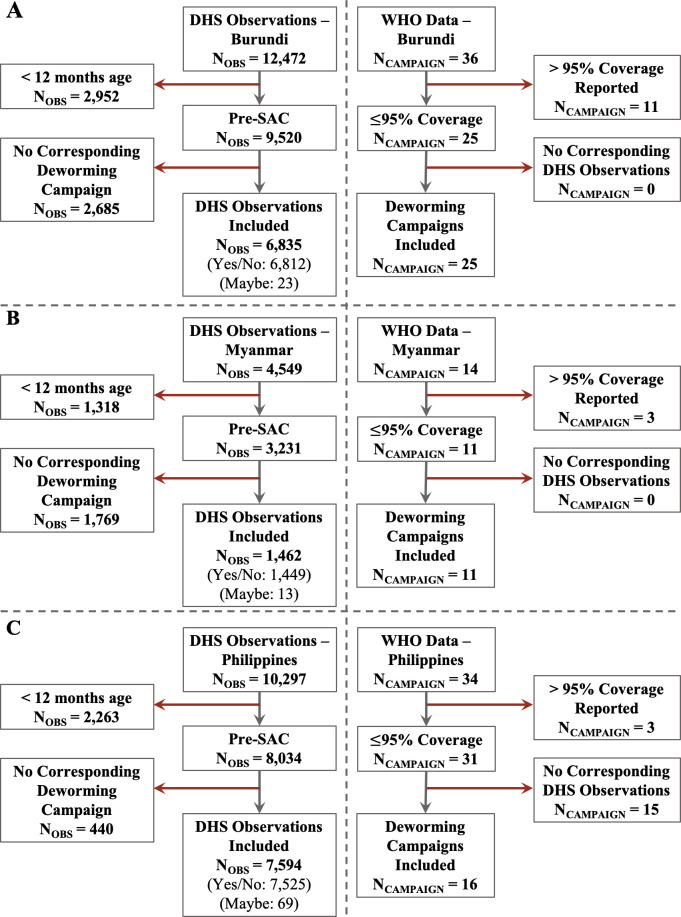
We compared data on pre-school aged children from 13 of 18 districts in Burundi (N = 6,835 in DHS), 11 of 15 districts in Myanmar (N = 1,462 in DHS) and 16 of 17 districts in the Philippines (N = 7,594 in DHS) following data exclusion. The national deworming coverages estimated by DHS in Burundi, Myanmar, and the Philippines were 75.5% (95% CI: 73.7%-77.7%), 47.0% (95% CI: 42.7%-51.3%), and 48.0% (95% CI: 46.0%-50.0%), respectively. The national deworming coverages reported by WHO in Burundi, Myanmar, and the Philippines were 80.1%, 93.6% and 75.7%, respectively. The mean absolute differences in district-level coverage reported to WHO and estimated by DHS in Burundi, Myanmar, and the Philippines were 9.5%, 41.5%, and 24.6%, respectively. Across countries, coverage reported to WHO was frequently higher than DHS estimates (32 of 40 districts). National deworming coverage from DHS estimates were similar by gender within countries.
Agreement of deworming coverage reported to WHO and estimated by DHS data was heterogeneous across countries, varying from broadly compatible in Burundi to largely discrepant in Myanmar. DHS data could complement deworming data reported to WHO to improve data monitoring practices and serve as an independent sub-national source of coverage data.
监测控制土壤传播性蠕虫病(STH)驱虫计划进展的关键指标是向世界卫生组织(WHO)报告的全国药物覆盖率。人们越来越感兴趣的是利用地理上分散的数据来估计次国家驱虫覆盖率和公平性,以及性别均等。人口与健康调查(DHS)提供了次国家数据的潜在来源。本研究旨在比较向 WHO 报告的和 DHS 估计的学前儿童驱虫覆盖率,以为全球 STH 测量和评估提供信息。
我们比较了在学前儿童中向 WHO 报告的和 DHS 估计的次国家驱虫覆盖率,这些数据在空间和时间上是一致的。我们根据数据的可用性,纳入了布隆迪(2016-2017 年)、缅甸(2015-2016 年)和菲律宾(2017 年)的数据。WHO 提供了关于卫生部报告的每次大规模药物治疗的日期和次国家覆盖率的数据。DHS 包括每个接受调查的儿童在过去 6 个月内由母亲报告的驱虫状况。我们使用 WHO 和 DHS 数据估计了次国家驱虫覆盖率的差异,并进行了敏感性分析。
我们比较了布隆迪 18 个区中的 13 个区(DHS 中共有 6835 名儿童)、缅甸 15 个区中的 11 个区(DHS 中共有 1462 名儿童)和菲律宾 17 个区中的 16 个区(DHS 中共有 7594 名儿童)的学前儿童数据。布隆迪、缅甸和菲律宾的 DHS 估计的全国驱虫覆盖率分别为 75.5%(95%CI:73.7%-77.7%)、47.0%(95%CI:42.7%-51.3%)和 48.0%(95%CI:46.0%-50.0%)。布隆迪、缅甸和菲律宾向 WHO 报告的全国驱虫覆盖率分别为 80.1%、93.6%和 75.7%。布隆迪、缅甸和菲律宾的 DHS 估计的地区层面覆盖率与 WHO 报告的覆盖率之间的平均绝对差异分别为 9.5%、41.5%和 24.6%。在所有国家中,向 WHO 报告的覆盖率通常高于 DHS 估计值(40 个区中有 32 个)。在各国,DHS 估计的全国驱虫覆盖率在性别之间相似。
向 WHO 报告的驱虫覆盖率与 DHS 数据估计的覆盖率在各国之间存在差异,在布隆迪基本一致,而在缅甸则存在较大差异。DHS 数据可以补充向 WHO 报告的驱虫数据,以改善数据监测实践,并作为独立的次国家覆盖率数据来源。