Baik Myunggi, Jeong Jin Young, Park Seung Ju, Yoo Seon Pil, Lee Jin Oh, Lee Jae Sung, Haque Md Najmul, Lee Hyun-Jeong
Department of Agricultural Biotechnology, College of Agriculture and Life Sciences, Seoul National University, 1 Gwanak-ro, Gwanak-gu, Seoul, 08826, Republic of Korea.
Research Institute of Agriculture and Life Sciences, College of Agriculture and Life Sciences, Seoul National University, Seoul, Republic of Korea.
Genes Nutr. 2020 Aug 17;15(1):14. doi: 10.1186/s12263-020-00673-1.
Testosterone deficiency in men is clinically associated with the development of metabolic syndrome, which manifests as obesity, hepatic steatosis, and type-2 diabetes. We investigated the effects of castration-induced testosterone deficiency on body adiposity and the expression of genes related to lipid metabolism and glucose uptake and androgen signaling in male rats fed a normal diet (ND) or a high-fat diet (HFD).
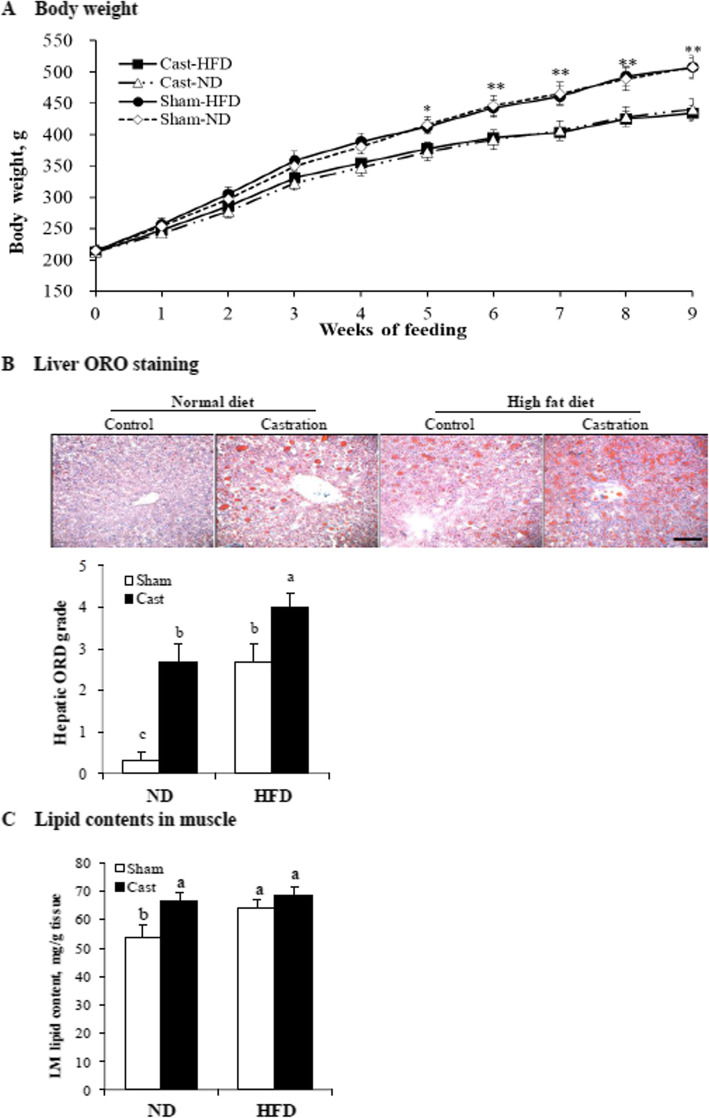
Changes in lipid and glucose metabolism and androgen signaling were investigated at physiological and molecular levels in the muscle, liver, and adipose tissues of non-castrated and castrated rats under ND or HFD feeding.
Castration-induced testosterone deficiency predisposed animals on ND to early development of fatty liver by activating fatty acid (FA) synthesis, whereas HFD activated hepatic FA uptake CD36 expression, leading to the development of hepatic steatosis. In rats fed ND, castration induced muscle fat accumulation by activating CD36 expression. In the subcutaneous fat of ND-fed rats, castration increased adiposity and the expression of FA synthesis-related genes, but it decreased glucose transporter gene expression. In the abdominal fat of rats fed ND, castration increased adiposity by upregulating FA synthesis-related genes, and HFD promoted adiposity by inducing FA uptake, glucose transporter, and FA synthesis-related gene expression. In rats fed ND, castration decreased body growth and muscle weight and downregulated the expression of genes androgen signaling in the longissimus dorsi muscle.
Testosterone deficiency increases adiposity in a tissue-specific and diet-dependent manner. Testosterone deficiency decreases body and muscle weights and downregulates androgen signaling.
男性睾酮缺乏在临床上与代谢综合征的发生有关,代谢综合征表现为肥胖、肝脂肪变性和2型糖尿病。我们研究了去势诱导的睾酮缺乏对正常饮食(ND)或高脂饮食(HFD)喂养的雄性大鼠身体脂肪以及与脂质代谢、葡萄糖摄取和雄激素信号相关基因表达的影响。
在ND或HFD喂养条件下,对未去势和去势大鼠的肌肉、肝脏和脂肪组织进行生理和分子水平的脂质和葡萄糖代谢以及雄激素信号变化研究。
去势诱导的睾酮缺乏通过激活脂肪酸(FA)合成使ND喂养的动物易患早期脂肪肝,而HFD激活肝脏FA摄取和CD36表达,导致肝脂肪变性的发生。在ND喂养的大鼠中,去势通过激活CD36表达诱导肌肉脂肪堆积。在ND喂养大鼠的皮下脂肪中,去势增加了肥胖和FA合成相关基因的表达,但降低了葡萄糖转运蛋白基因的表达。在ND喂养大鼠的腹部脂肪中,去势通过上调FA合成相关基因增加肥胖,而HFD通过诱导FA摄取、葡萄糖转运蛋白和FA合成相关基因表达促进肥胖。在ND喂养的大鼠中,去势降低了身体生长和肌肉重量,并下调了背最长肌中雄激素信号相关基因的表达。
睾酮缺乏以组织特异性和饮食依赖性方式增加肥胖。睾酮缺乏降低身体和肌肉重量,并下调雄激素信号。