Department of Bacteriology, University of Wisconsin-Madison, Microbial Sciences Building, 1550 Linden Drive, Madison, WI, 53706, USA.
University of Utah, School of Medicine, 30 N 1900 E, Salt Lake City, UT, 84132, USA.
BMC Genomics. 2020 Aug 17;21(1):562. doi: 10.1186/s12864-020-06943-x.
Enterohemorrhagic Escherichia coli O157:H7 (EHEC) is a significant foodborne pathogen that resides asymptomatically within cattle and other ruminants. The EHEC genome harbors an extensive collection of mobile genetic elements (MGE), including multiple prophage, prophage-like elements, plasmids, and insertion sequence (IS) elements.
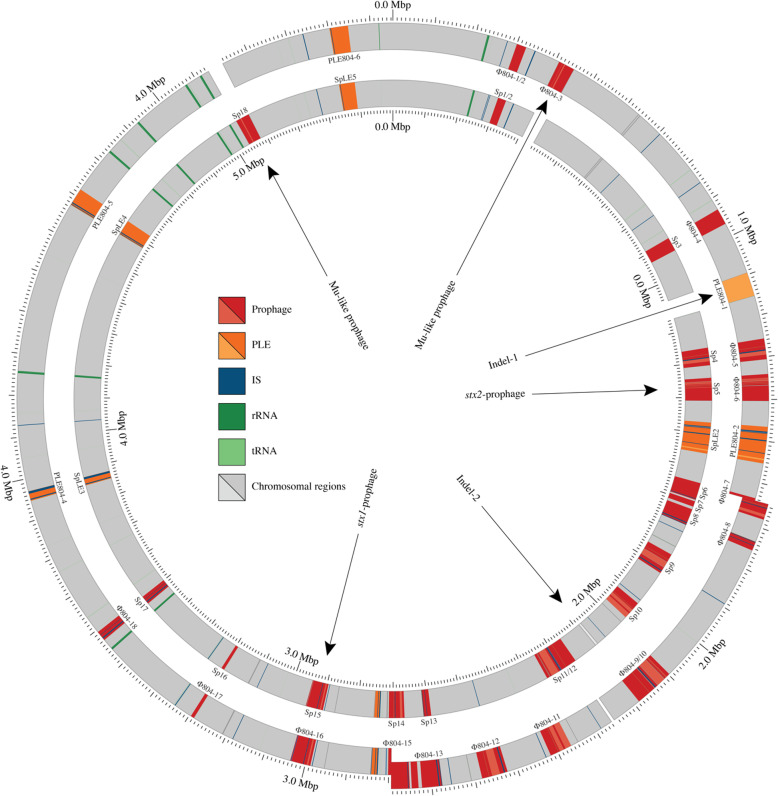
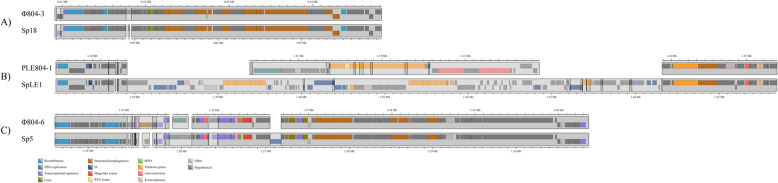
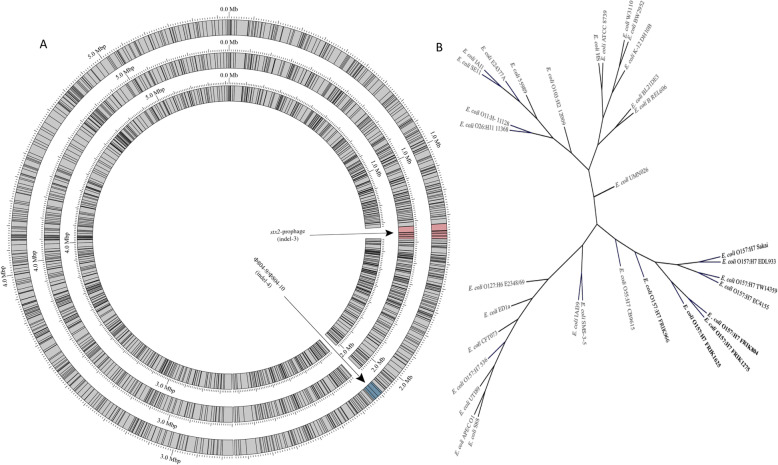
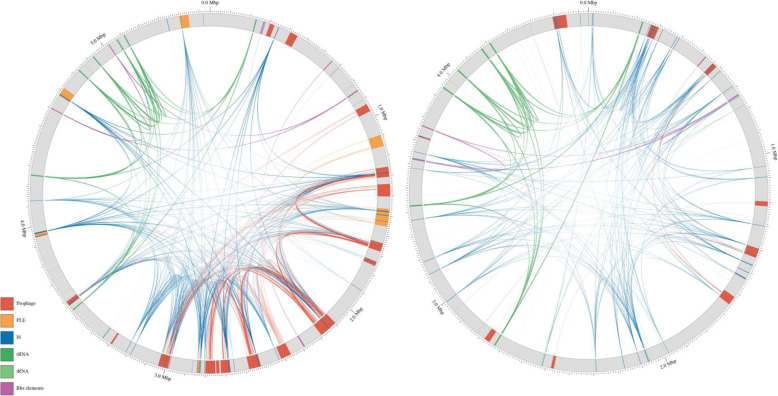
A chronological collection of EHEC strains (FRIK804, FRIK1275, and FRIK1625) isolated from a Wisconsin dairy farm (farm X) comprised a closely related clade genetically differentiated by structural alterations to the chromosome. Comparison of the FRIK804 genome with a reference EHEC strain Sakai found a unique prophage like element (PLE, indel 1) and an inversion (1.15 Mb) situated symmetrically with respect to the terminus region. Detailed analysis determined the inversion was due to homologous recombination between repeat sequences in prophage. The three farm X strains were distinguished by the presence or absence of indel 3 (61 kbp) and indel 4 (48 kbp); FRIK804 contained both of these regions, FRIK1275 lacked indel 4, and indels 3 and 4 were both absent in FRIK1625. Indel 3 was the stx2 prophage and indel 4 involved a deletion between two adjacent prophage with shared repeat sequences. Both FRIK804 and FRIK1275 produced functional phage while FRIK1625 did not, which is consistent with indel 3. Due to their involvement in recombination events, direct and inverted repeat sequences were identified, and their locations mapped to the chromosome. FRIK804 had a greater number and overall length of repeat sequences than E. coli K12 strain MG1655. Repeat sequences were most commonly associated with MGE.
This research demonstrated that three EHEC strains from a Wisconsin dairy farm were closely related and distinguished by variability within prophage regions and other MGE. Chromosome alterations were associated with recombination events between repeat sequences. An inventory of direct and inverted repeat sequences found a greater abundance and total length of repeat sequences in the EHEC strains compared to E. coli strain MG1655. The locations of the repeat sequences were biased towards MGE. The findings from this study expand our understanding of the precise molecular events and elements that contributed to genetic diversification of wild-type EHEC in the bovine and farm environments.
肠出血性大肠杆菌 O157:H7(EHEC)是一种重要的食源性病原体,它在牛和其他反刍动物体内无症状存在。EHEC 基因组携带有大量的可移动遗传元件(MGE),包括多个噬菌体、类噬菌体元件、质粒和插入序列(IS)元件。
从威斯康星州一个奶牛场(农场 X)分离的 EHEC 菌株(FRIK804、FRIK1275 和 FRIK1625)的时间序列集在遗传上具有密切相关的分支,其染色体结构的改变导致了基因分化。与参考 EHEC 菌株 Sakai 相比,FRIK804 基因组中存在一个独特的类噬菌体元件(PLE,插入缺失 1)和一个位于末端区域对称的倒位(1.15 Mb)。详细分析确定,该倒位是由于噬菌体中的重复序列之间的同源重组引起的。这 3 株农场 X 菌株的区别在于是否存在插入缺失 3(61 kbp)和插入缺失 4(48 kbp);FRIK804 含有这两个区域,FRIK1275 缺失插入缺失 4,而插入缺失 3 和 4 均不存在于 FRIK1625 中。插入缺失 3 是 stx2 噬菌体,插入缺失 4 涉及两个相邻噬菌体之间的缺失,它们具有共享的重复序列。FRIK804 和 FRIK1275 都产生了功能噬菌体,而 FRIK1625 则没有,这与插入缺失 3 一致。由于它们参与了重组事件,因此鉴定了直接和反向重复序列,并将其位置映射到染色体上。FRIK804 比大肠杆菌 K12 菌株 MG1655 具有更多的重复序列和更长的重复序列。重复序列最常与 MGE 相关。
本研究表明,来自威斯康星州一个奶牛场的 3 株 EHEC 菌株密切相关,通过噬菌体区域和其他 MGE 内的可变性来区分。染色体的改变与重复序列之间的重组事件有关。直接和反向重复序列的清单发现,与大肠杆菌菌株 MG1655 相比,EHEC 菌株中的重复序列数量更多,总长度更长。重复序列的位置偏向于 MGE。本研究的结果扩展了我们对导致牛和农场环境中野生型 EHEC 遗传多样化的精确分子事件和元件的理解。