Ohar Jill A, Bauer Andrea, Sharma Sanjay, Sanjar Shahin
Wake Forest University, Winston-Salem, NC, USA.
Sunovion Pharmaceuticals Inc., Marlborough, MA, USA.
Pulm Ther. 2020 Dec;6(2):289-301. doi: 10.1007/s41030-020-00125-6. Epub 2020 Aug 18.
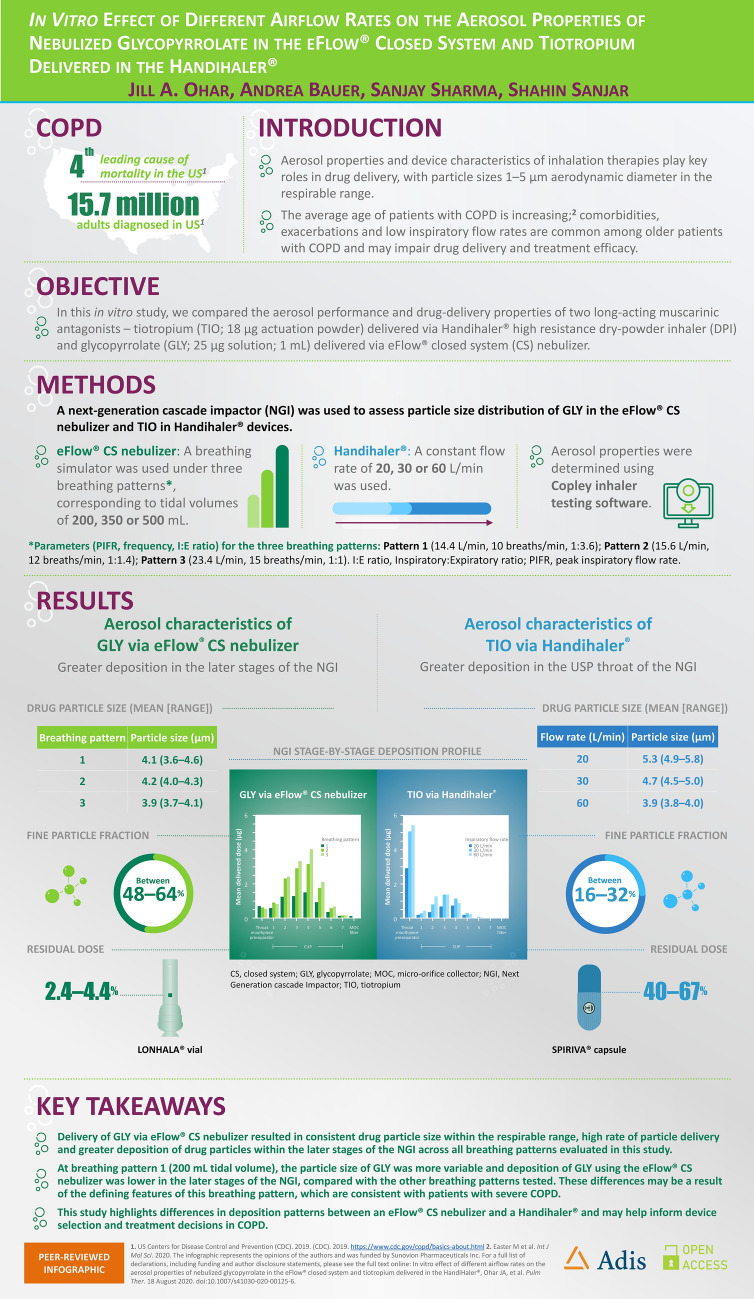
Personalized therapy for patients with COPD requires appropriate choice of drug and delivery device. Inhalers and nebulizers vary in their drug delivery characteristics, particularly the need for passive or active patient inhalation for appropriate drug dispersal and delivery. In this in vitro analysis, we assessed the aerosol performance and drug delivery of two long-acting muscarinic antagonists, glycopyrrolate (GLY; 25 µg solution; 1 ml) and tiotropium (TIO; 18 µg powder) through their respective delivery systems: the eFlow® Closed System (CS) vibrating membrane nebulizer and the HandiHaler® dry-powder inhaler (DPI).
The aerosol performances of the eFlow® CS nebulizer and the HandiHaler® were determined using the Next Generation cascade Impactor. The delivered dose of GLY and TIO was determined using different breathing patterns, which varied in tidal volume and peak inspiratory flow rate, respectively, to simulate breathing conditions ranging from normal to severe obstruction.
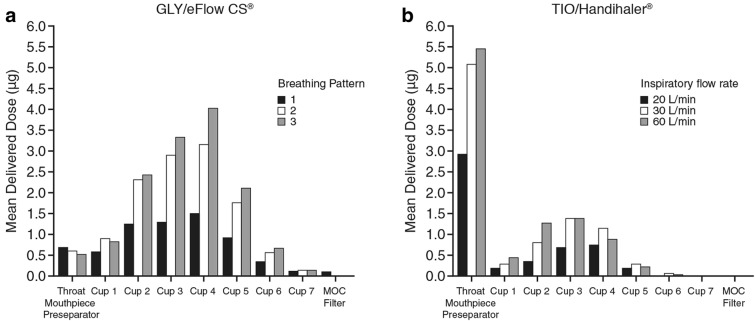
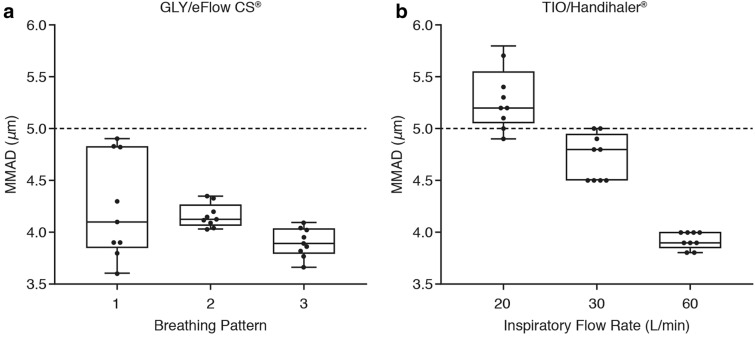
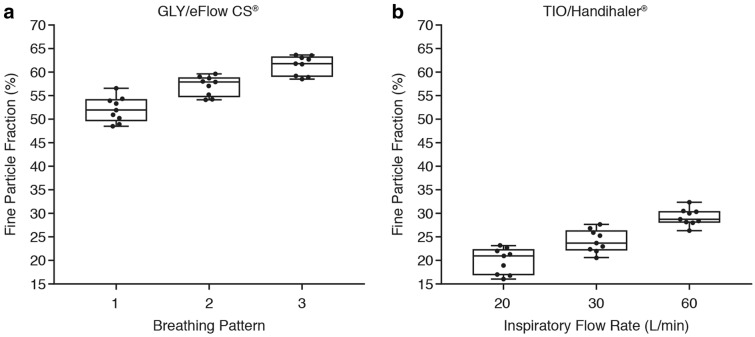
Aerodynamic particle analysis showed generally similar mass median aerodynamic diameter (MMAD, range, 3.6-4.6 µm) and fine particle fraction (FPF, range, 48.2%-63.7%) with GLY delivered using the eFlow® CS nebulizer under all breathing patterns tested. TIO, delivered via the HandiHaler®, showed variations in MMAD (range, 3.8-5.8 µm) and FPF (range, 16.1%-32.4%) under different inspiratory flow rates. The majority of GLY was deposited in stages 2-5 of the impactor, which corresponds with particle sizes in the respirable range (< 5 µm), whereas a large proportion of TIO was deposited in the throat/mouthpiece pre-separator, irrespective of test conditions. The median residual dose of GLY with eFlow® CS was notably lower compared to that of TIO with HandiHaler® (2.4%-4.4% vs. 40%-67%, respectively).
These simulation results highlight the different deposition patterns generated by a DPI device and a vibrating membrane nebulizer, which may help inform device selection and treatment decision in COPD management.
慢性阻塞性肺疾病(COPD)患者的个性化治疗需要合理选择药物和给药装置。吸入器和雾化器的药物输送特性各不相同,尤其是在药物适当分散和输送所需的被动或主动患者吸入方面。在这项体外分析中,我们通过各自的给药系统,即eFlow®封闭式系统(CS)振动膜雾化器和HandiHaler®干粉吸入器(DPI),评估了两种长效毒蕈碱拮抗剂格隆溴铵(GLY;25μg溶液;1ml)和噻托溴铵(TIO;18μg粉末)的气溶胶性能和药物输送情况。
使用下一代撞击器测定eFlow®CS雾化器和HandiHaler®的气溶胶性能。使用不同的呼吸模式测定GLY和TIO的输送剂量,这些呼吸模式的潮气量和吸气峰流速各不相同,以模拟从正常到严重阻塞的呼吸状况。
空气动力学颗粒分析显示,在所有测试的呼吸模式下,使用eFlow®CS雾化器输送GLY时,质量中值空气动力学直径(MMAD,范围为3.6 - 4.6μm)和细颗粒分数(FPF,范围为48.2% - 63.7%)总体上相似。通过HandiHaler®输送的TIO在不同吸气流速下,MMAD(范围为?3.8 - 5.8μm)和FPF(范围为16.1% - 32.4%)存在变化。大多数GLY沉积在撞击器的2 - 5阶段,这与可吸入范围内(<5μm)的颗粒大小相对应,而无论测试条件如何,很大一部分TIO沉积在咽喉/口含器预分离器中。与使用HandiHaler®的TIO相比,使用eFlow®CS的GLY的中位残留剂量明显更低(分别为2.4% - 4.4%和40% - 67%)。
这些模拟结果突出了干粉吸入器装置和振动膜雾化器产生的不同沉积模式,这可能有助于为COPD管理中的装置选择和治疗决策提供参考。