Van 't Hoff laboratory for Physical and Colloid Chemistry, Debye Institute for Nanomaterials Science, Utrecht University, 3584 CH, Utrecht, The Netherlands.
High Field Magnet Laboratory (HFML-EMFL), Radboud University Nijmegen, 6525 ED, Nijmegen, The Netherlands.
J Phys Chem B. 2020 Sep 10;124(36):7989-7998. doi: 10.1021/acs.jpcb.0c06795. Epub 2020 Aug 28.
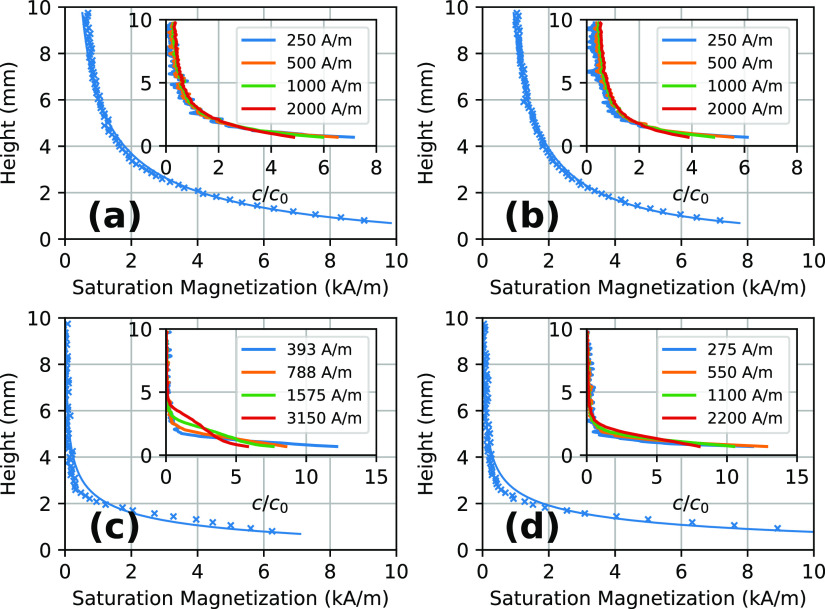
Dilute ferrofluids have important applications in the separation of materials via magnetic levitation. However, dilute ferrofluids pose an additional challenge compared to concentrated ones. Migration of the magnetic nanoparticles toward a magnet is not well counteracted by a buildup of an osmotic pressure gradient, and consequently, homogeneity of the fluid is gradually lost. Here, we investigate this phenomenon by measuring and numerically modeling time-dependent concentration profiles in aqueous ferrofluids in the field of a neodymium magnet and at 10 T in a Bitter magnet. The numerical model incorporates magnetic, frictional, and osmotic forces on the particles and takes into account the polydispersity of the particles and the spatial dependence of the magnetic field. The magnetic sedimentation rate in our most stable ferrofluids can be understood in terms of the magnetophoresis of separate nanoparticles, a best-case scenario when it comes to applications.
稀磁流体在通过磁悬浮分离材料方面有重要应用。然而,与浓磁流体相比,稀磁流体带来了额外的挑战。磁性纳米粒子向磁铁迁移的过程中,渗透压梯度的建立并不能很好地抵消,因此,流体的均一性逐渐丧失。在这里,我们通过在钕磁铁的磁场中和在 Bitter 磁铁中 10T 的条件下测量和数值模拟水基磁流体中随时间变化的浓度分布来研究这一现象。数值模型考虑了颗粒的磁场、摩擦和渗透压,并考虑了颗粒的多分散性和磁场的空间依赖性。在我们最稳定的磁流体中,磁沉降速率可以用单个纳米颗粒的磁泳来解释,这在应用方面是一个最佳情况。