Department of Chemistry and Chemical Engineering, Chalmers University of Technology, Kemivägen 9, 412 96, Göteborg, Sweden.
Sci Rep. 2020 Aug 20;10(1):14040. doi: 10.1038/s41598-020-70562-5.
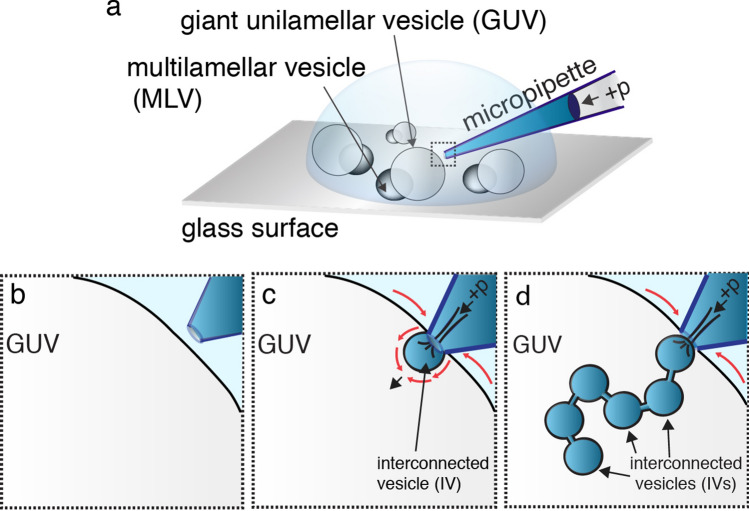
We introduce an experimental method based upon a glass micropipette microinjection technique for generating a multitude of interconnected vesicles (IVs) in the interior of a single giant unilamellar phospholipid vesicle (GUV) serving as a cell model system. The GUV membrane, consisting of a mixture of soybean polar lipid extract and anionic phosphatidylserine, is adhered to a multilamellar lipid vesicle that functions as a lipid reservoir. Continuous IV formation was achieved by bringing a micropipette in direct contact with the outer GUV surface and subjecting it to a localized stream of a Ca solution from the micropipette tip. IVs are rapidly and sequentially generated and inserted into the GUV interior and encapsulate portions of the micropipette fluid content. The IVs remain connected to the GUV membrane and are interlinked by short lipid nanotubes and resemble beads on a string. The vesicle chain-growth from the GUV membrane is maintained for as long as there is the supply of membrane material and Ca solution, and the size of the individual IVs is controlled by the diameter of the micropipette tip. We also demonstrate that the IVs can be co-loaded with high concentrations of neurotransmitter and protein molecules and displaying a steep calcium ion concentration gradient across the membrane. These characteristics are analogous to native secretory vesicles and could, therefore, serve as a model system for studying secretory mechanisms in biological systems.
我们介绍了一种基于玻璃微量移液器微注射技术的实验方法,用于在单个巨单层磷脂囊泡(GUV)内部生成多个相互连接的囊泡(IVs),该 GUV 作为细胞模型系统。GUV 膜由大豆极性脂质提取物和阴离子磷脂酰丝氨酸的混合物组成,粘附在多层层状脂质囊泡上,作为脂质储库。通过将微量移液器直接接触外 GUV 表面,并从微量移液器尖端施加局部 Ca 溶液流,实现连续 IV 形成。IVs 迅速且连续地生成并插入 GUV 内部,并包裹微量移液器流体内容物的部分。IVs 仍然与 GUV 膜相连,并通过短脂质纳米管相互连接,类似于串珠。只要有膜材料和 Ca 溶液的供应,囊泡就会从 GUV 膜上不断生长,并且每个 IVs 的大小由微量移液器尖端的直径控制。我们还证明,IVs 可以与高浓度的神经递质和蛋白质分子共加载,并在膜上显示出陡峭的钙离子浓度梯度。这些特性类似于天然分泌囊泡,因此可以作为研究生物系统中分泌机制的模型系统。