
槲皮素在水中抗氧化活性期间氧化还原能量的流动。
The Flow of the Redox Energy in Quercetin during Its Antioxidant Activity in Water.
机构信息
Department of Pharmacology and Toxicology, Faculty of Health, Medicine and Life Sciences, Maastricht University, P.O. Box 616, 6200 MD Maastricht, The Netherlands.
Research Centre Material Sciences, Zuyd University of Applied Sciences, 6419 DJ Heerlen, The Netherlands.
出版信息
Int J Mol Sci. 2020 Aug 21;21(17):6015. doi: 10.3390/ijms21176015.
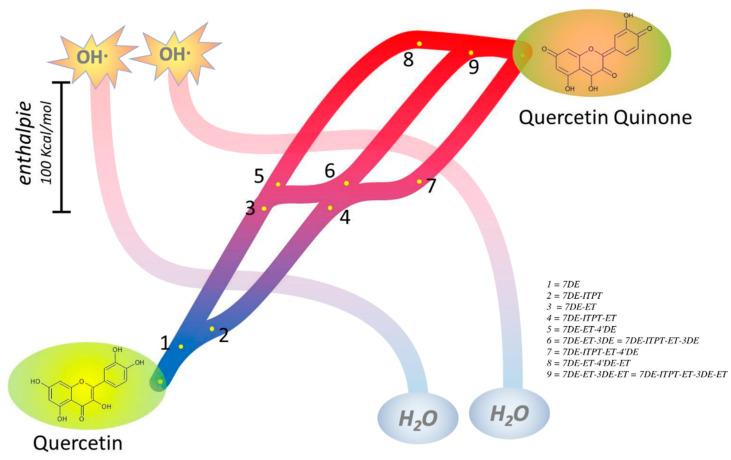
Most studies on the antioxidant activity of flavonoids like Quercetin (Q) do not consider that it comprises a series of sequential reactions. Therefore, the present study examines how the redox energy flows through the molecule during Q's antioxidant activity, by combining experimental data with quantum calculations. It appears that several main pathways are possible. Pivotal are subsequently: deprotonation of the 7-OH group; intramolecular hydrogen transfer from the 3-OH group to the 4-Oxygen atom; electron transfer leading to two conformers of the Q radical; deprotonation of the OH groups in the B-ring, leading to three different deprotonated Q radicals; and finally electron transfer of each deprotonated Q radical to form the corresponding quercetin quinones. The quinone in which the carbonyl groups are the most separated has the lowest energy content, and is the most abundant quinone. The pathways are also intertwined. The calculations show that Q can pick up redox energy at various sites of the molecule which explains Q's ability to scavenge all sorts of reactive oxidizing species. In the described pathways, Q picked up, e.g., two hydroxyl radicals, which can be processed and softened by forming quercetin quinone.
大多数关于类黄酮(如槲皮素(Q))抗氧化活性的研究都没有考虑到它包含一系列连续的反应。因此,本研究通过将实验数据与量子计算相结合,考察了 Q 在抗氧化活性过程中氧化还原能量如何在分子中流动。似乎有几种主要途径是可能的。关键随后是:7-OH 基团的去质子化;3-OH 基团与 4-氧原子之间的分子内氢键转移;导致 Q 自由基两种构象的电子转移;B 环中 OH 基团的去质子化,导致三种不同的去质子化 Q 自由基;最后,每个去质子化 Q 自由基的电子转移形成相应的槲皮素醌。羰基分离程度最大的醌具有最低的能量含量,也是最丰富的醌。这些途径也相互交织。计算表明,Q 可以在分子的各个部位获取氧化还原能量,这解释了 Q 能够清除各种活性氧化物质的能力。在描述的途径中,Q 例如,它可以通过形成槲皮素醌来处理和软化吸收的两个羟基自由基。


 Zotero 插件