Hahn Hye Jee, Escrig Jose Ignacio, Shing Brian, Debnath Anjan
Center for Discovery and Innovation in Parasitic Diseases, Skaggs School of Pharmacy and Pharmaceutical Sciences, University of California, San Diego, CA 92093, USA.
Pathogens. 2020 Aug 21;9(9):681. doi: 10.3390/pathogens9090681.
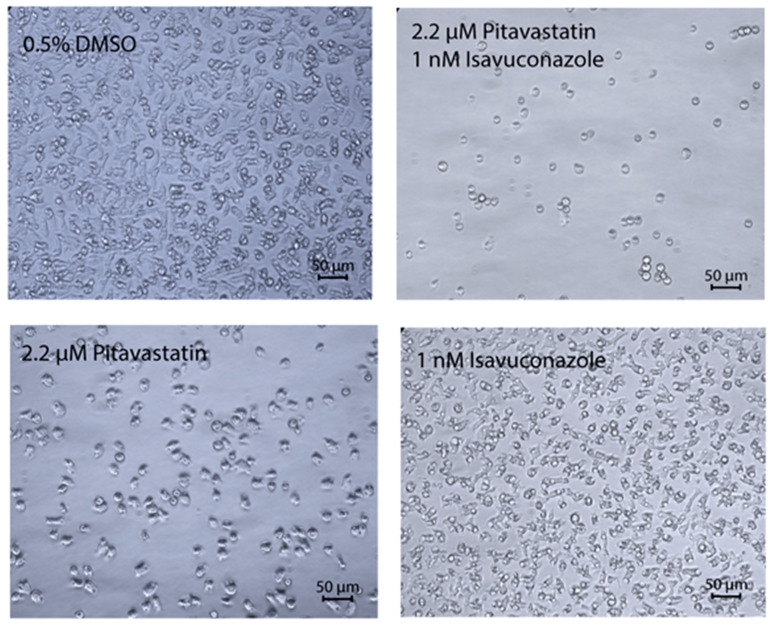
keratitis (AK) can occur in healthy individuals wearing contact lenses and it is a painful, blinding infection of the cornea caused by a free-living ameba . Current treatment for AK relies on a combination of chlorhexidine, propamidine isethionate, and polyhexamethylene biguanide. However, the current regimen includes an aggressive disinfectant and in 10% of cases recurrent infection ensues. Therefore, development of efficient and safe drugs is a critical unmet need to avert blindness. sterol biosynthesis includes two essential enzymes HMG-CoA reductase (HMGR) and sterol 14-demethylase (CYP51), and we earlier identified a CYP51 inhibitor isavuconazole that demonstrated nanomolar potency against trophozoites. In this study, we investigated the effect of well-tolerated HMGR inhibitors and identified pitavastatin that is active against trophozoites of three different clinical strains of . Pitavastatin demonstrated an EC of 0.5 to 1.9 µM, depending on strains. Combination of pitavastatin and isavuconazole is synergistic and led to 2- to 9-fold dose reduction for pitavastatin and 11- to 4000-fold dose reduction for isavuconazole to achieve 97% of growth inhibition. Pitavastatin, either alone or in combination with isavuconazole, may lead to repurposing for the treatment of keratitis.
棘阿米巴角膜炎(AK)可发生于佩戴隐形眼镜的健康个体,是一种由自由生活阿米巴引起的角膜疼痛性致盲感染。目前AK的治疗依赖于洗必泰、依西酸丙脒和聚六亚甲基双胍的联合使用。然而,目前的治疗方案包含一种强效消毒剂,10%的病例会出现反复感染。因此,开发高效且安全的药物是预防失明的一项关键未满足需求。甾醇生物合成包括两种关键酶,即3-羟基-3-甲基戊二酰辅酶A还原酶(HMGR)和甾醇14-去甲基酶(CYP51),我们之前鉴定出一种CYP51抑制剂艾沙康唑,其对滋养体具有纳摩尔级别的效力。在本研究中,我们研究了耐受性良好的HMGR抑制剂的作用,并鉴定出匹伐他汀对三种不同临床菌株的滋养体具有活性。匹伐他汀的半数效应浓度(EC)为0.5至1.9 μM,具体取决于菌株。匹伐他汀和艾沙康唑联合使用具有协同作用,可使匹伐他汀的剂量降低2至9倍,艾沙康唑的剂量降低11至4000倍,以实现97%的生长抑制。匹伐他汀单独使用或与艾沙康唑联合使用,可能会使其重新用于棘阿米巴角膜炎的治疗。