Sanchez Jessica N, Hudgens Brian R
Institute for Wildlife Studies, P.O. Box 1104, Arcata, California 95518, USA.
Biol Conserv. 2019 Aug;236:593-603. doi: 10.1016/j.biocon.2019.05.045. Epub 2019 Jun 19.
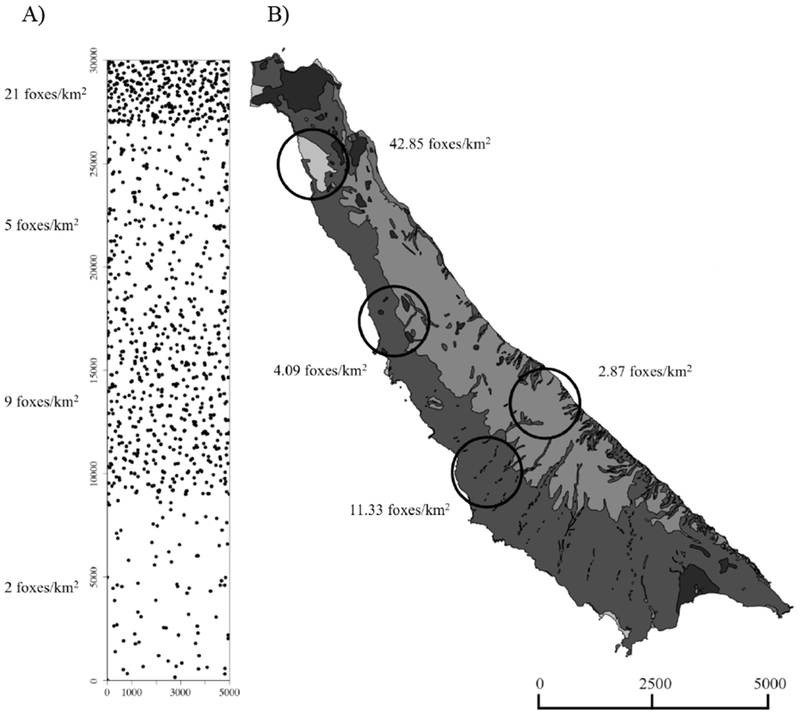
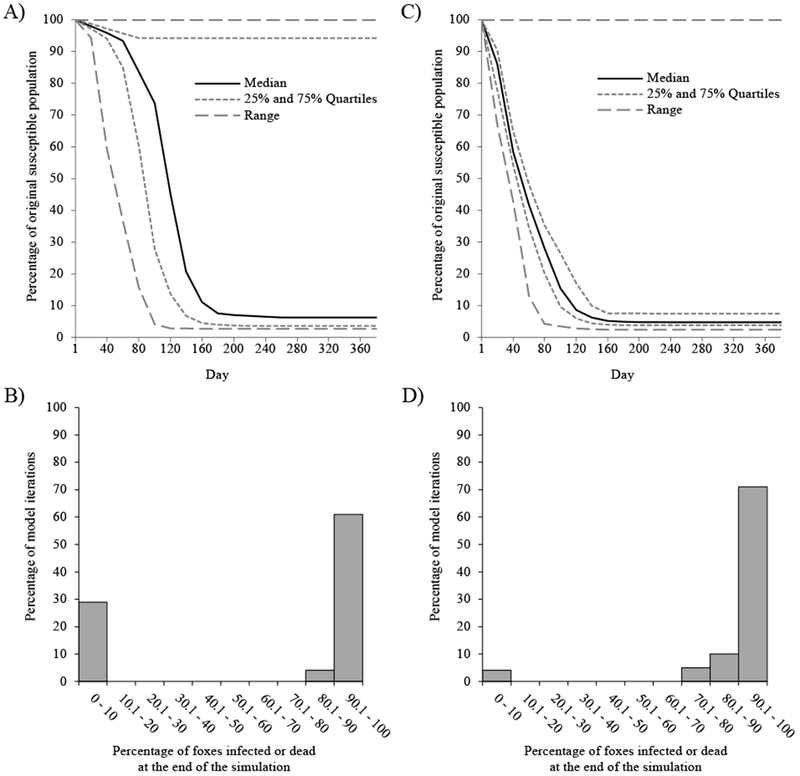
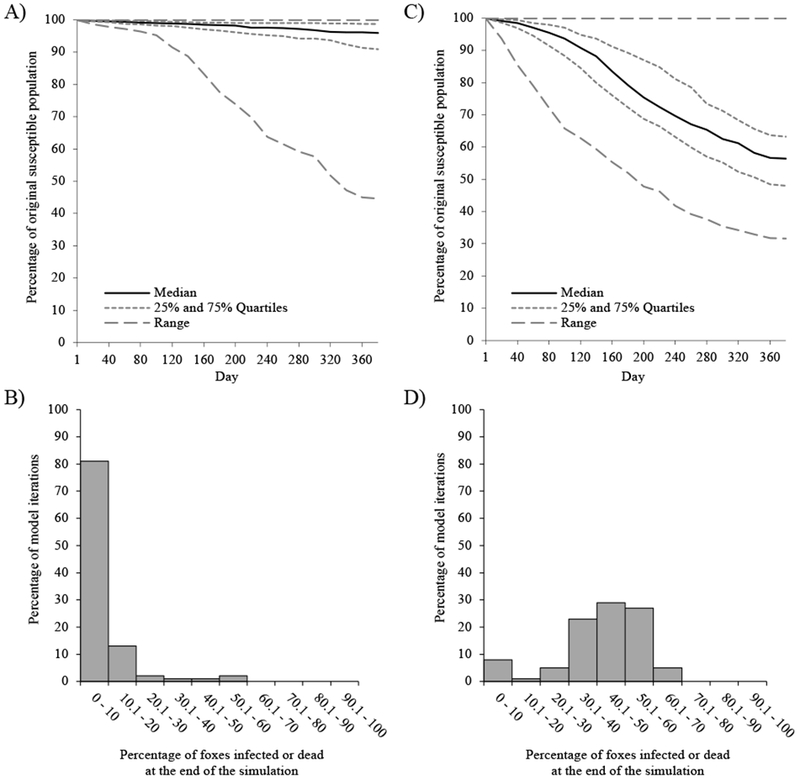
Diseases threaten wildlife populations worldwide and have caused severe declines resulting in host species being listed as threatened or endangered. The risk of a widespread epidemic is especially high when pathogens are introduced to naive host populations, often leading to high morbidity and mortality. Prevention and control of these epidemics is based on knowledge of what drives pathogen transmission among hosts. Previous disease outbreaks suggest the spread of directly transmitted pathogens is determined by host contact rates and local host density. While theoretical models of disease spread typically assume a constant host density, most wildlife populations occur at a variety of densities across the landscape. We explored how spatial heterogeneity in host density influences pathogen spread by simulating the introduction and spread of rabies and canine distemper in a spatially heterogeneous population of Channel Island foxes (), coupling fox density and contact rates with probabilities of viral transmission. For both diseases, the outcome of pathogen introductions varied widely among simulation iterations and depended on the density of hosts at the site of pathogen introduction. Introductions into areas of higher fox densities resulted in more rapid pathogen transmission and greater impact on the host population than if the pathogen was introduced at lower densities. Both pathogens were extirpated in a substantial fraction of iterations. Rabies was over five times more likely to go locally extinct when introduced at low host density sites than at high host-density sites, leaving an average of >99% of foxes uninfected. Canine distemper went extinct in >98% of iterations regardless of introduction site, but only after >90% of foxes had become infected. Our results highlight the difficulty in predicting the course of an epidemic, in part due to complex interactions between pathogen biology and host behavior, exacerbated by the spatial variation of most host populations.
疾病威胁着全球的野生动物种群,已导致其数量严重下降,致使宿主物种被列为受威胁或濒危物种。当病原体被引入对其尚无免疫力的宿主种群时,大规模流行的风险尤其高,常常导致高发病率和高死亡率。这些流行病的预防和控制基于对病原体在宿主间传播驱动因素的了解。以往的疾病暴发表明,直接传播病原体的扩散取决于宿主接触率和当地宿主密度。虽然疾病传播的理论模型通常假定宿主密度恒定,但大多数野生动物种群在整个景观中的密度各不相同。我们通过模拟狂犬病和犬瘟热在海峡群岛狐狸空间异质种群中的引入和传播,将狐狸密度和接触率与病毒传播概率相结合,探讨了宿主密度的空间异质性如何影响病原体传播。对于这两种疾病,病原体引入的结果在模拟迭代中差异很大,并取决于病原体引入地点的宿主密度。与在较低密度下引入病原体相比,在狐狸密度较高的地区引入病原体导致病原体传播更快,对宿主种群的影响更大。在相当一部分迭代中,两种病原体都灭绝了。狂犬病在低宿主密度地点引入时比在高宿主密度地点引入时,局部灭绝的可能性高出五倍多,平均有超过99%的狐狸未被感染。无论引入地点如何,犬瘟热在超过98%的迭代中都灭绝了,但只有在超过90%的狐狸被感染之后才会灭绝。我们的结果凸显了预测流行病进程的困难,部分原因是病原体生物学与宿主行为之间的复杂相互作用,而大多数宿主种群的空间变化又加剧了这种相互作用。