Mass Spectrometry Resource, Division of Endocrinology, Diabetes, Metabolism, and Lipid Research, Department of Medicine, Washington University School of Medicine, St. Louis, MO, United States of America.
Departments of Ophthalmology and Visual Sciences, Washington University School of Medicine, St. Louis, MO, United States of America.
PLoS One. 2020 Aug 24;15(8):e0238081. doi: 10.1371/journal.pone.0238081. eCollection 2020.
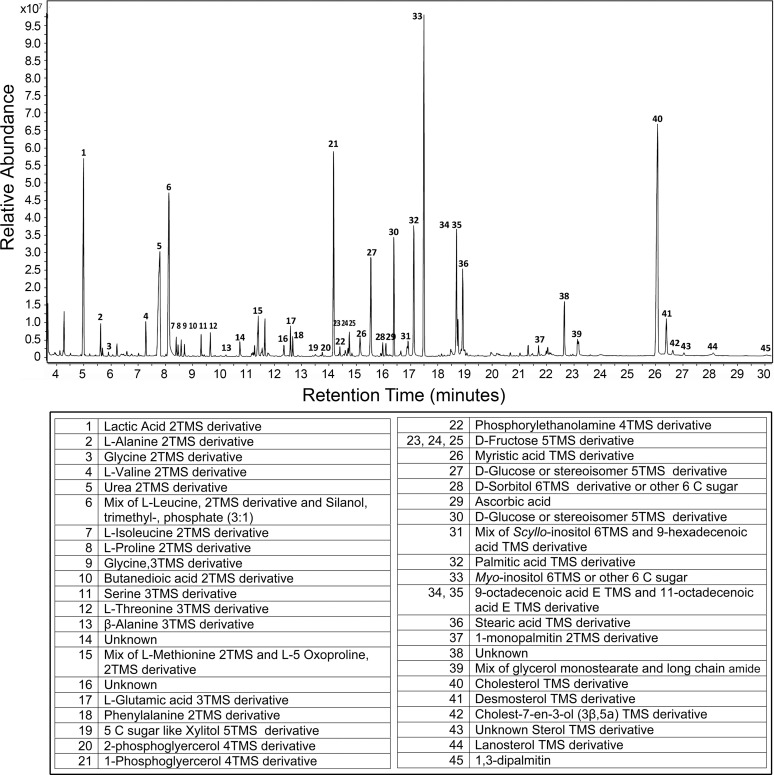
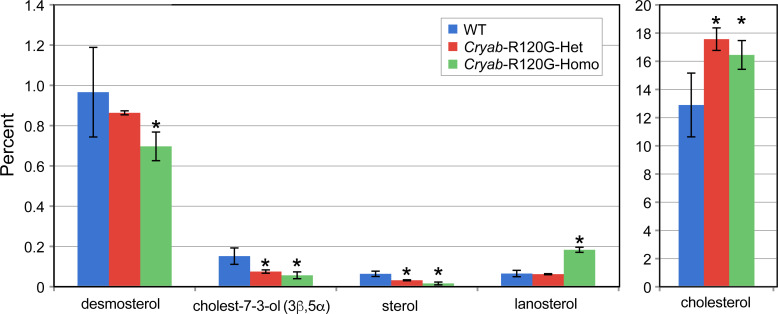
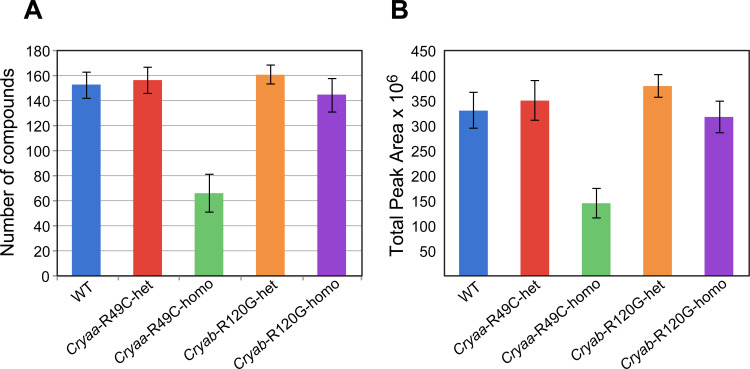
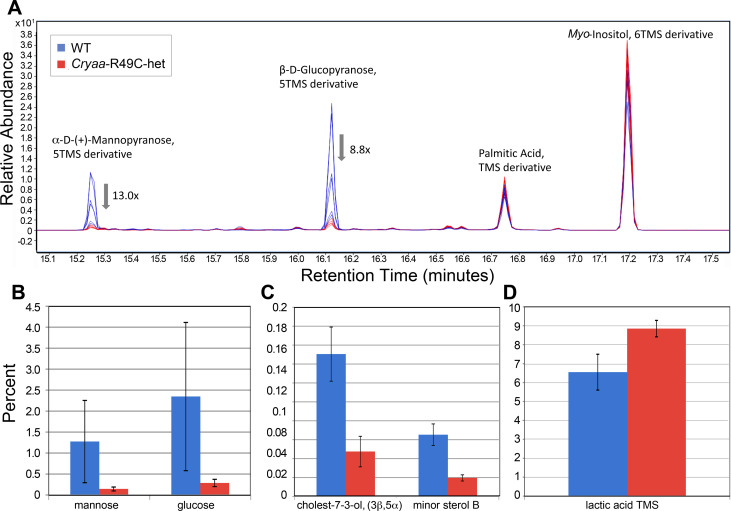
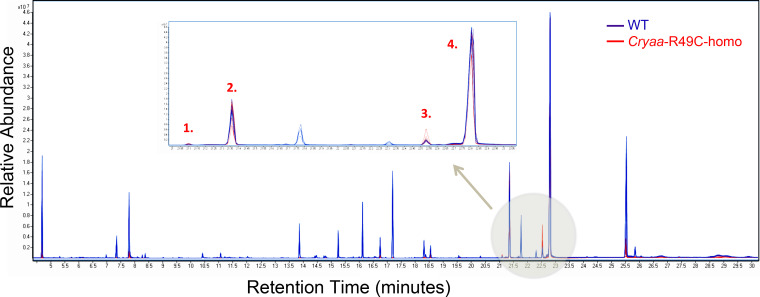
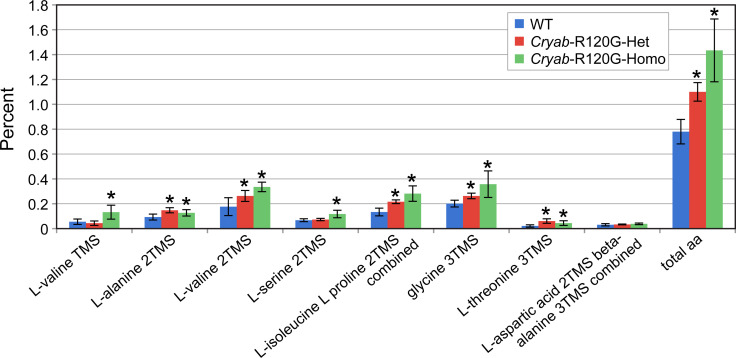
Cataracts are a major cause of blindness worldwide and commonly occur in individuals over 70 years old. Cataracts can also appear earlier in life due to genetic mutations. The lens proteins, αA- and αB-crystallins, are chaperone proteins that have important roles maintaining protein solubility to prevent cataract formation. Mutations in the CRYAA and CRYAB crystallin genes are associated with autosomal dominant early onset human cataracts. Although studies about the proteomic and genomic changes that occur in cataracts have been reported, metabolomics studies are very limited. Here, we directly investigated cataract metabolism using gas-chromatography-mass spectrometry (GC-MS) to analyze the metabolites in adult Cryaa-R49C and Cryab-R120G knock-in mouse lenses. The most abundant metabolites were myo-inositol, L-(+)-lactic acid, cholesterol, phosphate, glycerol phosphate, palmitic and 9-octadecenoic acids, α-D-mannopyranose, and β-D-glucopyranose. Cryaa-R49C knock-in mouse lenses had a significant decrease in the number of sugars and minor sterols, which occurred in concert with an increase in lactic acid. Cholesterol composition was unchanged. In contrast, Cryab-R120G knock-in lenses exhibited increased total amino acid content including valine, alanine, serine, leucine, isoleucine, glycine, and aspartic acid. Minor sterols, including cholest-7-en-3-ol and glycerol phosphate were decreased. These studies indicate that lenses from Cryaa-R49C and Cryab-R120G knock-in mice, which are models for human cataracts, have unique amino acid and metabolite profiles.
白内障是全球范围内导致失明的主要原因,常见于 70 岁以上的人群。由于基因突变,白内障也可能在年轻时出现。晶状体蛋白αA-和αB-晶体蛋白是伴侣蛋白,对于维持蛋白质的可溶性以防止白内障的形成具有重要作用。CRYAA 和 CRYAB 晶体蛋白基因突变与常染色体显性遗传的早发性人类白内障有关。尽管已经报道了有关白内障中发生的蛋白质组学和基因组变化的研究,但代谢组学研究非常有限。在这里,我们使用气相色谱-质谱联用(GC-MS)直接研究白内障代谢,以分析成年 Cryaa-R49C 和 Cryab-R120G 敲入小鼠晶状体中的代谢物。最丰富的代谢物是肌醇、L-(+)-乳酸、胆固醇、磷酸盐、甘油磷酸、棕榈酸和 9-十八烯酸、α-D-甘露吡喃糖和β-D-吡喃葡萄糖。Cryaa-R49C 敲入小鼠晶状体中的糖和少量固醇数量显著减少,同时乳酸增加。胆固醇组成不变。相比之下,Cryab-R120G 敲入晶状体表现出总氨基酸含量增加,包括缬氨酸、丙氨酸、丝氨酸、亮氨酸、异亮氨酸、甘氨酸和天冬氨酸。少量固醇,包括胆甾-7-烯-3-醇和甘油磷酸减少。这些研究表明,Cryaa-R49C 和 Cryab-R120G 敲入小鼠的晶状体,作为人类白内障的模型,具有独特的氨基酸和代谢物谱。