Khan Owais, Daddi Tiberio, Slabbinck Hendrik, Kleinhans Kerstin, Vazquez-Brust Diego, De Meester Steven
Department of Green Chemistry and Technology, Ghent University, Coupure Links 653, block B, 9000 Ghent, Belgium.
EMbeDS - Institute of Management, Scuola Superiore Sant'Anna, Piazza Martiri della Libertà, 33, 56127 Pisa, Italy.
Resour Conserv Recycl. 2020 Dec;163:105069. doi: 10.1016/j.resconrec.2020.105069. Epub 2020 Aug 1.
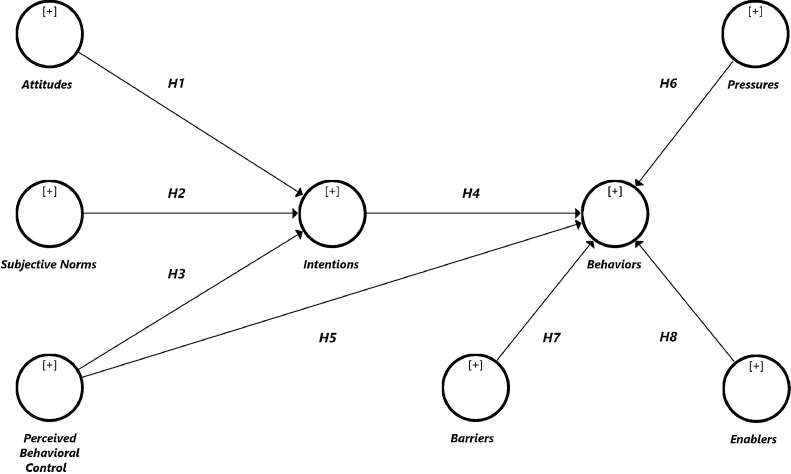
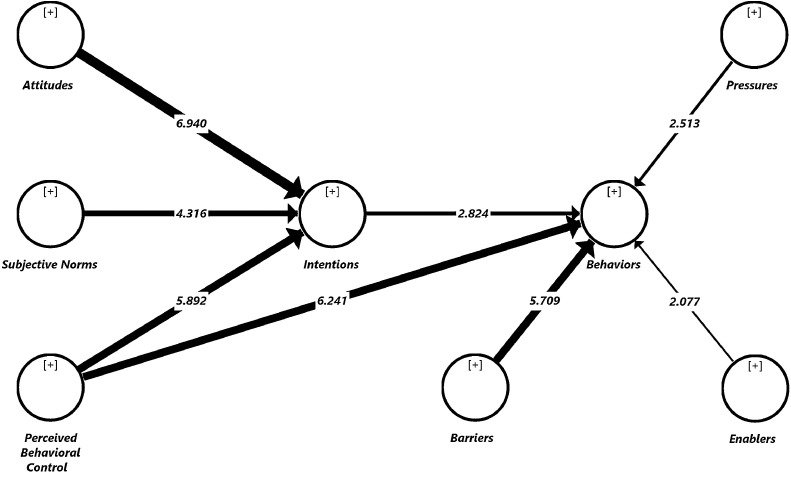
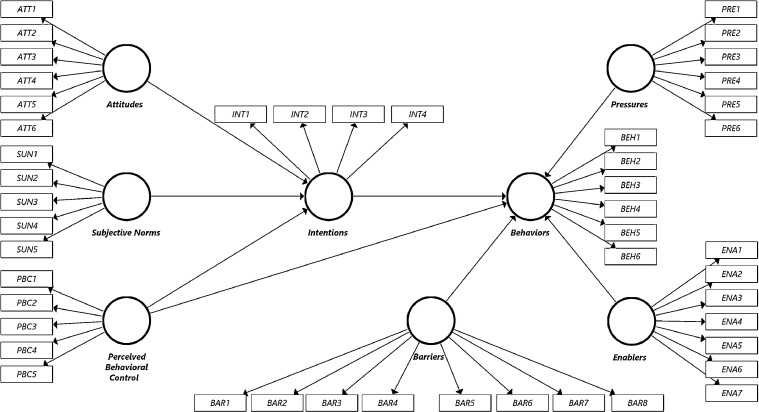
The production and consumption of plastics, although inevitable in our modern life, are predominantly unsustainable and inefficient. Hence, the concept of a circular economy for plastics has been proposed as a sustainable approach to thrive both economy and our modern life. To implement a circular economy for plastics, an understanding of both individuals' and organizations' behaviors is needed since psychological effects often undermine technical solutions. We particularly focus on organizations' behaviors since commercial plastic waste has not been thoroughly investigated compared to household plastic waste. Using the Theory of Planned Behavior (TPB) and Partial Least Squares Structural Equation Modeling (PLS-SEM), we assess the determinants of intentions and behaviors of 637 organizations in Belgium towards a circular economy for plastics. Our PLS-SEM analysis support that attitudes, subjective norms, and perceived behavioral control of decision makers positively influence organizations' intentions to implement best practices of plastic recycling. Furthermore, organizations' intentions, perceived behavioral control, pressures, and enablers positively, whereas barriers negatively, influence organizations' behaviors. Our study shows that most organizations have positive intentions, yet they seem to be failing in implementing best practices of plastic recycling due to some critical barriers. To overcome this intention-behavior gap and to attain a circular economy for plastics, our study suggests some measures.
塑料的生产和消费,尽管在我们的现代生活中不可避免,但总体上是不可持续且低效的。因此,塑料循环经济的概念被提出,作为一种使经济和现代生活蓬勃发展的可持续方法。要实施塑料循环经济,需要了解个人和组织的行为,因为心理效应常常会破坏技术解决方案。我们特别关注组织的行为,因为与家庭塑料垃圾相比,商业塑料垃圾尚未得到充分研究。我们运用计划行为理论(TPB)和偏最小二乘结构方程模型(PLS-SEM),评估了比利时637个组织对塑料循环经济的意图和行为的决定因素。我们的PLS-SEM分析支持以下观点:决策者的态度、主观规范和感知行为控制对组织实施塑料回收最佳实践的意图有积极影响。此外,组织的意图、感知行为控制、压力和促进因素对组织的行为有积极影响,而障碍则有消极影响。我们的研究表明,大多数组织有积极的意图,但由于一些关键障碍,它们似乎未能实施塑料回收的最佳实践。为了克服这种意图-行为差距并实现塑料循环经济,我们的研究提出了一些措施。