Patrício Silva Ana L, Prata Joana C, Walker Tony R, Duarte Armando C, Ouyang Wei, Barcelò Damià, Rocha-Santos Teresa
Centre for Environmental and Marine Studies (CESAM) & Department of Biology, University of Aveiro, 3810-193 Aveiro, Portugal.
Centre for Environmental and Marine Studies (CESAM) & Department of Chemistry, University of Aveiro, 3810-193 Aveiro, Portugal.
Chem Eng J. 2021 Feb 1;405:126683. doi: 10.1016/j.cej.2020.126683. Epub 2020 Aug 17.
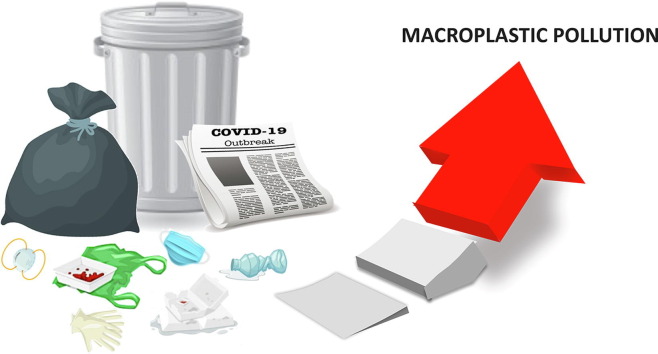
Plastics have become a severe transboundary threat to natural ecosystems and human health, with studies predicting a twofold increase in the number of plastic debris (including micro and nano-sized plastics) by 2030. However, such predictions will likely be aggravated by the excessive use and consumption of single-use plastics (including personal protective equipment such as masks and gloves) due to COVID-19 pandemic. This review aimed to provide a comprehensive overview on the effects of COVID-19 on macroplastic pollution and its potential implications on the environment and human health considering short- and long-term scenarios; addressing the main challenges and discussing potential strategies to overcome them. It emphasises that future measures, involved in an emergent health crisis or not, should reflect a balance between public health and environmental safety as they are both undoubtedly connected. Although the use and consumption of plastics significantly improved our quality of life, it is crucial to shift towards sustainable alternatives, such as bio-based plastics. Plastics should remain in the top of the political agenda in Europe and across the world, not only to minimise plastic leakage and pollution, but to promote sustainable growth and to stimulate both green and blue- economies. Discussions on this topic, particularly considering the excessive use of plastic, should start soon with the involvement of the scientific community, plastic producers and politicians in order to be prepared for the near future.
塑料已成为对自然生态系统和人类健康的严重跨界威胁,研究预测到2030年塑料碎片(包括微塑料和纳米塑料)的数量将增加一倍。然而,由于新冠疫情导致一次性塑料(包括口罩和手套等个人防护装备)的过度使用和消费,这些预测可能会加剧。本综述旨在全面概述新冠疫情对宏观塑料污染的影响及其在短期和长期情况下对环境和人类健康的潜在影响;解决主要挑战并讨论克服这些挑战的潜在策略。它强调,未来的措施,无论是否涉及突发健康危机,都应在公共卫生和环境安全之间取得平衡,因为它们无疑是相互关联的。尽管塑料的使用和消费显著提高了我们的生活质量,但转向可持续替代品,如生物基塑料,至关重要。塑料问题应继续位列欧洲乃至全球政治议程的首要位置,这不仅是为了尽量减少塑料泄漏和污染,也是为了促进可持续增长并刺激绿色经济和蓝色经济。关于这个话题的讨论,特别是考虑到塑料的过度使用,应尽快在科学界、塑料生产商和政治家的参与下展开,以便为不久的将来做好准备。