Diamond Shawn, Lundy Jonathan B, Weber Erin L, Lalezari Shadi, Rafijah Gregory, Leis Amber, Gray Benjamin L, Lin Ines C, Gupta Ranjan
Department of Plastic Surgery, University of California, Irvine, Orange, CA.
Department of Orthopaedic Surgery, University of California, Irvine, Orange, CA.
J Hand Surg Glob Online. 2020 Jul;2(4):175-181. doi: 10.1016/j.jhsg.2020.05.004. Epub 2020 May 29.
Limited data exist regarding volumetric trends and management of upper-extremity emergencies during periods of social restriction and duress, such as the coronavirus disease 2019 pandemic. We sought to study the effect of shelter-in-place orders on emergent operative upper-extremity surgery.
All patients undergoing emergent and time-sensitive operations to the finger(s), hand, wrist, and forearm were tracked over an equal number of days before and after shelter-in-place orders at 2 geographically distinct Level I trauma centers. Surgical volume and resources, patient demographics, and injury patterns were compared before and after official shelter-in-place orders.
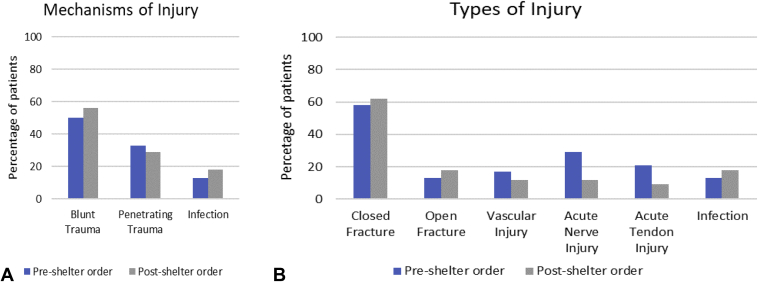
A total of 58 patients underwent time-sensitive or emergent operations. Mean patient age was 42 years; mean injury severity score was 9 and median American Society of Anesthesiologist score was 2. There was a 40% increase in volume after shelter-in-place orders, averaging 1.4 cases/d. Indications for surgery included high-energy closed fracture (60%), traumatic nerve injury (19%), severe soft tissue infection (15%), and revascularization of the arm, hand, or digit(s) (15%). High-risk behavior, defined as lawlessness, assault, and high-speed auto accidents, was associated with a significantly greater proportion of operations after shelter-in-place orders (40% vs 12.5%; < .05). Each institution dedicated an average of 3 inpatient beds and one intensive care unit-capable bed to upper-extremity care daily. Resources used included an average of 115 minutes of daily operating room time and 8 operating room staff or personnel per case.
Hand and upper-extremity operative volume increased after shelter-in-place orders at 2 major Level I trauma centers across the country, demanding considerable hospital resources. The rise in volume was associated with an increase in high-risk behavior.
TYPE OF STUDY/LEVEL OF EVIDENCE: Therapeutic IV.
关于在社会限制和胁迫时期,如2019年冠状病毒病大流行期间上肢急症的容量趋势和管理,现有数据有限。我们试图研究就地避难令对上肢急诊手术的影响。
在两个地理位置不同的一级创伤中心,对所有接受手指、手部、腕部和前臂急诊及时间敏感手术的患者,在就地避难令发布前后的相同天数内进行跟踪。比较官方就地避难令发布前后的手术量、资源、患者人口统计学特征和损伤模式。
共有58例患者接受了时间敏感或急诊手术。患者平均年龄为42岁;平均损伤严重程度评分为9分,美国麻醉医师协会评分中位数为2分。就地避难令发布后手术量增加了40%,平均每天1.4例。手术指征包括高能闭合性骨折(60%)、创伤性神经损伤(19%)、严重软组织感染(15%)以及手臂、手部或手指的血管重建(15%)。高风险行为,定义为违法、袭击和高速汽车事故,与就地避难令发布后手术比例显著增加相关(40%对12.5%;P<0.05)。每个机构平均每天为上肢护理分配3张住院床位和1张重症监护病房床位。使用的资源包括平均每天115分钟的手术室时间和每例手术8名手术室工作人员。
在全国两个主要的一级创伤中心,就地避难令发布后手部和上肢手术量增加,需要大量医院资源。手术量的增加与高风险行为的增加相关。
研究类型/证据水平:治疗性IV级。