Department of Neurology, Ulm University Hospital, 89070, Ulm, Germany.
Department of Neurology and Stroke, University Hospital of Tübingen, 72076, Tübingen, Germany.
J Neurol. 2021 Apr;268(4):1133-1170. doi: 10.1007/s00415-020-10124-x. Epub 2020 Aug 25.
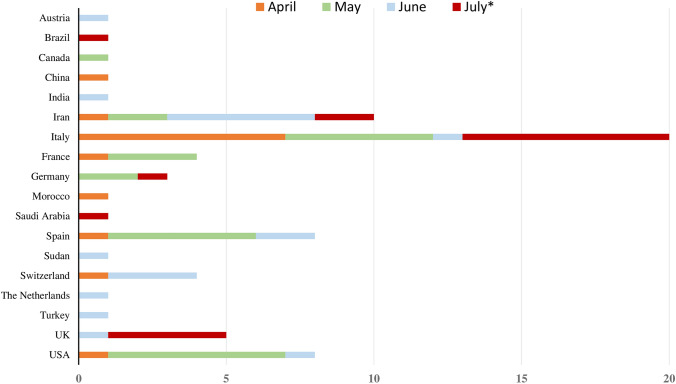
Since coronavirus disease-2019 (COVID-19) outbreak in January 2020, several pieces of evidence suggested an association between the spectrum of Guillain-Barré syndrome (GBS) and severe acute respiratory syndrome coronavirus-2 (SARS-CoV-2). Most findings were reported in the form of case reports or case series, whereas a comprehensive overview is still lacking. We conducted a systematic review and searched for all published cases until July 20th 2020. We included 73 patients reported in 52 publications. A broad age range was affected (mean 55, min 11-max 94 years) with male predominance (68.5%). Most patients showed respiratory and/or systemic symptoms, and developed GBS manifestations after COVID-19. However, asymptomatic cases for COVID-19 were also described. The distributions of clinical variants and electrophysiological subtypes resemble those of classic GBS, with a higher prevalence of the classic sensorimotor form and the acute inflammatory demyelinating polyneuropathy, although rare variants like Miller Fisher syndrome were also reported. Cerebrospinal fluid (CSF) albuminocytological dissociation was present in around 71% cases, and CSF SARS-CoV-2 RNA was absent in all tested cases. More than 70% of patients showed a good prognosis, mostly after treatment with intravenous immunoglobulin. Patients with less favorable outcome were associated with a significantly older age in accordance with previous findings regarding both classic GBS and COVID-19. COVID-19-associated GBS seems to share most features of classic post-infectious GBS and possibly the same immune-mediated pathogenetic mechanisms. Nevertheless, more extensive epidemiological studies are needed to clarify these issues.
自 2020 年 1 月新冠肺炎(COVID-19)爆发以来,有几项证据表明,格林-巴利综合征(GBS)的发病谱与严重急性呼吸综合征冠状病毒-2(SARS-CoV-2)之间存在关联。大多数发现是以病例报告或病例系列的形式报告的,而全面的综述仍然缺乏。我们进行了系统的综述,并搜索了截至 2020 年 7 月 20 日发表的所有病例。我们纳入了 52 篇文献报道的 73 例患者。受影响的年龄范围很广(平均 55 岁,最小 11 岁,最大 94 岁),男性居多(68.5%)。大多数患者出现呼吸道和/或全身症状,并在 COVID-19 后出现 GBS 表现。然而,也有描述无症状的 COVID-19 病例。临床变异型和电生理亚型的分布与经典 GBS 相似,经典的感觉运动形式和急性炎症性脱髓鞘性多发性神经病更为常见,尽管也有Miller Fisher 综合征等罕见变异型。约 71%的病例存在脑脊液(CSF)白蛋白细胞分离,所有检测病例的 CSF SARS-CoV-2 RNA 均为阴性。超过 70%的患者预后良好,大多数患者在接受静脉免疫球蛋白治疗后得到改善。预后较差的患者与经典 GBS 和 COVID-19 相关的年龄较大有关。COVID-19 相关的 GBS 似乎与经典感染后 GBS 有许多共同特征,并且可能具有相同的免疫介导的发病机制。然而,需要进行更广泛的流行病学研究来阐明这些问题。