Tsuji Naoko, Umehara Yasuko, Takenaka Mamoru, Minami Yasunori, Watanabe Tomohiro, Nishida Naoshi, Kudo Masatoshi
Department of Gastroenterology and Hepatology, Kindai University Faculty of Medicine, Osaka-Sayama, Japan.
Gastroenterol Rep (Oxf). 2019 Oct 30;8(4):293-298. doi: 10.1093/gastro/goz057. eCollection 2020 Aug.
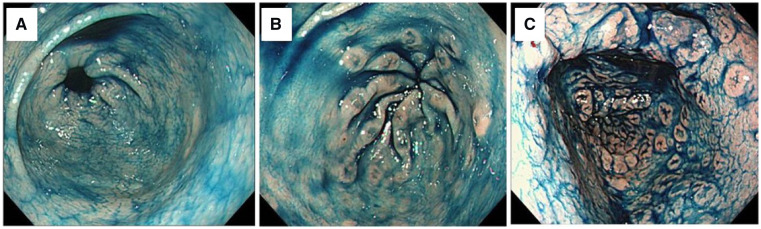
There have been few studies in the English literature regarding verrucous gastritis (VG). The present study investigated the clinical and endoscopic features of verrucous antral gastritis, especially focusing on infection, nutrition, and gastric atrophy.
We performed a retrospective study of patients who underwent routine endoscopy with indigo carmine chromoendoscopy and a comparative study was conducted between VG-positive and VG-negative groups. VG was subdivided into classical and numerous types based on the number and distribution of verrucous lesions. Demographic, clinical, and endoscopic data including body mass index (BMI), serum albumin and cholesterol, gastric atrophy, reflux oesophagitis, Barrett's oesophagus, and status were collected. Univariate and multivariable analyses were performed to identify factors associated with VG.
We analysed the data of 621 patients undergoing routine endoscopy and found that VG (=352) was significantly associated with increased BMI (1.12 [1.05-1.18], <0.01), reflux esophagitis (1.96 [1.10-3.28], <0.01), and negativity with or without a history of eradication (9.94 [6.00-16.47] and 6.12 [3.51-10.68], <0.001, respectively). Numerous-type (=163) VG was associated with both closed- and open-type gastric atrophy (9.9 [4.04-21.37] and 8.10 [3.41-19.24], <0.001, respectively). There were no statistical differences between groups regarding age, sex, total cholesterol, albumin, and bile-colored gastric juice.
Verrucous antral gastritis was related to increased BMI, reflux esophagitis, and negativity. Numerous-type verrucous lesions were associated with gastric atrophy. These indicate that VG may be a physiological phenomenon due to high gastric acidity, mechanical overload, and vulnerability of background mucosa.
英文文献中关于疣状胃炎(VG)的研究较少。本研究调查了疣状胃窦炎的临床和内镜特征,尤其关注感染、营养和胃萎缩情况。
我们对接受常规内镜检查并进行靛胭脂染色内镜检查的患者进行了回顾性研究,并在VG阳性组和VG阴性组之间进行了比较研究。根据疣状病变的数量和分布,将VG分为经典型和多发型。收集了包括体重指数(BMI)、血清白蛋白和胆固醇、胃萎缩、反流性食管炎、巴雷特食管以及幽门螺杆菌状态等人口统计学、临床和内镜数据。进行单因素和多因素分析以确定与VG相关的因素。
我们分析了621例接受常规内镜检查患者的数据,发现VG(=352)与BMI增加(1.12 [1.05 - 1.18],P<0.01)、反流性食管炎(1.96 [1.10 - 3.28],P<0.01)以及幽门螺杆菌阴性(无论有无根除史,分别为9.94 [6.00 - 16.47]和6.12 [3.51 - 10.68],P<0.001)显著相关。多发型(=163)VG与闭合型和开放型胃萎缩均相关(分别为9.9 [4.04 - 21.37]和8.10 [3.41 - 19.24],P<0.001)。两组在年龄、性别、总胆固醇、白蛋白和胆汁色胃液方面无统计学差异。
疣状胃窦炎与BMI增加、反流性食管炎和幽门螺杆菌阴性有关。多发型疣状病变与胃萎缩相关。这些表明VG可能是由于胃酸过高、机械性负荷过重以及背景黏膜易损性导致的一种生理现象。