Zhang Fan, Iwaki Sunao
Graduate School of Comprehensive Human Sciences, University of Tsukuba, Tsukuba, Japan.
Department of Information Technology and Human Factors, National Institute of Advanced Industrial Science and Technology (AIST), Tsukuba, Japan.
Front Hum Neurosci. 2020 Jul 24;14:279. doi: 10.3389/fnhum.2020.00279. eCollection 2020.
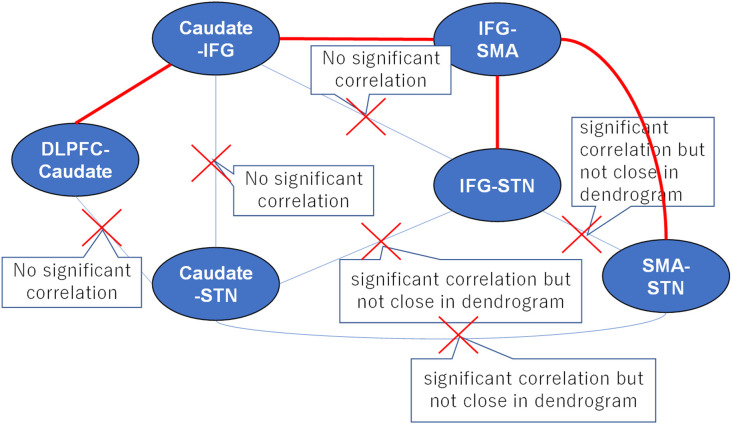
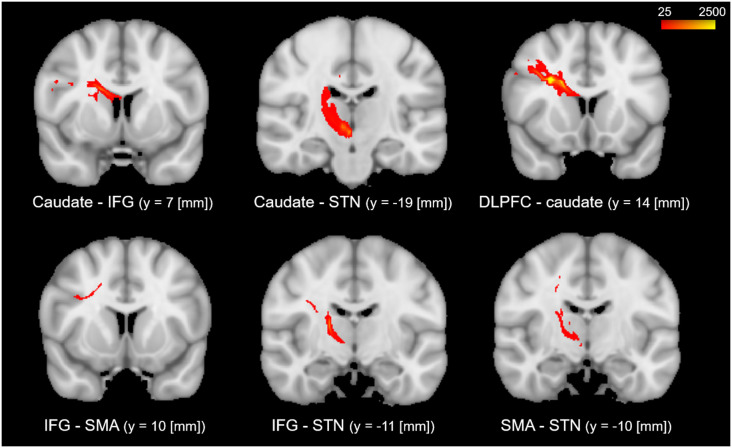
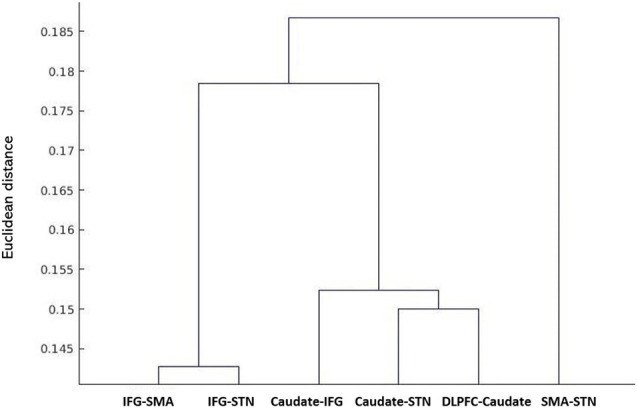
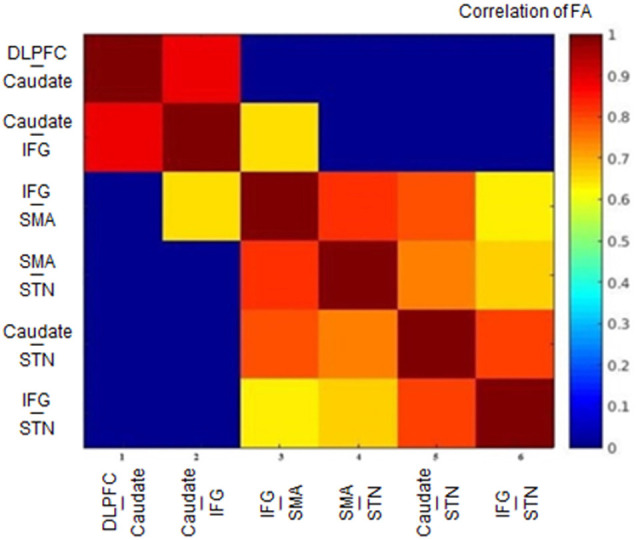
Response inhibition is considered to involve the fronto-basal ganglia circuit including the inferior frontal gyrus (IFG), pre-supplementary motor area (preSMA)/SMA, subthalamic nucleus (STN), and the motor cortices, but it remains unclear whether there exists a correspondence between the anatomical and effective connections between these regions. We defined regions of interest (ROI) based on the results of our previous study, and subsequently used diffusion tensor imaging (DTI), especially probabilistic fiber tractography, for the identification of white matter tracts of interest. Accordingly, we extracted the fractional anisotropy (FA) from the tracts of interest and applied data-driven hierarchical clustering to examine whether a specific pattern exists in white matter tracts. We found three clusters in the fronto-basal ganglia circuits: (1) the IFG-SMA and IFG- STN; (2) the dorsolateral prefrontal cortex (DLPFC)-caudate and caudate-STN and caudate-IFG; and (3) the SMA-STN. Further investigation with pairwise linear inter-tract FA correlations revealed that there were significant correlations between specific pairs: (1) the DLPFC-caudate and caudate-IFG; (2) the caudate-IFG and IFG-SMA; (3) the IFG-SMA and SMA-STN; (4) the IFG-SMA and caudate-SMA; (5) the IFG-SMA and IFG-STN; (6) the SMA-STN and caudate-STN; (7) the SMA-STN and IFG-STN; and (8) the caudate-STN and IFG-STN. The combination of results from hierarchical clustering and microstructural correlations showed that probabilistic tractography infers effective connectivity: i.e., the DLPFC-caudate-IFG-SMA-STN pathway. Our results revealed that specific clusters in the fronto-basal ganglia circuit and certain pairs of white matter tracts with significant correlations predict the effective pathways (hyper-direct and indirect pathways) in response inhibition.
反应抑制被认为涉及额底神经节回路,包括额下回(IFG)、辅助运动前区(preSMA)/运动辅助区(SMA)、丘脑底核(STN)和运动皮层,但这些区域之间的解剖学连接和有效连接是否存在对应关系仍不清楚。我们根据之前的研究结果定义了感兴趣区域(ROI),随后使用扩散张量成像(DTI),特别是概率纤维束成像,来识别感兴趣的白质束。因此,我们从感兴趣的束中提取了分数各向异性(FA),并应用数据驱动的层次聚类来检查白质束中是否存在特定模式。我们在额底神经节回路中发现了三个聚类:(1)IFG-SMA和IFG-STN;(2)背外侧前额叶皮层(DLPFC)-尾状核、尾状核-STN和尾状核-IFG;(3)SMA-STN。通过成对线性束间FA相关性的进一步研究发现,特定对之间存在显著相关性:(1)DLPFC-尾状核和尾状核-IFG;(2)尾状核-IFG和IFG-SMA;(3)IFG-SMA和SMA-STN;(4)IFG-SMA和尾状核-SMA;(5)IFG-SMA和IFG-STN;(6)SMA-STN和尾状核-STN;(7)SMA-STN和IFG-STN;(8)尾状核-STN和IFG-STN。层次聚类和微观结构相关性的结果相结合表明,概率纤维束成像推断出有效连接性:即DLPFC-尾状核-IFG-SMA-STN通路。我们的结果表明,额底神经节回路中的特定聚类以及某些具有显著相关性的白质束对预测了反应抑制中的有效通路(超直接和间接通路)。