
神经连接蛋白与神经发育障碍:X连锁遗传学
Neuroligins and Neurodevelopmental Disorders: X-Linked Genetics.
作者信息
Nguyen Thien A, Lehr Alexander W, Roche Katherine W
机构信息
Receptor Biology Section, National Institute of Neurological Disorders and Stroke, National Institutes of Health, Bethesda, MD, United States.
Department of Pharmacology and Physiology, Georgetown University, Washington, DC, United States.
出版信息
Front Synaptic Neurosci. 2020 Aug 11;12:33. doi: 10.3389/fnsyn.2020.00033. eCollection 2020.
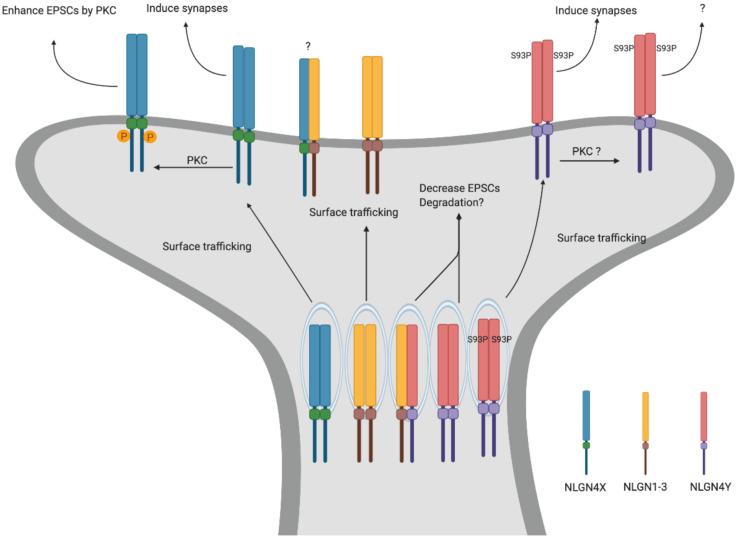
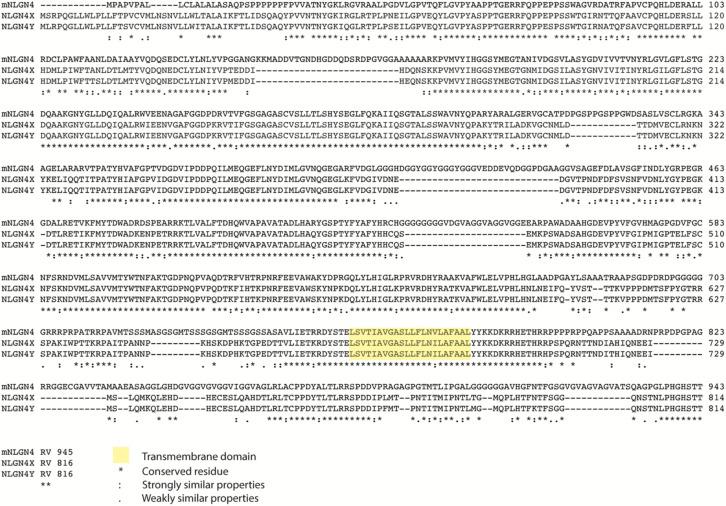
Autism spectrum disorder (ASD) is a neurodevelopmental disorder that results in social-communication impairments, as well as restricted and repetitive behaviors. Moreover, ASD is more prevalent in males, with a male to female ratio of 4 to 1. Although the underlying etiology of ASD is generally unknown, recent advances in genome sequencing have facilitated the identification of a host of associated genes. Among these, synaptic proteins such as cell adhesion molecules have been strongly linked with ASD. Interestingly, many large genome sequencing studies exclude sex chromosomes, which leads to a shift in focus toward autosomal genes as targets for ASD research. However, there are many genes on the X chromosome that encode synaptic proteins, including strong candidate genes. Here, we review findings regarding two members of the neuroligin (NLGN) family of postsynaptic adhesion molecules, and . Neuroligins have multiple isoforms (NLGN1-4), which are both autosomal and sex-linked. The sex-linked genes, and , are both on the X chromosome and were among the first few genes to be linked with ASD and intellectual disability (ID). In addition, there is a less studied human neuroligin on the Y chromosome, NLGN4Y, which forms an X-Y pair with NLGN4X. We will discuss recent findings of these neuroligin isoforms regarding function at the synapse in both rodent models and human-derived differentiated neurons, and highlight the exciting challenges moving forward to a better understanding of ASD/ID.
自闭症谱系障碍(ASD)是一种神经发育障碍,会导致社交沟通障碍以及受限的重复行为。此外,ASD在男性中更为普遍,男女比例为4比1。尽管ASD的潜在病因通常尚不清楚,但基因组测序的最新进展有助于识别许多相关基因。其中,诸如细胞粘附分子等突触蛋白与ASD密切相关。有趣的是,许多大型基因组测序研究排除了性染色体,这导致研究重点转向常染色体基因,将其作为ASD研究的目标。然而,X染色体上有许多编码突触蛋白的基因,包括强有力的候选基因。在这里,我们综述了关于突触后粘附分子神经连接蛋白(NLGN)家族的两个成员NLGN3和NLGN4的研究结果。神经连接蛋白有多种亚型(NLGN1 - 4),它们既存在于常染色体上,也存在于性染色体上。与性染色体相关的基因NLGN3和NLGN4都位于X染色体上,并且是最早与ASD和智力残疾(ID)相关联的少数基因之一。此外,Y染色体上还有一种研究较少的人类神经连接蛋白NLGN4Y,它与NLGN4X形成X - Y配对。我们将讨论这些神经连接蛋白亚型在啮齿动物模型和人类来源的分化神经元突触功能方面的最新研究结果,并强调在更好地理解ASD/ID方面面临的令人兴奋的挑战。
 Zotero 插件