Kaur Savneet, Tripathi Dinesh M, Yadav Angeera
Department of Molecular and Cellular Medicine, Institute of Liver and Biliary Sciences, New Delhi, India.
Department of Pharmacy Practice, National Institute of Pharmaceutical Education and Research, Guwahati, India.
Front Physiol. 2020 Aug 4;11:989. doi: 10.3389/fphys.2020.00989. eCollection 2020.
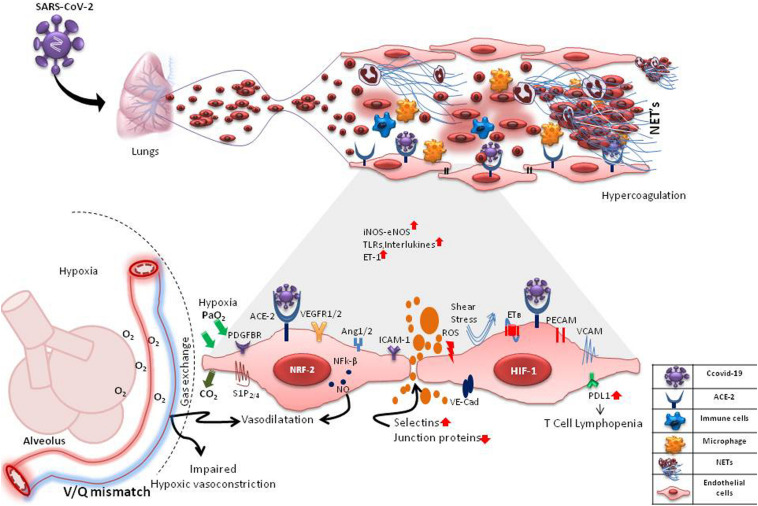
Coronavirus disease 2019 (COVID-19), caused by severe acute respiratory syndrome-related coronavirus-2 (SARS-CoV-2) has affected millions of people globally. Clinically, it presents with mild flu-like symptoms in most cases but can cause respiratory failure in high risk population. With the aim of unearthing newer treatments, scientists all over the globe are striving hard to comprehend the underlying mechanisms of COVID-19. Several studies till date have indicated a dysregulated host immune response as the major cause of COVID-19 induced mortality. In this Perspective, we propose a key role of endothelium, particularly pulmonary endothelium in the pathogenesis of COVID-19. We draw parallels and divergences between COVID-19-induced respiratory distress and bacterial sepsis-induced lung injury and recommend the road ahead with respect to identification of endothelium-based biomarkers and plausible treatments for COVID-19.
2019年冠状病毒病(COVID-19)由严重急性呼吸综合征相关冠状病毒2(SARS-CoV-2)引起,已在全球范围内影响了数百万人。临床上,大多数病例表现为轻度流感样症状,但在高危人群中可导致呼吸衰竭。为了找到新的治疗方法,全球科学家都在努力理解COVID-19的潜在机制。迄今为止的多项研究表明,宿主免疫反应失调是COVID-19导致死亡的主要原因。在这篇观点文章中,我们提出内皮细胞,特别是肺内皮细胞在COVID-19发病机制中起关键作用。我们比较了COVID-19引起的呼吸窘迫与细菌败血症引起的肺损伤之间的异同,并就识别基于内皮细胞的生物标志物以及COVID-19的合理治疗方法提出了未来的方向。