Baharikhoob Paria, Kolla Nathan J
Institute of Medical Science, University of Toronto, Toronto, ON, Canada.
Centre for Addiction and Mental Health (CAMH) Research Imaging Centre and Campbell Family Mental Health Research Institute, Toronto, ON, Canada.
Front Psychiatry. 2020 Aug 11;11:781. doi: 10.3389/fpsyt.2020.00781. eCollection 2020.
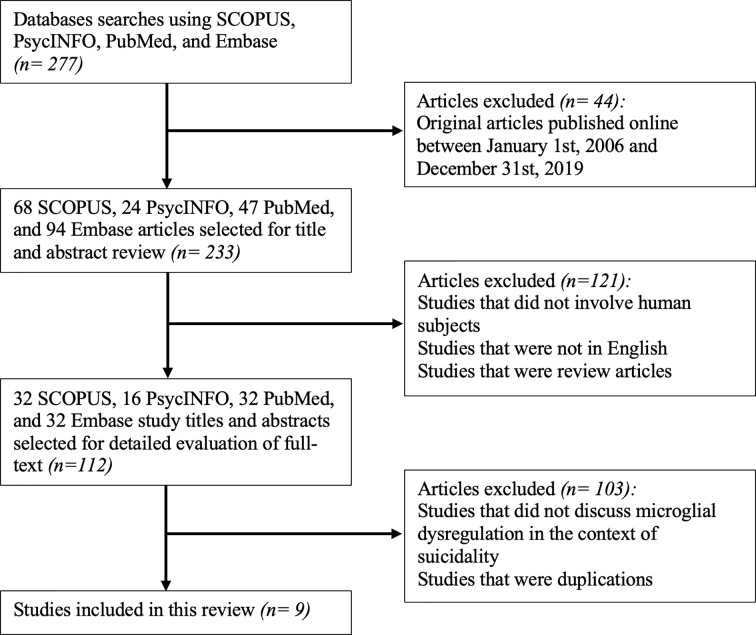
According to the stress-diathesis model of suicidal behavior, completed suicide depends on the interaction between psychosocial stressors and a trait-like susceptibility. While there are likely multiple biological processes at play in suicidal behavior, recent findings point to over-activation of microglia, the resident macrophages of the central nervous system, as implicated in stress-induced suicidal behavior. However, it remains unclear how microglial dysregulation can be integrated into a clinical model of suicidal behavior. Therefore, this narrative review aims to (1) examine the findings from human post-mortem and neuroimaging studies that report a relationship between microglial activation and suicidal behavior, and (2) update the clinical model of suicidal behavior to integrate the role of microglia. A systematic search of SCOPUS, PubMed, PsycINFO, and Embase databases revealed evidence of morphological alterations in microglia and increased translocator protein density in the brains of individuals with suicidality, pointing to a positive relationship between microglial dysregulation and suicidal behavior. The studies also suggested several pathological mechanisms leading to suicidal behavior that may involve microglial dysregulation, namely (1) enhanced metabolism of tryptophan to quinolinic acid through the kynurenine pathway and associated serotonin depletion; (2) increased quinolinic acid leading to excessive N-methyl-D-aspartate-signaling, resulting in potential disruption of the blood brain barrier; (3) increased quinolinic acid resulting in higher neurotoxicity, and; (4) elevated interleukin 6 contributing to loss of inhibition of glutamatergic neurons, causing heightened glutamate release and excitotoxicity. Based on these pathways, we reconceptualized the stress-diathesis theory of suicidal behavior to incorporate the role of microglial activity.
根据自杀行为的应激-素质模型,自杀死亡取决于心理社会应激源与特质性易感性之间的相互作用。虽然自杀行为可能涉及多种生物学过程,但最近的研究结果表明,小胶质细胞(中枢神经系统中的常驻巨噬细胞)过度激活与应激诱导的自杀行为有关。然而,目前尚不清楚小胶质细胞失调如何纳入自杀行为的临床模型。因此,本叙述性综述旨在:(1)研究人体尸检和神经影像学研究的结果,这些研究报告了小胶质细胞激活与自杀行为之间的关系;(2)更新自杀行为的临床模型,以纳入小胶质细胞的作用。对SCOPUS、PubMed、PsycINFO和Embase数据库进行系统检索后发现,有证据表明自杀者大脑中的小胶质细胞存在形态改变,转位蛋白密度增加,这表明小胶质细胞失调与自杀行为之间存在正相关。这些研究还提出了几种可能导致自杀行为的病理机制,这些机制可能涉及小胶质细胞失调,即:(1)通过犬尿氨酸途径使色氨酸代谢增强生成喹啉酸,并伴随血清素耗竭;(2)喹啉酸增加导致N-甲基-D-天冬氨酸信号过度,可能导致血脑屏障破坏;(3)喹啉酸增加导致更高的神经毒性;(4)白细胞介素6升高导致谷氨酸能神经元抑制丧失,导致谷氨酸释放增加和兴奋性毒性增强。基于这些途径,我们重新构建了自杀行为的应激-素质理论,以纳入小胶质细胞活动的作用。