
基于混合特征的联合稀疏表示的图像目标识别。
Image Target Recognition via Mixed Feature-Based Joint Sparse Representation.
机构信息
School of Computer and Communication Engineering, Changsha University of Science and Technology, Changsha 410114, China.
School of Electronics and Communications Engineering, Sun Yat-sen University, Shenzhen 518107, China.
出版信息
Comput Intell Neurosci. 2020 Aug 10;2020:8887453. doi: 10.1155/2020/8887453. eCollection 2020.
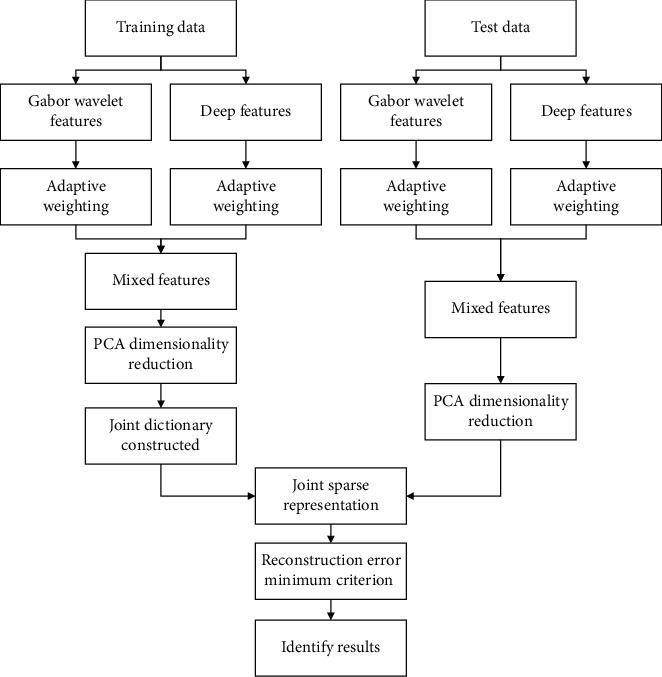
An image target recognition approach based on mixed features and adaptive weighted joint sparse representation is proposed in this paper. This method is robust to the illumination variation, deformation, and rotation of the target image. It is a data-lightweight classification framework, which can recognize targets well with few training samples. First, Gabor wavelet transform and convolutional neural network (CNN) are used to extract the Gabor wavelet features and deep features of training samples and test samples, respectively. Then, the contribution weights of the Gabor wavelet feature vector and the deep feature vector are calculated. After adaptive weighted reconstruction, we can form the mixed features and obtain the training sample feature set and test sample feature set. Aiming at the high-dimensional problem of mixed features, we use principal component analysis (PCA) to reduce the dimensions. Lastly, the public features and private features of images are extracted from the training sample feature set so as to construct the joint feature dictionary. Based on joint feature dictionary, the sparse representation based classifier (SRC) is used to recognize the targets. The experiments on different datasets show that this approach is superior to some other advanced methods.
本文提出了一种基于混合特征和自适应加权联合稀疏表示的图像目标识别方法。该方法对目标图像的光照变化、变形和旋转具有较强的鲁棒性,是一种数据轻量化的分类框架,只需少量训练样本就能很好地识别目标。首先,使用 Gabor 小波变换和卷积神经网络(CNN)分别提取训练样本和测试样本的 Gabor 小波特征和深度特征。然后,计算 Gabor 小波特征向量和深度特征向量的贡献权重。自适应加权重构后,形成混合特征,得到训练样本特征集和测试样本特征集。针对混合特征的高维问题,采用主成分分析(PCA)进行降维。最后,从训练样本特征集中提取图像的公共特征和私有特征,构建联合特征字典。基于联合特征字典,使用稀疏表示分类器(SRC)识别目标。在不同数据集上的实验表明,该方法优于一些其他先进的方法。





 Zotero 插件