Akar Irem, Keogh Robert, Blackman Lewis D, Foster Jeffrey C, Mathers Robert T, O'Reilly Rachel K
School of Chemistry, University of Birmingham, Edgbaston, Birmingham B15 2TT, United Kingdom.
Department of Chemistry, University of Warwick, Gibbet Hill Road, Coventry, CV4 7AL, United Kingdom.
ACS Macro Lett. 2020 Aug 18;9(8):1149-1154. doi: 10.1021/acsmacrolett.0c00461. Epub 2020 Jul 27.
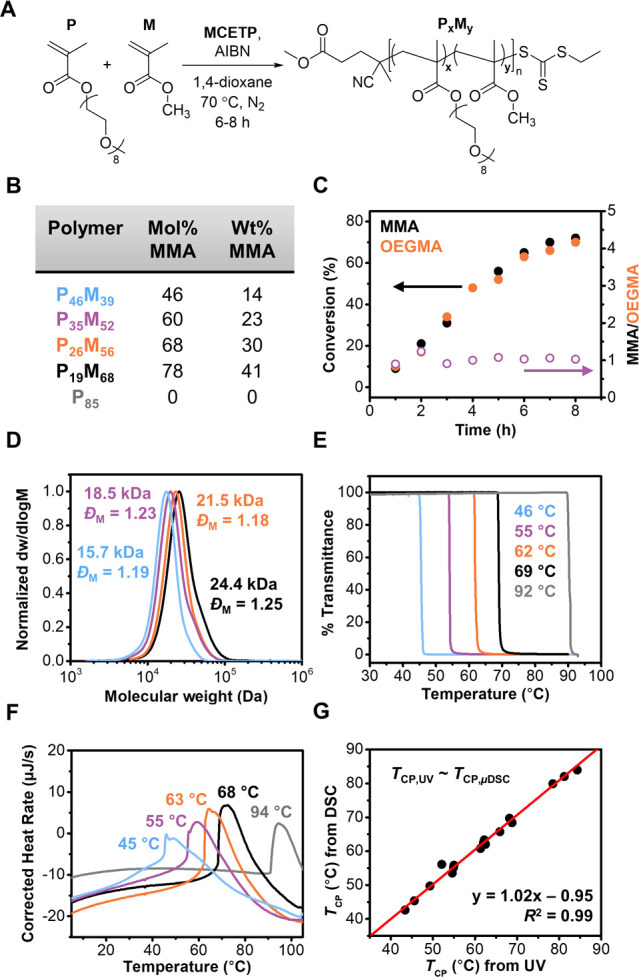
Thermoresponsive copolymers that exhibit a lower critical solution temperature (LCST) have been exploited to prepare stimuli-responsive materials for a broad range of applications. It is well understood that the LCST of such copolymers can be controlled by tuning molecular weight or through copolymerization of two known thermoresponsive monomers. However, no general methodology has been established to relate polymer properties to their temperature response in solution. Herein, we sought to develop a predictive relationship between polymer hydrophobicity and cloud point temperature ( ). A series of statistical copolymers were synthesized based on hydrophilic oligoethylene glycol monomethyl ether methacrylate (OEGMA) and hydrophobic alkyl methacrylate monomers and their hydrophobicity was compared using surface area-normalized partition coefficients (log /SA). However, while some insight was gained by comparing and hydrophobicity values, further statistical analysis on both experimental and literature data showed that the molar percentage of comonomer (i.e., grafting density) was the strongest influencer of , regardless of the comonomer used. The lack of dependence of on comonomer chemistry implies that a broad range of functional, thermoresponsive materials can be prepared based on OEGMA by simply tuning grafting density.
具有较低临界溶液温度(LCST)的热响应性共聚物已被用于制备适用于广泛应用的刺激响应材料。众所周知,此类共聚物的LCST可通过调节分子量或通过两种已知的热响应性单体的共聚来控制。然而,尚未建立将聚合物性质与其在溶液中的温度响应相关联的通用方法。在此,我们试图建立聚合物疏水性与浊点温度( )之间的预测关系。基于亲水性甲基丙烯酸寡聚乙二醇单甲醚(OEGMA)和疏水性甲基丙烯酸烷基酯单体合成了一系列统计共聚物,并使用表面积归一化分配系数(log /SA)比较了它们的疏水性。然而,虽然通过比较 和疏水性值获得了一些见解,但对实验数据和文献数据的进一步统计分析表明,无论使用何种共聚单体,共聚单体的摩尔百分比(即接枝密度)是 的最强影响因素。 对接枝单体化学性质的不依赖性意味着通过简单地调节接枝密度,可以基于OEGMA制备广泛的功能性热响应材料。