Sidhu-Muñoz Rebeca S, Tejedor Carmen, Vizcaíno Nieves
Departamento de Microbiología y Genética, Universidad de Salamanca, Salamanca, Spain.
Instituto de Investigación Biomédica de Salamanca (IBSAL), Salamanca, Spain.
Front Vet Sci. 2020 Jul 31;7:441. doi: 10.3389/fvets.2020.00441. eCollection 2020.
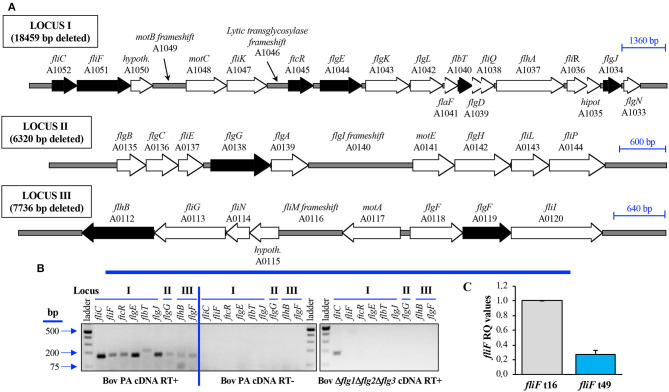
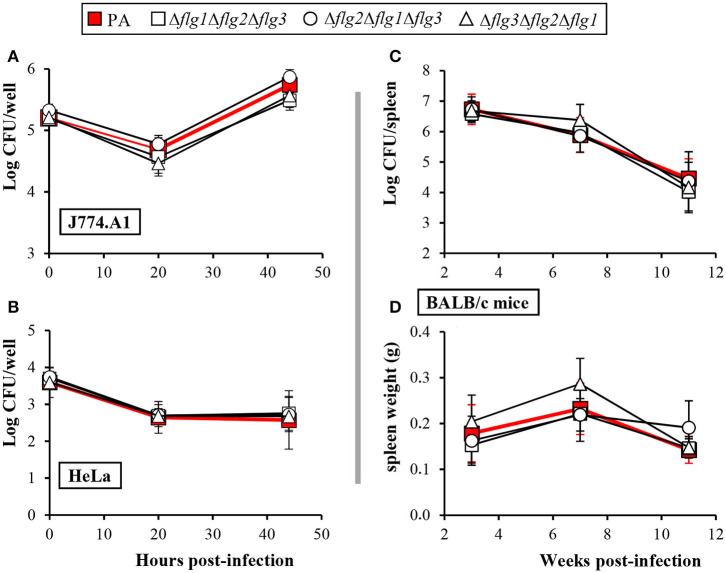
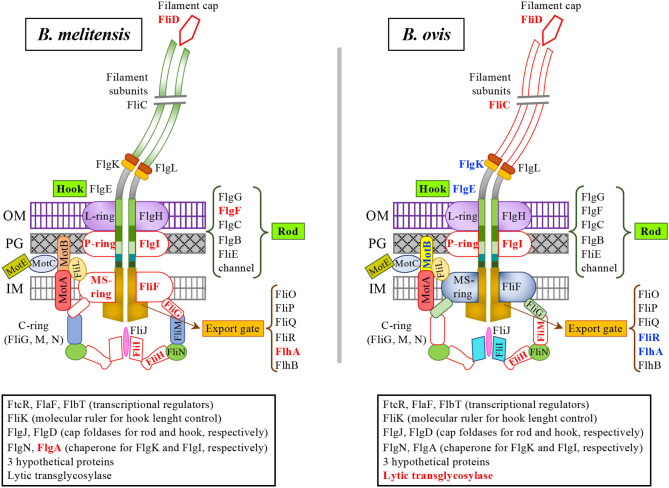
is a facultative intracellular bacterium that causes a non-zoonotic ovine brucellosis mainly characterized by male genital lesions and is responsible for important economic losses in sheep farming areas. Studies about the virulence mechanisms of have been mostly performed with smooth (bearing O-polysaccharide in lipopolysaccharide) zoonotic species, and those performed with have revealed similarities but also relevant differences. Except for few strains recently isolated from unconventional hosts, species are non-motile but contain the genes required to assemble a flagellum, which are organized in three main loci of about 18.5, 6.4, and 7.8 kb. Although these loci contain different pseudogenes depending on the non-motile species, smooth 16M builds a sheathed flagellum under particular culture conditions and requires flagellar genes for virulence. However, nothing is known in this respect regarding other strains. In this work, we have constructed a panel of PA mutants defective in one, two or the three flagellar loci in order to assess their role in virulence of this rough (lacking O-polysaccharide) species. No relevant differences in growth, outer membrane-related properties or intracellular behavior in cellular models were observed between flagellar mutants and the parental strain, which is in accordance with previous results with 16M single-gene mutants. However, contrary to these mutants, unable to establish a chronic infection in mice, removal of the three flagellar loci in did not affect virulence in the mouse model. These results evidence new relevant differences between and , two species highly homologous at the DNA level and that cause ovine brucellosis, but that exhibit differences in the zoonotic potential, pathogenicity and tissue tropism.
是一种兼性胞内细菌,可引起非人畜共患的绵羊布鲁氏菌病,主要特征为雄性生殖器官病变,给养羊地区造成重大经济损失。关于该菌毒力机制的研究大多是针对光滑型(脂多糖中带有O-多糖)人畜共患菌种进行的,而针对该菌进行的研究揭示了相似性,但也有显著差异。除了最近从非传统宿主中分离出的少数菌株外,该菌属物种无运动能力,但含有组装鞭毛所需的基因,这些基因分布在三个主要位点,大小约为18.5、6.4和7.8 kb。尽管根据无运动能力的该菌属物种不同,这些位点含有不同的假基因,但光滑型的16M菌株在特定培养条件下可形成鞘鞭毛,且毒力需要鞭毛基因。然而,关于其他该菌菌株在这方面的情况尚不清楚。在这项工作中,我们构建了一组在一个、两个或三个鞭毛位点有缺陷的该菌PA突变体,以评估它们在这种粗糙型(缺乏O-多糖)该菌属物种毒力中的作用。鞭毛突变体与亲本菌株在细胞模型中的生长、外膜相关特性或细胞内行为方面未观察到相关差异,这与之前对16M单基因突变体的结果一致。然而,与这些无法在小鼠中建立慢性感染的突变体相反,去除该菌的三个鞭毛位点并不影响其在小鼠模型中的毒力。这些结果证明了该菌与16M在DNA水平上高度同源但引起绵羊布鲁氏菌病的两个物种之间新的显著差异,它们在人畜共患潜力、致病性和组织嗜性方面存在差异。